Tidal Limits to Planetary Habitability
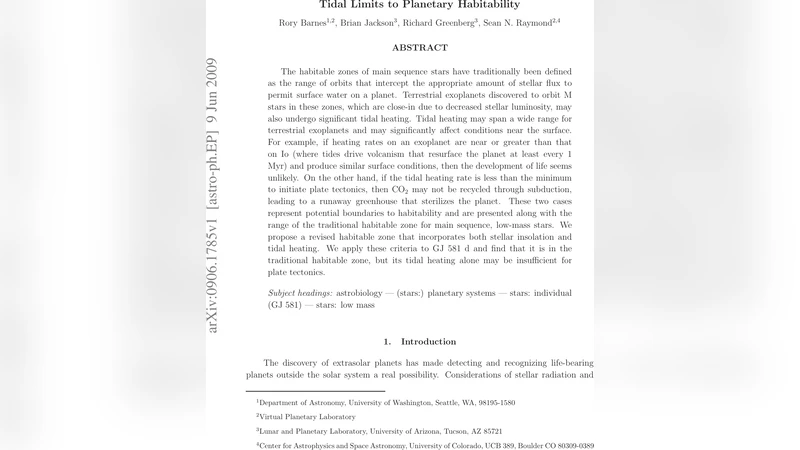
The habitable zones of main sequence stars have traditionally been defined as the range of orbits that intercept the appropriate amount of stellar flux to permit surface water on a planet. Terrestrial exoplanets discovered to orbit M stars in these zones, which are close-in due to decreased stellar luminosity, may also undergo significant tidal heating. Tidal heating may span a wide range for terrestrial exoplanets and may significantly affect conditions near the surface. For example, if heating rates on an exoplanet are near or greater than that on Io (where tides drive volcanism that resurface the planet at least every 1 Myr) and produce similar surface conditions, then the development of life seems unlikely. On the other hand, if the tidal heating rate is less than the minimum to initiate plate tectonics, then CO_2 may not be recycled through subduction, leading to a runaway greenhouse that sterilizes the planet. These two cases represent potential boundaries to habitability and are presented along with the range of the traditional habitable zone for main sequence, low-mass stars. We propose a revised habitable zone that incorporates both stellar insolation and tidal heating. We apply these criteria to GJ 581 d and find that it is in the traditional habitable zone, but its tidal heating alone may be insufficient for plate tectonics.
💡 Research Summary
The paper revisits the conventional definition of the circumstellar habitable zone (HZ), which is based solely on stellar insolation sufficient to keep surface water liquid, and argues that for terrestrial planets orbiting low‑mass, especially M‑type, stars this definition is incomplete. Because M dwarfs emit far less luminosity, their HZs lie very close to the star, exposing planets to strong tidal forces. These forces generate internal friction and consequently tidal heating, an additional heat source that can dominate the planet’s energy budget.
Using the standard tidal heating formula
(\dot{E}{\text{tidal}} = \frac{21}{2}\frac{k_2}{Q}\frac{G M{\star}^2 R_p^5 e^2}{a^6})
the authors quantify heating as a function of stellar mass (M_{\star}), planetary radius (R_p), orbital semi‑major axis (a), eccentricity (e), the Love number (k_2), and the tidal quality factor (Q). Even modest eccentricities or small planetary radii can produce substantial heating when the orbit is tight, as is typical for planets in the HZ of M dwarfs.
Two extreme tidal‑heating regimes are identified. If the heating flux exceeds that of Io (≈2 W m⁻²), continuous intense volcanism and rapid resurfacing occur, dramatically altering atmospheric composition and likely preventing the development of complex life. Conversely, if the heating flux falls below the threshold needed to sustain plate tectonics (≈0.04 W m⁻²), the planet may be unable to recycle carbon through subduction, leading to a buildup of atmospheric CO₂, a runaway greenhouse effect, and eventual sterilization. These two limits define a “tidal heating window” within which a planet can benefit from internal heat without suffering destructive volcanism.
The authors propose a revised habitability framework—the Tidal‑Insolation Habitable Zone (TIHZ)—that requires simultaneous satisfaction of (i) the traditional insolation bounds for liquid water and (ii) a tidal heating flux that lies between the lower plate‑tectonics limit and the upper Io‑like limit. In many M‑star systems the TIHZ is considerably narrower than the classic HZ, and in some cases it may disappear entirely.
Applying this framework to the well‑studied exoplanet GJ 581 d, the paper finds that while the planet resides within the conventional HZ, its calculated tidal heating (≈0.01 W m⁻²) is below the plate‑tectonics threshold. Consequently, GJ 581 d may lack the internal dynamism required for a stable carbon cycle, making long‑term climate stability doubtful and reducing its habitability prospects.
Overall, the study highlights that tidal heating is a critical factor for habitability assessments of planets around low‑mass stars. Adequate tidal heating can maintain geological activity and a temperate surface, but excessive heating leads to Io‑like volcanic devastation, and insufficient heating may cause a stagnant‑lid regime and runaway greenhouse conditions. By integrating tidal heating with stellar insolation, the TIHZ offers a more comprehensive metric for prioritizing exoplanet targets in future observational campaigns.
Comments & Academic Discussion
Loading comments...
Leave a Comment