Real-time optical spectroscopy of VUV irradiated pyrene:H_2O interstellar ice
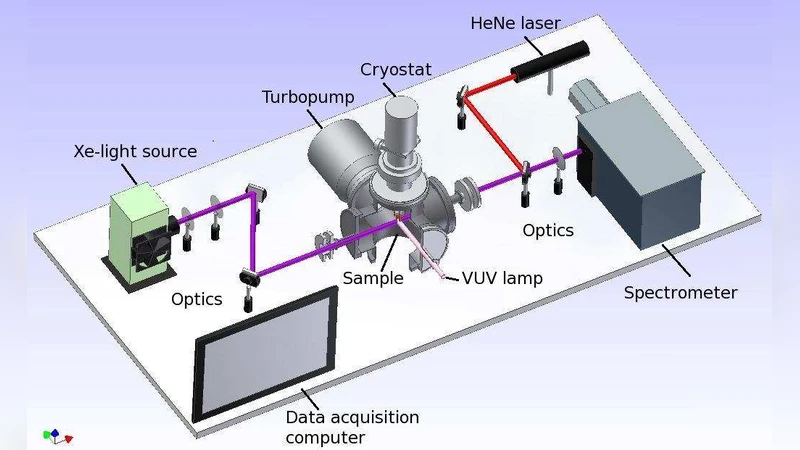
This paper describes a near-UV/VIS study of a pyrene:H_2O interstellar ice analogue at 10 K using optical absorption spectroscopy. A new experimental approach makes it possible to irradiate the sample with vacuum ultraviolet (VUV) light (7-10.5 eV) while simultaneously recording spectra in the 240-1000 nm range with subsecond time resolution. Both spectroscopic and dynamic information on VUV processed ices are obtained in this way. This provides a powerful tool to follow, in-situ and in real time, the photophysical and photochemical processes induced by VUV irradiation of a polycyclic aromatic hydrocarbon containing inter- and circumstellar ice analogue. Results on the VUV photolysis of a prototype sample - strongly diluted pyrene in H_2O ice - are presented. In addition to the pyrene cation (Py+), other products - hydroxypyrene (PyOH), possibly hydroxypyrene cation (PyOH+), and pyrene/pyrenolate anion (Py-/PyO-) - are observed. It is found that the charge remains localized in the ice, also after the VUV irradiation is stopped. The astrochemical implications and observational constraints are discussed.
💡 Research Summary
The paper presents a novel experimental platform that enables simultaneous vacuum‑ultraviolet (VUV) irradiation and near‑UV/visible absorption spectroscopy of an interstellar ice analogue containing pyrene (C₁₆H₁₀) diluted in water at 10 K. By coupling a broadband VUV source (7–10.5 eV) with a fast‑response photomultiplier‑based spectrometer, the authors record spectra from 240 nm to 1000 nm with sub‑second time resolution, thereby capturing both the immediate photophysical response and the subsequent chemical evolution of the ice.
During VUV exposure, pyrene molecules undergo ionization, producing the pyrene cation (Py⁺) which manifests as a strong absorption band near 360 nm. Concurrently, reactions with the surrounding H₂O matrix generate hydroxypyrene (PyOH) and possibly its cation (PyOH⁺), identified by new bands in the 400–420 nm region. A weaker feature around 460 nm is attributed to anionic species, either the pyrene anion (Py⁻) or the pyrenolate anion (PyO⁻), indicating that electron capture by pyrene also occurs under these conditions.
Kinetic analysis shows that the Py⁺ signal rises rapidly and reaches a plateau within roughly 10 seconds of VUV onset, suggesting a fast ionization process limited by the available neutral pyrene. In contrast, the growth of PyOH and its cation follows a slower, approximately first‑order behavior with a rate constant on the order of 0.02 s⁻¹, reflecting the need for subsequent chemical steps involving water molecules. Notably, after the VUV lamp is switched off, the absorption signatures of both cations and anions persist for many tens of seconds, demonstrating that the charge remains localized within the ice matrix and does not recombine immediately. This charge trapping is a direct consequence of the extremely low temperature and the insulating nature of the amorphous water ice, which suppresses charge mobility.
The authors discuss the astrochemical implications of these findings. In dense molecular clouds and protoplanetary disks, PAHs are expected to be embedded in icy mantles on dust grains. The experimental evidence that VUV photons can generate long‑lived ionic and anionic PAH species suggests that such ions could serve as reservoirs of charge, influencing the ion–neutral chemistry that drives complex organic synthesis in these environments. Moreover, the persistence of charge after the radiation field ceases implies that ion‑mediated reactions could continue during quiescent periods, potentially affecting the composition of the ice over astronomical timescales.
From an observational standpoint, the characteristic electronic transitions of Py⁺ and PyOH fall in the near‑UV/visible range, which is largely inaccessible to current astronomical facilities due to interstellar extinction. However, the authors note that vibrational overtones of these species may appear in the mid‑infrared (3–5 µm) and could be targeted by high‑sensitivity instruments such as JWST’s NIRSpec or MIRI. Additionally, the presence of trapped charges might be inferred indirectly through radio‑frequency or electron‑spin‑resonance signatures, offering alternative pathways to detect PAH ion chemistry in ices.
In summary, this work establishes a powerful real‑time spectroscopic method for probing VUV‑driven photochemistry in cryogenic ices. It provides quantitative kinetic data on the formation of pyrene cations, hydroxypyrene, and anionic derivatives, and demonstrates that charge can remain immobilized within the ice matrix for extended periods. These results enrich astrochemical models by incorporating ion formation, charge trapping, and subsequent ion‑neutral reactions, thereby advancing our understanding of the molecular evolution that precedes star and planet formation.
Comments & Academic Discussion
Loading comments...
Leave a Comment