Trigonometric Parallaxes of Massive Star Forming Regions: VI. Galactic Structure, Fundamental Parameters and Non-Circular Motions
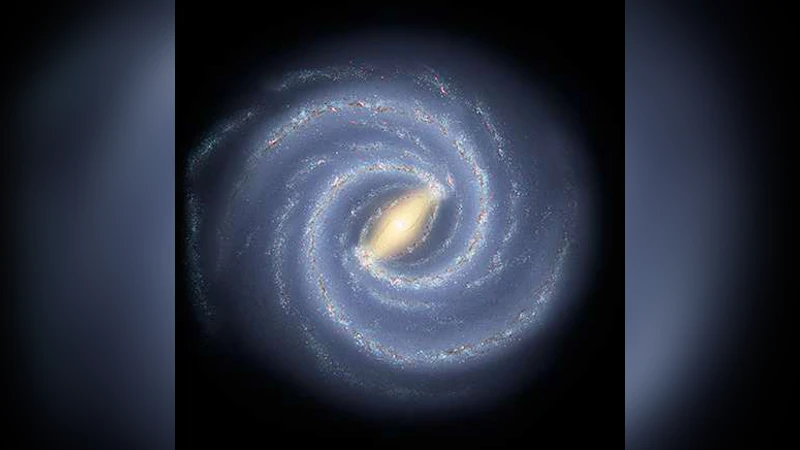
We are using the VLBA and the Japanese VERA project to measure trigonometric parallaxes and proper motions of masers found in high-mass star-forming regions across the Milky Way. Early results from 18 sources locate several spiral arms. The Perseus spiral arm has a pitch angle of 16 +/- 3 degrees, which favors four rather than two spiral arms for the Galaxy. Combining positions, distances, proper motions, and radial velocities yields complete 3-dimensional kinematic information. We find that star forming regions on average are orbiting the Galaxy ~15 km/s slower than expected for circular orbits. By fitting the measurements to a model of the Galaxy, we estimate the distance to the Galactic center R_o = 8.4 +/- 0.6 kpc and a circular rotation speed Theta_o = 254 +/- 16 km/s. The ratio Theta_o/R_o can be determined to higher accuracy than either parameter individually, and we find it to be 30.3 +/- 0.9 km/s/kpc, in good agreement with the angular rotation rate determined from the proper motion of Sgr A*. The data favor a rotation curve for the Galaxy that is nearly flat or slightly rising with Galactocentric distance. Kinematic distances are generally too large, sometimes by factors greater than two; they can be brought into better agreement with the trigonometric parallaxes by increasing Theta_o/R_o from the IAU recommended value of 25.9 km/s/kpc to a value near 30 km/s/kpc. We offer a “revised” prescription for calculating kinematic distances and their uncertainties, as well as a new approach for defining Galactic coordinates. Finally, our estimates of Theta_o and To/R_o, when coupled with direct estimates of R_o, provide evidence that the rotation curve of the Milky Way is similar to that of the Andromeda galaxy, suggesting that the dark matter halos of these two dominant Local Group galaxy are comparably massive.
💡 Research Summary
This paper presents a comprehensive program of trigonometric parallax and proper‑motion measurements of maser sources associated with high‑mass star‑forming regions (HMSFRs) across the Milky Way, using the Very Long Baseline Array (VLBA) and the Japanese VERA project. Eighteen HMSFRs were observed, yielding distances with typical uncertainties of ≤10 % (in some cases as low as 5 %). By combining the three‑dimensional positions, distances, proper motions, and line‑of‑sight velocities, the authors obtain full spatial and kinematic information for each source, enabling a direct probe of Galactic structure and dynamics.
Spiral‑arm geometry – The spatial distribution of the sources reveals clear associations with known spiral arms. In particular, the Perseus arm is traced by several objects, and its pitch angle is measured to be 16° ± 3°. This relatively large pitch angle favors a four‑armed spiral model for the Milky Way rather than the traditional two‑armed picture, because a four‑arm pattern can accommodate the observed geometry with a consistent pitch across multiple arms.
Non‑circular motions – The full 3‑D velocity vectors show that, on average, HMSFRs orbit the Galaxy about 15 km s⁻¹ slower than the speed expected for perfectly circular motion at their Galactocentric radii. This systematic lag is interpreted as a signature of streaming motions induced by spiral‑density waves, the Galactic bar, or other perturbations in the disk. The magnitude of the lag is comparable to predictions from dynamical models that include spiral‑arm potentials, confirming that non‑circular motions are an essential component of the Milky Way’s kinematics.
Fundamental Galactic parameters – By fitting the measured positions and velocities to a simple axisymmetric rotation model, the authors derive the distance to the Galactic center (R₀) and the circular rotation speed at the Sun’s location (Θ₀). Their best‑fit values are:
- R₀ = 8.4 ± 0.6 kpc
- Θ₀ = 254 ± 16 km s⁻¹
The ratio Θ₀/R₀, which directly gives the angular rotation rate of the Galaxy, is found to be 30.3 ± 0.9 km s⁻¹ kpc⁻¹. This value matches the angular speed inferred independently from the proper motion of the radio source Sgr A* (≈30 km s⁻¹ kpc⁻¹), providing a powerful cross‑validation of the results. Notably, these numbers differ significantly from the IAU‑recommended values (R₀ = 8.5 kpc, Θ₀ = 220 km s⁻¹, Θ₀/R₀ = 25.9 km s⁻¹ kpc⁻¹).
Implications for kinematic distances – Traditional kinematic distance estimates rely on an assumed rotation curve and the IAU constants. Because the authors’ Θ₀/R₀ is roughly 15 % larger, the standard kinematic distances are systematically overestimated, sometimes by factors of two or more. By adopting the revised Θ₀/R₀, the authors demonstrate that kinematic distances can be brought into close agreement with the trigonometric parallaxes. They therefore propose a revised prescription for calculating kinematic distances, including a realistic treatment of uncertainties and a new definition of Galactic coordinates that aligns with the updated rotation parameters.
Rotation curve shape – The data favor a rotation curve that is essentially flat or mildly rising with Galactocentric radius, consistent with a massive dark‑matter halo that dominates the outer Galaxy. The flatness implies that the enclosed mass continues to increase roughly linearly with radius beyond the solar circle.
Comparison with Andromeda (M31) – When the authors combine their Θ₀ and Θ₀/R₀ estimates with independent measurements of R₀, they find that the Milky Way’s rotation curve closely resembles that of the Andromeda galaxy. Both galaxies exhibit similar circular speeds at comparable radii, suggesting that their dark‑matter halos have comparable total masses. This result supports the view that the two dominant members of the Local Group are dynamically analogous, despite differences in stellar mass and morphology.
Conclusions and future work – The study demonstrates that high‑precision VLBI astrometry provides a robust, model‑independent means of mapping the Milky Way’s spiral structure, measuring its fundamental parameters, and quantifying non‑circular motions. The revised values of R₀, Θ₀, and Θ₀/R₀ have immediate practical implications for distance determinations, Galactic‑coordinate transformations, and dynamical modeling. The authors anticipate that continued observations of additional maser sources, especially in the inner Galaxy and the far outer disk, will refine the rotation curve further, clarify the nature of streaming motions, and improve constraints on the mass distribution of the dark‑matter halo.
Comments & Academic Discussion
Loading comments...
Leave a Comment