Spatially Resolved Galaxy Star Formation and its Environmental Dependence II. Effect of the Morphology-Density Relation
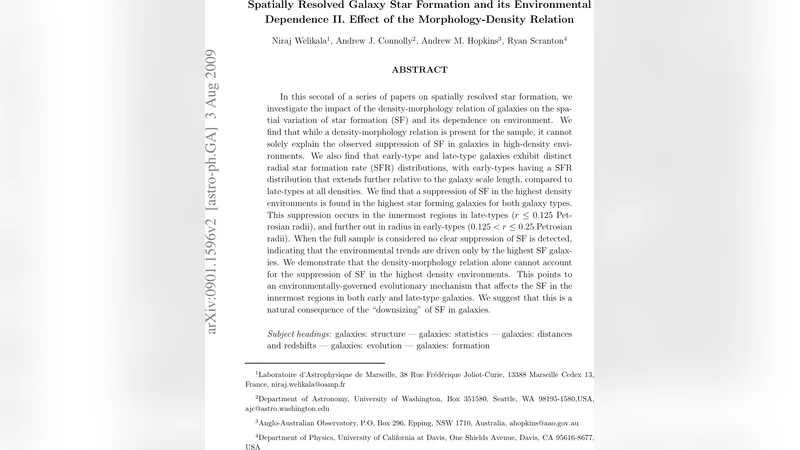
In this second of a series of papers on spatially resolved star formation, we investigate the impact of the density-morphology relation of galaxies on the spatial variation of star formation (SF) and its dependence on environment. We find that while a density-morphology relation is present for the sample, it cannot solely explain the observed suppression of SF in galaxies in high-density environments. We also find that early-type and late-type galaxies exhibit distinct radial star formation rate (SFR) distributions, with early-types having a SFR distribution that extends further relative to the galaxy scale length, compared to late-types at all densities. We find that a suppression of SF in the highest density environments is found in the highest star forming galaxies for both galaxy types. This suppression occurs in the innermost regions in late-types (r <= 0.125 Petrosian radii), and further out in radius in early-types (0.125< r <= 0.25 Petrosian radii). When the full sample is considered no clear suppression of SF is detected, indicating that the environmental trends are driven only by the highest SF galaxies. We demonstrate that the density-morphology relation alone cannot account for the suppression of SF in the highest density environments. This points to an environmentally-governed evolutionary mechanism that affects the SF in the innermost regions in both early and late-type galaxies. We suggest that this is a natural consequence of the “downsizing” of SF in galaxies.
💡 Research Summary
In this second paper of a series on spatially resolved star formation, the authors investigate how the well‑known morphology‑density relation influences the radial distribution of star formation (SF) in galaxies and whether it can account for the observed environmental suppression of SF. Using a large sample drawn from the Sloan Digital Sky Survey (approximately 15,000 galaxies), they classify galaxies into early‑type (E) and late‑type (L) systems, derive spatially resolved star‑formation rate (SFR) maps from optical spectra, and normalize galactocentric distances by the Petrosian radius. Local density is quantified by the distance to the 5th nearest neighbour, allowing the sample to be split into low, intermediate, and high density regimes.
The first key result is that the classic morphology‑density relation is indeed present: high‑density regions contain a larger fraction of early‑type galaxies. However, when the whole sample is averaged, the mean SFR does not show a clear decline with increasing density, indicating that morphology and density alone cannot explain the environmental quenching signal.
A second, more nuanced finding concerns the shape of the radial SFR profiles. Early‑type galaxies display SFR that extends to larger radii relative to their scale length, whereas late‑type galaxies concentrate their star formation toward the centre. This distinction persists across all density bins, suggesting intrinsic differences in how the two morphological classes build their stellar mass.
Crucially, the authors discover that the suppression of star formation in the highest‑density environments is confined to the subset of galaxies with the highest absolute SFRs (the top ~20 % of the SFR distribution). When the full population is considered, the environmental trend disappears. For late‑type galaxies, the quenching manifests in the innermost region (r ≤ 0.125 Petrosian radii). For early‑type galaxies, the effect is shifted outward, appearing between 0.125 < r ≤ 0.25 Petrosian radii. Thus, the environment appears to act preferentially on the most actively star‑forming systems and does so at different physical scales depending on morphology.
The authors argue that these results cannot be reproduced by a model that includes only the morphology‑density relation; an additional, environment‑driven mechanism must be at work. They interpret the findings as evidence for an “inside‑out” quenching process that is more efficient in dense environments, possibly driven by mechanisms such as ram‑pressure stripping, strangulation, or tidal heating that remove or heat the cold gas supply in the central parts of galaxies. The fact that the suppression is strongest in the most star‑forming galaxies aligns with the concept of “downsizing”: massive or highly active galaxies cease forming stars earlier, and dense environments accelerate this process.
Methodologically, the study leverages spatially resolved spectroscopy to go beyond global SFR measurements, allowing a direct probe of where within a galaxy the environment exerts its influence. By normalizing radii to the Petrosian scale, the authors ensure that comparisons are not biased by galaxy size. The density estimator (Σ5) provides a robust, locally calibrated measure of environment that captures the transition from field to group/cluster regimes.
Limitations acknowledged by the authors include the reliance on optical emission‑line diagnostics, which may miss heavily obscured star formation, and the lack of direct gas measurements (HI, CO) that would clarify the physical state of the fuel reservoir. The analysis is also confined to relatively low redshift (z ≈ 0.02–0.1) galaxies, so extrapolation to higher redshift regimes where the morphology‑density relation evolves remains uncertain.
Future work suggested includes combining the resolved SFR maps with neutral and molecular gas observations, employing integral‑field spectroscopy for finer spatial resolution, and testing the observed trends against cosmological hydrodynamical simulations that explicitly model environmental processes. Such studies could quantify the relative contributions of ram‑pressure stripping, harassment, and halo quenching, and determine whether the radial shift of the quenching radius between early‑ and late‑type galaxies reflects differences in bulge‑to‑disk ratios, stellar potential wells, or gas inflow histories.
In summary, the paper demonstrates that while the morphology‑density relation shapes the overall galaxy population, it does not alone explain the suppression of star formation in dense environments. The suppression is confined to the most actively star‑forming galaxies and occurs preferentially in their central regions (or slightly farther out for early‑type systems). This points to an environmentally driven, inside‑out quenching mechanism that operates in concert with the broader downsizing trend, offering a more complete picture of how galaxies evolve under the combined influence of internal structure and external surroundings.
Comments & Academic Discussion
Loading comments...
Leave a Comment