A Note on Coincidence Isometries of Modules in Euclidean Space
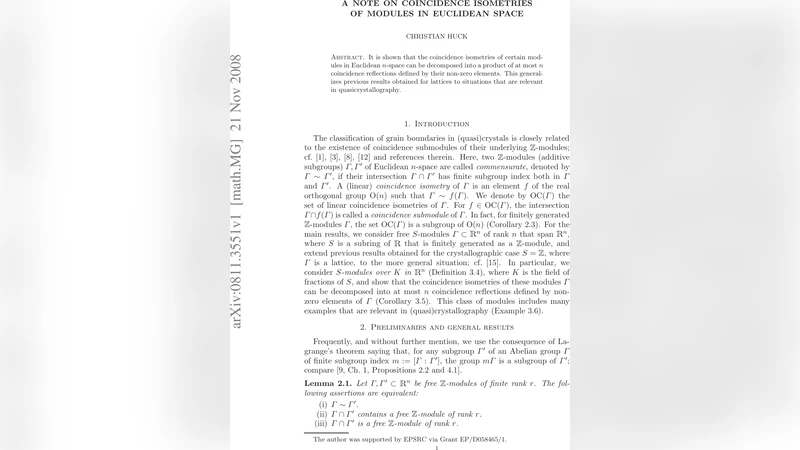
It is shown that the coincidence isometries of certain modules in Euclidean $n$-space can be decomposed into a product of at most $n$ coincidence reflections defined by their non-zero elements. This generalizes previous results obtained for lattices to situations that are relevant in quasicrystallography.
💡 Research Summary
The paper investigates the structure of coincidence isometries for a broad class of ℤ‑modules embedded in Euclidean n‑space, extending classical results that were previously confined to full lattices. A “module” here means a finitely generated ℤ‑subgroup of ℝⁿ that need not be a lattice in the strict sense (i.e., it may lack global linear independence). The authors focus on modules that satisfy two natural conditions: transitivity, meaning that the non‑zero elements of the module are dense enough to approximate any vector in ℝⁿ by integer combinations, and regularity, meaning that the module can be mapped to the standard integer lattice ℤⁿ by an invertible integer matrix. Under these hypotheses, the main theorem states that every coincidence isometry g (an orthogonal transformation for which the intersection M ∩ g(M) has finite index in M) can be expressed as a product of at most n “coincidence reflections”. Each such reflection is defined by a non‑zero element v of the module via the formula
R_v(x) = x – 2⟨x, v⟩ v / ⟨v, v⟩.
The proof proceeds by first using regularity to identify M with a lattice Λ through an integer change‑of‑basis matrix P. Classical lattice theory guarantees that any coincidence isometry of Λ can be decomposed into at most n lattice reflections. Conjugating this decomposition by P transports it back to M, and transitivity ensures that the resulting reflections are precisely those generated by the original non‑zero module elements. Consequently, the entire orthogonal group generated by coincidence isometries of M is spanned by these module‑defined reflections, and no more than n of them are needed for any single isometry.
To illustrate the theory, the authors treat two concrete examples relevant to quasicrystallography. In two dimensions they consider the module underlying the Penrose tiling; every coincidence isometry of this module is shown to be a product of two reflections, reproducing the well‑known ten‑fold rotational symmetry of Penrose diffraction patterns. In three dimensions they examine an icosahedral module that models many icosahedral quasicrystals; here any coincidence isometry can be written using at most three reflections. These examples demonstrate that the abstract decomposition theorem has direct computational implications for the analysis of non‑periodic structures.
Beyond the theoretical result, the paper discusses algorithmic aspects. By selecting an optimal ordering of the reflections, the authors argue that the decomposition can be computed with a complexity that grows at most quadratically with the dimension, making the method feasible for large‑scale simulations of quasicrystalline materials. Moreover, because the coincidence index (the index of M ∩ g(M) in M) can be read off from the product of reflections, the approach provides a practical tool for quantifying defect densities and for predicting physical properties that depend on the symmetry of the underlying atomic arrangement.
In summary, the work generalizes the classical lattice‑based coincidence reflection decomposition to a much wider class of modules, thereby furnishing a rigorous mathematical framework that aligns with the symmetry considerations of modern quasicrystallography. The result not only deepens our understanding of the algebraic structure of coincidence isometries but also opens the door to efficient computational techniques for studying aperiodic order in higher dimensions.
Comments & Academic Discussion
Loading comments...
Leave a Comment