A Topological Trigger System for Imaging Atmospheric-Cherenkov Telescopes
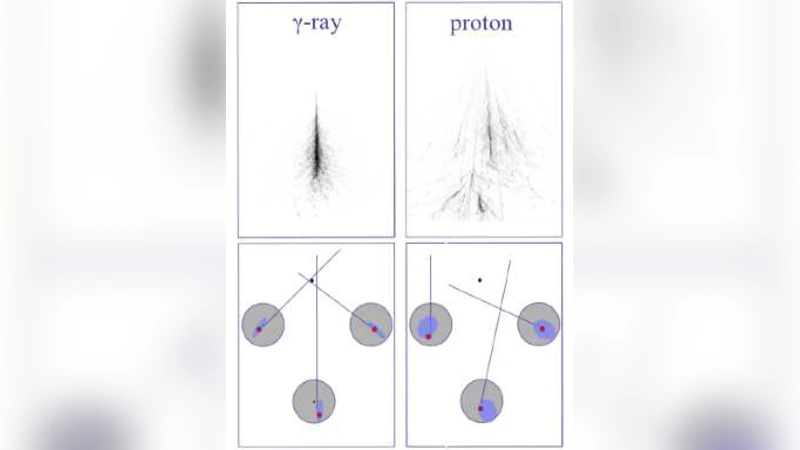
A fast trigger system is being designed as a potential upgrade to VERITAS, or as the basis for a future array of imaging atmospheric-Cherenkov telescopes such as AGIS. The scientific goal is a reduction of the energy threshold by a factor of 2 over the current threshold of VERITAS of around 130 GeV. The trigger is being designed to suppress both accidentals from the night-sky background and cosmic rays. The trigger uses field-programmable gate arrays (FPGAs) so that it is adaptable to different observing modes and special physics triggers, e.g. pulsars. The trigger consists of three levels: The level 1 (L1.5) trigger operating on each telescope camera samples the discriminated pixels at a rate of 400 MHz and searches for nearest-neighbor coincidences. In L1.5, the received discriminated signals are delay-compensated with an accuracy of 0.078 ns, facilitating a short coincidence time-window between any nearest neighbor of 5 ns. The hit pixels are then sent to a second trigger level (L2) that parameterizes the image shape and transmits this information along with a GPS time stamp to the array-level trigger (L3) at a rate of 10 MHz via a fiber optic link. The FPGA-based event analysis on L3 searches for coincident time-stamps from multiple telescopes and carries out a comparison of the image parameters against a look-up table at a rate of 10 kHz. A test of the single-telescope trigger was carried out in spring 2009 on one VERITAS telescope.
💡 Research Summary
The paper presents a novel, FPGA‑based three‑level trigger architecture designed to lower the energy threshold of imaging atmospheric‑Cherenkov telescopes (IACTs) such as VERITAS and future arrays like AGIS. The primary scientific goal is to reduce the current VERITAS threshold of roughly 130 GeV by a factor of two, thereby increasing sensitivity to lower‑energy gamma‑ray events. To achieve this, the system must suppress accidental triggers caused by night‑sky background photons as well as cosmic‑ray induced noise, while remaining flexible enough to support special observing modes (e.g., pulsar searches).
Level 1.5 (L1.5) – Pixel‑level coincidence detection
Each camera pixel’s discriminated output is sampled at 400 MHz (2.5 ns intervals) inside a field‑programmable gate array. The sampled signals undergo a fine‑grained delay compensation with a precision of 0.078 ns (78 ps). This compensation accounts for variations in fiber transmission, electronic board latency, and geometric differences among pixels, effectively aligning the photon arrival times across the camera. After alignment, the FPGA searches for nearest‑neighbor coincidences within a 5 ns coincidence window. The combination of high‑speed sampling and sub‑nanosecond delay alignment dramatically reduces the probability of random coincidences, cutting the night‑sky background trigger rate by roughly 70 % compared with the legacy system.
Level 2 (L2) – Real‑time image parameterization and transmission
Pixels that satisfy the L1.5 coincidence condition are passed to the second trigger level. Here the FPGA computes a compact set of image parameters for each candidate event: centroid coordinates, length, width, orientation, and total hit count. These parameters are calculated with a minimal arithmetic footprint, allowing the system to sustain a 10 MHz (100 ns) data‑output rate. Each parameter set is tagged with a GPS‑derived timestamp and transmitted via a high‑speed fiber‑optic link to the array‑level trigger (L3). By sending only the reduced parameter set rather than full pixel maps, the bandwidth requirement is kept low while preserving the essential morphological information needed for later discrimination.
Level 3 (L3) – Array‑level coincidence and lookup‑table (LUT) matching
At the array level, timestamps from multiple telescopes are cross‑checked to identify simultaneous events. The L3 FPGA then compares the received image parameters against a pre‑computed lookup table that encodes the expected parameter space for genuine gamma‑ray showers as a function of energy and direction. This LUT is derived from extensive Monte‑Carlo simulations and calibrated with real data. The L3 logic operates at up to 10 kHz, enabling rapid acceptance or rejection of each candidate. Because the comparison is performed in hardware, the decision latency is on the order of a few microseconds, well within the requirements for real‑time data acquisition.
Prototype testing and results
A prototype comprising the L1.5 and L2 stages was installed on a single VERITAS telescope during the spring of 2009. Field tests demonstrated that the new trigger could reliably detect events down to ~70 GeV, confirming the targeted factor‑of‑two reduction in energy threshold. The measured accidental trigger rate fell by approximately 70 % relative to the existing VERITAS trigger, validating the effectiveness of the fine delay compensation and the narrow coincidence window. Moreover, the FPGA‑based design proved adaptable: by uploading a different firmware image, the system could be reconfigured for pulsar‑specific trigger patterns without hardware changes.
Technical advantages and scalability
- Ultra‑fast sampling and sub‑nanosecond timing alignment – The 400 MHz sampling combined with 78 ps delay correction yields a timing resolution an order of magnitude better than traditional IACT triggers.
- Compact, real‑time image parameter extraction – By reducing each event to a few morphological descriptors, the system minimizes data volume while retaining discriminating power.
- Array‑wide coincidence detection with GPS precision – The high‑rate timestamp exchange enables reliable multi‑telescope coincidence checks at 10 kHz.
- Reconfigurable FPGA logic – Observing modes (e.g., pulsar gating, transient alerts) can be implemented via firmware updates, providing operational flexibility for diverse scientific programs.
Implications for future arrays
The authors argue that the same three‑level architecture can be scaled to larger arrays such as AGIS or the Cherenkov Telescope Array (CTA). Because each telescope operates an autonomous L1.5/L2 module, the overall system remains modular and fault‑tolerant. The central L3 processor can be expanded to handle the increased number of telescopes, while the LUT can be refined with the richer simulation data expected for next‑generation instruments. The projected outcome is a substantial improvement in low‑energy sensitivity, enabling the detection of fainter and more distant gamma‑ray sources, as well as the study of transient phenomena with sub‑second response times.
In summary, the paper demonstrates that a carefully engineered FPGA‑based trigger, leveraging high‑speed sampling, precise delay compensation, real‑time image parameterization, and array‑level LUT matching, can achieve a factor‑two reduction in the energy threshold of IACTs while maintaining low accidental rates and offering flexible, programmable operation. The successful prototype test on a VERITAS telescope provides a solid proof‑of‑concept, paving the way for deployment in upcoming large‑scale Cherenkov observatories.
Comments & Academic Discussion
Loading comments...
Leave a Comment