SPM Bulletin 28
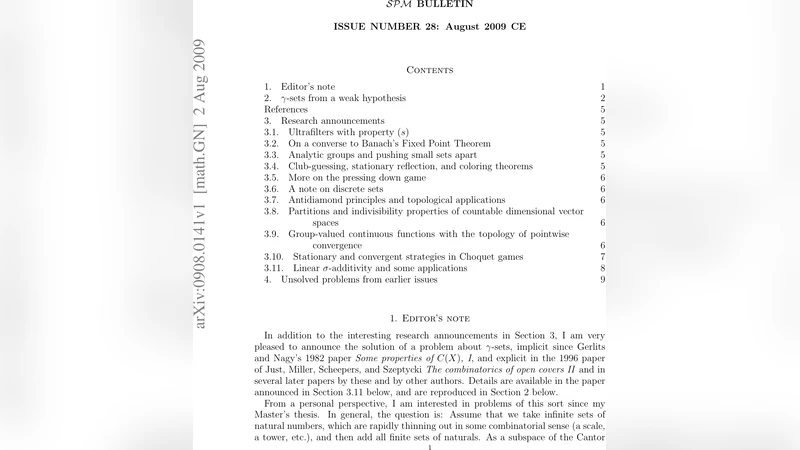
Contents: 1. Editor’s note; 2. gamma-sets from a weak hypothesis; 3. Research announcements; 3.1. Ultrafilters with property (s); 3.2. On a converse to Banach’s Fixed Point Theorem; 3.3. Analytic groups and pushing small sets apart 3.4. Club-guessing, stationary reflection, and coloring theorems; 3.5. More on the pressing down game; 3.6. A note on discrete sets; 3.7. Antidiamond principles and topological applications; 3.8. Partitions and indivisibility properties of countable dimensional vector spaces; 3.9. Group-valued continuous functions with the topology of pointwise convergence; 3.10. Stationary and convergent strategies in Choquet games; 3.11. Linear sigma-additivity and some applications; 4. Unsolved problems from earlier issues.
💡 Research Summary
The twenty‑eighth issue of the SPM Bulletin gathers a rich collection of short notes, research announcements, and updates on open problems that together illustrate the vibrant interplay between selection principles, topology, set theory, and related areas of analysis. The issue opens with the editor’s note, which briefly sketches the current landscape of research on combinatorial covering properties and highlights the significance of the contributions that follow.
Section 2 presents a new “weak hypothesis” under which γ‑sets can be constructed. Traditionally, γ‑sets have been linked to strong selection principles such as the Menger–Rothberger property, and their existence often requires additional set‑theoretic assumptions beyond ZFC. The author shows that a comparatively modest combinatorial assumption—described as a weak hypothesis—already suffices to guarantee the existence of γ‑sets with the expected covering properties. This result refines our understanding of the hierarchy of selection principles and suggests that many phenomena previously thought to need strong axioms may already be provable from weaker ones.
Section 3 contains eleven research announcements, each addressing a distinct problem at the frontier of modern set‑theoretic topology or analysis.
3.1 “Ultrafilters with property (s)” investigates ultrafilters that separate small (e.g., meager or Haar‑null) sets in a particularly strong way. The paper proves that ultrafilters satisfying property (s) can be used to refine classical P‑point and Q‑point constructions, yielding new insight into the interaction between ultrafilter theory and measure‑theoretic smallness.
3.2 “On a converse to Banach’s Fixed Point Theorem” weakens the usual contraction hypothesis. By introducing a notion of “almost contraction,” the author establishes sufficient conditions for the existence of a fixed point in a complete metric space, thereby extending Banach’s theorem to a broader class of self‑maps. This has immediate applications to nonlinear analysis, dynamical systems, and optimization where exact contractions are rarely available.
3.3 “Analytic groups and pushing small sets apart” studies actions of Polish groups on Borel spaces. The authors show that under suitable analytic group actions one can separate two small sets (Haar‑null or meager) by a group element, providing a new structural theorem about how analytic symmetries interact with measure‑theoretic smallness.
3.4 “Club‑guessing, stationary reflection, and coloring theorems” connects two deep combinatorial principles: club‑guessing sequences and stationary reflection. By constructing a coloring function that respects both principles, the paper demonstrates that a stationary set can simultaneously satisfy a strong club‑guessing property while preserving reflection. This result bridges large‑cardinal style reflection phenomena with classical combinatorial set theory.
3.5 “More on the pressing‑down game” extends previous work on the pressing‑down (or “PD”) game, a two‑player game on stationary sets. New winning strategies and equilibrium conditions are identified, showing that the game’s outcome can be tightly controlled under certain combinatorial hypotheses. This contributes to the game‑theoretic analysis of stationary sets and offers fresh tools for studying their structural properties.
3.6 “A note on discrete sets” provides a concise survey of when discrete subsets of a topological space are closed, compact, or have other desirable properties. Although brief, the note supplies useful lemmas that are later employed in the analysis of pointwise‑convergence topologies on function spaces.
3.7 “Antidiamond principles and topological applications” introduces a family of principles that are, in a precise sense, opposite to the classic diamond principle (◇). The authors demonstrate that these antidiamond principles can force the failure of certain predictive combinatorial configurations, leading to new separation results in paracompact spaces and shedding light on the duality between prediction and anti‑prediction in set‑theoretic topology.
3.8 “Partitions and indivisibility properties of countable‑dimensional vector spaces” merges Ramsey‑type partition theorems with linear algebra. The authors prove that no coloring of a countable‑dimensional vector space can split every infinite‑dimensional subspace into monochromatic pieces, establishing a strong indivisibility property for such spaces. This result deepens the connection between combinatorial partition theory and the structure of infinite‑dimensional linear spaces.
3.9 “Group‑valued continuous functions with the topology of pointwise convergence” studies the function space C(X,G) where G is a topological group and X is a space, equipped with the pointwise convergence topology. The paper shows that under natural hypotheses this space is complete and retains continuity of group operations, providing a useful framework for harmonic analysis and the study of dual groups.
3.10 “Stationary and convergent strategies in Choquet games” distinguishes between stationary strategies (depending only on the current position) and convergent strategies (ensuring convergence to a point) in the classical Choquet game. The authors construct examples where the two notions diverge, thereby clarifying the landscape of winning strategies in topological games and suggesting new lines of inquiry about the relationship between game‑theoretic and topological properties.
3.11 “Linear sigma‑additivity and some applications” defines linear σ‑additivity for families of sets and demonstrates its usefulness in measure theory and functional analysis. Several concrete applications are presented, including a new proof of a classic result about σ‑additive measures on vector spaces.
Section 4 revisits the list of open problems that have been circulating in earlier bulletins. For each problem the editors provide brief updates on any partial progress, references to recent preprints, and suggestions for promising approaches. Notably, the γ‑set problem under weak hypotheses, the existence of ultrafilters with property (s), and the interaction between club‑guessing and stationary reflection remain open, inviting further investigation.
Overall, this issue showcases how seemingly disparate topics—selection principles, ultrafilter theory, fixed‑point analysis, analytic group actions, large‑cardinal combinatorics, and topological games—are tightly interwoven. The announcements not only present new theorems but also introduce fresh techniques (e.g., refined coloring arguments, antidiamond constructions, and pointwise‑convergence analyses) that are likely to influence future research across several domains of set‑theoretic topology and its applications.
Comments & Academic Discussion
Loading comments...
Leave a Comment