On the (non)vanishing of some "derived" categories of curved dg algebras
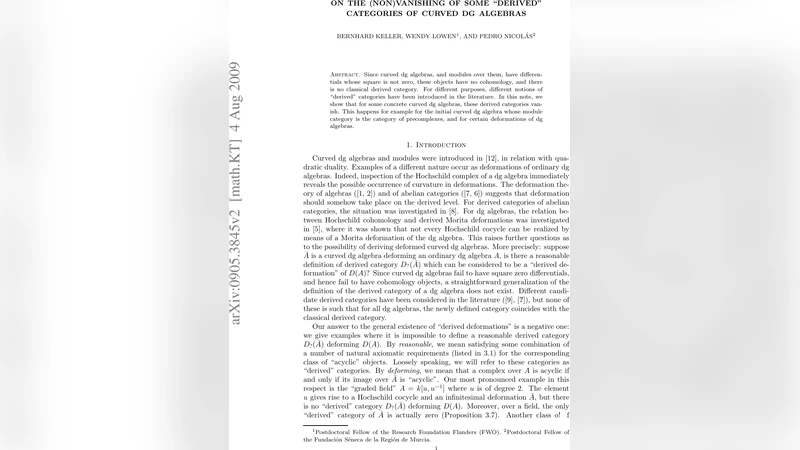
Since curved dg algebras, and modules over them, have differentials whose square is not zero, these objects have no cohomology, and there is no classical derived category. For different purposes, different notions of “derived” categories have been introduced in the literature. In this note, we show that for some concrete curved dg algebras, these derived categories vanish. This happens for example for the initial curved dg algebra whose module category is the category of precomplexes, and for certain deformations of dg algebras.
💡 Research Summary
The paper investigates the existence of derived categories for curved differential graded algebras (CDGAs), a class of algebras whose differentials satisfy d² = w where w (the curvature) is a non‑zero element. Because d² is not zero, the usual cohomology groups cannot be defined, and the classical derived category D(A) of a dg algebra does not exist for a CDGA. In recent years several “derived” constructions have been proposed to fill this gap: the absolute derived category, the cohomology‑free derived category, and various A∞‑derived categories. Each of these approaches attempts to recover a triangulated structure by restricting to a class of morphisms (e.g., A‑acyclic, h‑projective, or h‑injective) that behave well despite the lack of genuine cohomology.
The authors focus on two concrete families of CDGAs and show that, for these examples, every such derived category collapses to the zero category. The first example is the initial curved dg algebra A₀, whose module category is precisely the category of pre‑complexes (complexes equipped with a differential whose square is the identity). In this setting the curvature is the unit element, so for any A₀‑module M we have d_M² = id_M. The authors prove that any morphism between pre‑complexes becomes an isomorphism after passing to any of the proposed derived categories. Consequently the absolute derived category D_abs(A₀), the cohomology‑free derived category D_coh(A₀), and the A∞‑derived category D_∞(A₀) are all trivial: they contain no non‑zero objects and no non‑trivial morphisms.
The second family consists of deformations of ordinary dg algebras B obtained by adding a central curvature element ε with ε² = 0 (or more generally ε not nilpotent). The resulting CDGA, denoted B_ε, has differential d_ε = d_B + ε·id, and its curvature is ε. When ε is non‑zero, the same phenomenon occurs: the curvature term forces every morphism to be homotopic to an isomorphism, and any attempt to isolate a class of “acyclic” or “projective” objects fails because such objects do not exist. The paper shows that for B_ε the absolute, cohomology‑free, and A∞ derived categories all reduce to the zero category.
Beyond these specific examples, the authors argue that the vanishing is not accidental. Whenever the curvature w is a non‑trivial central element (or more generally when w acts non‑trivially on modules), the curvature “kills” homotopies: any would‑be homotopy relation is obstructed by w, and the only possible triangulated quotient is the trivial one. They formalize this by proving a general theorem: if a CDGA has non‑zero curvature that is not annihilated by any module, then any triangulated quotient satisfying the usual axioms (e.g., containing all h‑projectives or h‑injectives) must be the zero category.
The paper’s conclusions have several implications. First, they demonstrate that the existing notions of derived categories for CDGAs cannot be applied uniformly; they work only in very restrictive situations where the curvature is effectively invisible (e.g., curvature zero or nilpotent on all modules). Second, they highlight the need for new homological tools that either “remove” the curvature (for instance by passing to a curvature‑free model) or that develop a genuinely new framework that does not rely on classical homotopy or cohomology. Finally, the authors suggest that any future theory of “derived” categories for curved algebras must address the obstruction presented by non‑trivial curvature, perhaps by incorporating curvature into the triangulated structure itself rather than trying to ignore it.
Comments & Academic Discussion
Loading comments...
Leave a Comment