Highly Undecidable Problems For Infinite Computations
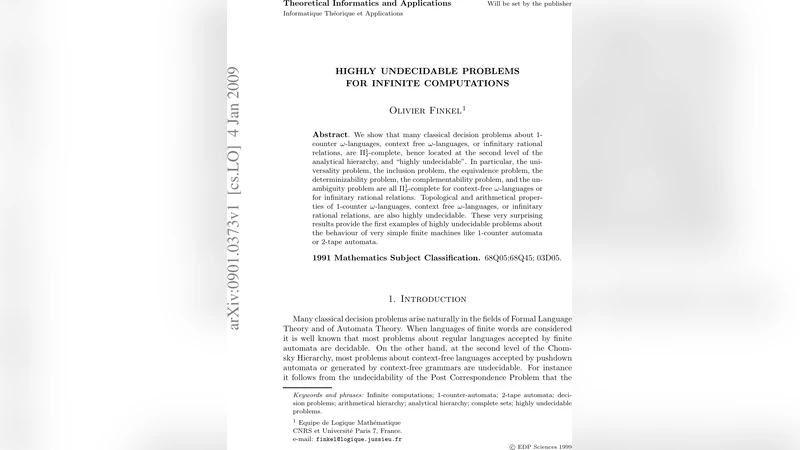
We show that many classical decision problems about 1-counter omega-languages, context free omega-languages, or infinitary rational relations, are $\Pi_2^1$-complete, hence located at the second level of the analytical hierarchy, and “highly undecidable”. In particular, the universality problem, the inclusion problem, the equivalence problem, the determinizability problem, the complementability problem, and the unambiguity problem are all $\Pi_2^1$-complete for context-free omega-languages or for infinitary rational relations. Topological and arithmetical properties of 1-counter omega-languages, context free omega-languages, or infinitary rational relations, are also highly undecidable. These very surprising results provide the first examples of highly undecidable problems about the behaviour of very simple finite machines like 1-counter automata or 2-tape automata.
💡 Research Summary
The paper investigates the decision‑problem complexity of very simple finite‑state devices when they are required to process infinite inputs (ω‑words). Specifically, it focuses on 1‑counter automata, context‑free ω‑languages generated by pushdown automata, and infinitary rational relations recognized by two‑tape automata. The authors show that a wide range of classical decision problems—universality, inclusion, equivalence, determinization, complementability, and unambiguity—are not merely undecidable but sit at the second level of the analytical hierarchy, i.e., they are Π₂¹‑complete.
The work begins with a concise review of ω‑languages, the Borel hierarchy, and the analytical hierarchy (Σₙ¹, Πₙ¹). It then formalizes the computational models: a 1‑counter automaton (a finite‑state machine equipped with a single non‑negative integer counter) and a 2‑tape automaton (the source of infinitary rational relations). Despite their limited memory, these machines can generate languages of substantial topological complexity when the input is an infinite word.
The core technical contribution is a two‑step reduction scheme that embeds any Π₂¹ sentence of the form ∀X∃Y φ(X,Y) (with φ arithmetical) into the behavior of a 1‑counter automaton. The universal quantifier over X corresponds to “for every ω‑input w”, while the existential quantifier over Y is simulated by the nondeterministic choices of the automaton’s transitions and counter operations. By constructing a specific automaton A_φ, the authors prove that the statement “A_φ accepts all ω‑words” is equivalent to the original Π₂¹ sentence. Consequently, the universality problem for these automata is Π₂¹‑hard.
To place the problem inside Π₂¹, they observe that universality can be expressed as ∀w∈Σ^ω ∃run R (R is an accepting run of the automaton on w). Since the existence of a run is an arithmetical predicate, the whole formula is a Π₂¹ statement, establishing Π₂¹‑completeness.
Using standard polynomial‑time reductions, the same completeness transfers to inclusion (A⊆B) and equivalence (A≡B) because these can be reformulated as universality questions on suitably constructed difference automata. Determinization asks whether a nondeterministic 1‑counter automaton has an equivalent deterministic one; this requires checking that for every ω‑input there exists a unique deterministic run, again a Π₂¹ condition. Complementability asks whether the complement of the language recognized by a given automaton is also recognizable by a 1‑counter automaton; this reduces to a universality test on the union of the original language and a candidate complement. Unambiguity asks whether each ω‑input has at most one accepting run, which is expressed as ∀w∈Σ^ω ∃!run R, a Π₂¹ formula.
Beyond decision problems, the authors explore topological consequences. They prove that 1‑counter ω‑languages and context‑free ω‑languages can occupy high Borel levels (e.g., Σ₃⁰, Π₃⁰) and that infinitary rational relations can be analytic but not Borel, reflecting the same Π₂¹ hardness. This demonstrates that even the simplest machines can generate sets of maximal descriptive‑set‑theoretic complexity when fed infinite inputs.
The paper concludes by emphasizing the significance of these “highly undecidable” results. While finite‑input verification for such machines is relatively tame, the moment infinite behavior is considered, the verification problems become as hard as any Π₂¹ problem. This has implications for model checking of infinite‑state systems, verification of protocols with unbounded streams, and the theoretical limits of automated reasoning about simple computational models. The authors suggest extending the analysis to other restricted devices (e.g., one‑stack pushdown automata) and to explore whether similar completeness results hold for quantitative extensions such as weighted ω‑automata.
Comments & Academic Discussion
Loading comments...
Leave a Comment