Highly Undecidable Problems about Recognizability by Tiling Systems
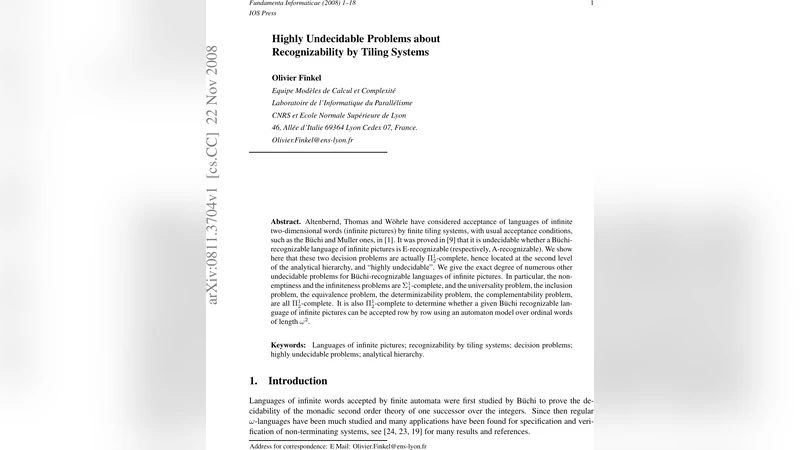
Altenbernd, Thomas and W"ohrle have considered acceptance of languages of infinite two-dimensional words (infinite pictures) by finite tiling systems, with usual acceptance conditions, such as the B"uchi and Muller ones [1]. It was proved in [9] that it is undecidable whether a B"uchi-recognizable language of infinite pictures is E-recognizable (respectively, A-recognizable). We show here that these two decision problems are actually $\Pi_2^1$-complete, hence located at the second level of the analytical hierarchy, and “highly undecidable”. We give the exact degree of numerous other undecidable problems for B"uchi-recognizable languages of infinite pictures. In particular, the non-emptiness and the infiniteness problems are $\Sigma^1_1$-complete, and the universality problem, the inclusion problem, the equivalence problem, the determinizability problem, the complementability problem, are all $\Pi^1_2$-complete. It is also $\Pi^1_2$-complete to determine whether a given B"uchi recognizable language of infinite pictures can be accepted row by row using an automaton model over ordinal words of length $\omega^2$.
💡 Research Summary
The paper investigates decision problems concerning the recognizability of infinite two‑dimensional words (infinite pictures) by finite tiling systems equipped with classical acceptance conditions such as Büchi and Muller. Building on earlier work by Altenbernd, Thomas, and Wöhrle, which showed that it is undecidable whether a Büchi‑recognizable picture language is also E‑recognizable (every row eventually repeats) or A‑recognizable (every row follows a fixed pattern), the authors sharpen these results by locating the problems precisely within the analytical hierarchy.
First, the authors formalize infinite pictures as functions from ℕ×ℕ to a finite alphabet and define tiling systems as finite sets of tiles together with adjacency constraints. Acceptance conditions (Büchi, Muller) are imposed on infinite tilings, yielding the class of Büchi‑recognizable picture languages.
The core contribution is a systematic complexity classification of several natural decision problems for these languages. Using reductions from well‑known Σ₁¹‑complete and Π₂¹‑complete problems, the paper proves:
-
Non‑emptiness (does a given Büchi‑recognizable language contain any picture?) and infiniteness (are there infinitely many pictures in the language?) are Σ₁¹‑complete. This places the existence questions at the first level of the analytical hierarchy, reflecting the inherent quantification over infinite objects.
-
Universality (does the language contain all pictures?), inclusion (L₁ ⊆ L₂?), equivalence (L₁ = L₂?), determinizability (is there an equivalent deterministic tiling system?), and complementability (is the complement Büchi‑recognizable?) are all Π₂¹‑complete. The proofs encode second‑order statements about sets of natural numbers into tiling constraints, showing that checking universal or relational properties of picture languages requires a universal quantifier over sets followed by an existential quantifier—exactly the structure of Π₂¹ formulas.
-
Moreover, the paper studies a row‑by‑row acceptance model where an infinite picture is read line by line, each row being treated as an ω‑word, and the whole picture as an ω²‑length ordinal word. Determining whether a Büchi‑recognizable language can be accepted by such a model is also Π₂¹‑complete. This result demonstrates that even when the two‑dimensional structure is linearized into a higher‑order ordinal word, the decision problem remains at the same high level of undecidability.
Methodologically, the authors develop a sophisticated encoding technique that translates arbitrary Σ₁¹ or Π₂¹ logical formulas into tiling constraints. For Σ₁¹‑hardness, they construct a tiling system that has a non‑empty language precisely when a given analytic set is non‑empty. For Π₂¹‑hardness, they build a system whose universality (or inclusion, etc.) holds exactly when a given co‑analytic statement is true. The constructions exploit the ability of tiling systems to enforce global consistency across an infinite grid, effectively simulating quantifier alternations over infinite sets.
The paper’s findings have several important implications. They reveal that the landscape of decision problems for infinite picture languages is dramatically more complex than for one‑dimensional ω‑languages, where many analogous problems sit at lower levels (e.g., Σ₁⁰ or Π₁⁰). The placement of basic properties such as emptiness at Σ₁¹ already indicates that any algorithmic approach would have to handle analytic quantification, which is beyond the reach of recursive enumerability. The Π₂¹‑completeness of universality, inclusion, and equivalence underscores that even comparing two such languages is as hard as solving arbitrary second‑order universal statements.
Finally, by connecting row‑by‑row acceptance to automata over ordinal words of length ω², the authors bridge two research areas: two‑dimensional tiling automata and ordinal automata. The Π₂¹‑completeness result for this model suggests that attempts to simplify infinite picture recognition by linearizing the input do not reduce the inherent logical complexity.
In summary, the paper provides a comprehensive and precise map of the “highly undecidable” nature of recognizability problems for infinite pictures, establishing Σ₁¹‑completeness for existence‑type questions and Π₂¹‑completeness for universal‑type questions, and extending these results to ordinal‑word acceptance models. This work deepens our understanding of the limits of algorithmic analysis for two‑dimensional infinite structures.
Comments & Academic Discussion
Loading comments...
Leave a Comment