Classical and Effective Descriptive Complexities of omega-Powers
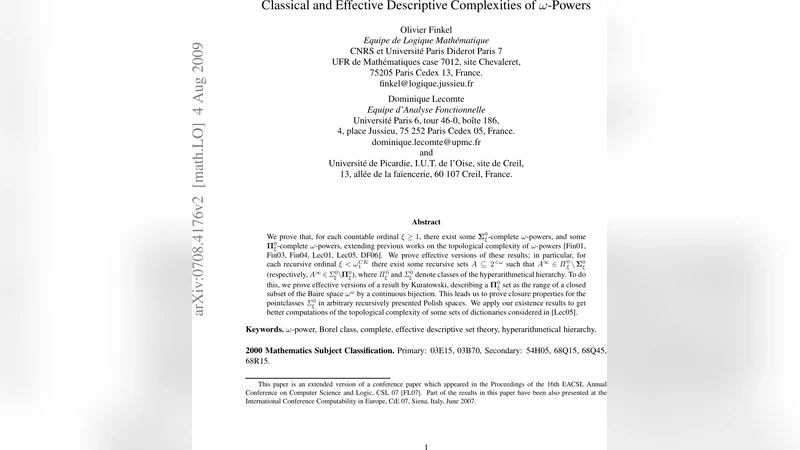
We prove that, for each non null countable ordinal alpha, there exist some Sigma^0_alpha-complete omega-powers, and some Pi^0_alpha-complete omega-powers, extending previous works on the topological complexity of omega-powers. We prove effective versions of these results. In particular, for each non null recursive ordinal alpha, there exists a recursive finitary language A such that A^omega is Sigma^0_alpha-complete (respectively, Pi^0_alpha-complete). To do this, we prove effective versions of a result by Kuratowski, describing a Borel set as the range of a closed subset of the Baire space by a continuous bijection. This leads us to prove closure properties for the classes Effective-Pi^0_alpha and Effective-Sigma^0_alpha of the hyperarithmetical hierarchy in arbitrary recursively presented Polish spaces. We apply our existence results to get better computations of the topological complexity of some sets of dictionaries considered by the second author in [Omega-Powers and Descriptive Set Theory, Journal of Symbolic Logic, Volume 70 (4), 2005, p. 1210-1232].
💡 Research Summary
The paper investigates the descriptive set‑theoretic complexity of ω‑powers, i.e., sets of infinite words obtained by iterating a finitary language A infinitely many times (A^ω). While earlier work had shown the existence of Σ⁰₂‑complete and Π⁰₂‑complete ω‑powers, the authors extend this to every non‑zero countable ordinal α. They prove that for each such α there are languages whose ω‑powers are Σ⁰_α‑complete as well as Π⁰_α‑complete. Moreover, when α is a recursive (hyperarithmetical) ordinal, the witnessing language A can be chosen recursive, yielding an effective version of the result.
The technical core rests on an effective rendition of Kuratowski’s theorem, which states that any Borel set can be represented as the continuous bijective image of a closed subset of Baire space. The authors construct, for each α, a closed set C_α and a continuous bijection f_α whose inverse is also effectively continuous. This construction uses recursive tree codings and hyperarithmetical approximations, ensuring that both f_α and f_α⁻¹ are computable in the sense of effective descriptive set theory.
Using these effective maps, the authors define, for each α, a recursive finitary language A_α over a finite alphabet. The language is engineered so that the image of C_α under f_α coincides with A_α^ω. Consequently, A_α^ω attains exactly the Borel rank Σ⁰_α (or Π⁰_α) and is complete for that class: any Σ⁰_α (resp. Π⁰_α) set can be reduced to A_α^ω via a continuous, effectively computable reduction. The proof of completeness exploits the effective continuity of f_α and its inverse to build the required reductions explicitly.
Beyond the construction of specific ω‑powers, the paper establishes closure properties for the effective Borel classes Effective‑Σ⁰_α and Effective‑Π⁰_α in arbitrary recursively presented Polish spaces. It shows that these classes are closed under effective continuous images and pre‑images, mirroring the classical closure results but now within the hyperarithmetical hierarchy. This meta‑result guarantees that the effective descriptive complexity behaves robustly across different Polish spaces, not only in the canonical Baire space.
Finally, the authors apply their existence theorems to refine the topological complexity analysis of several “dictionary” sets previously studied by the second author. By embedding those sets into appropriately chosen ω‑powers, they demonstrate that some of them achieve higher Borel ranks than originally reported, thereby sharpening earlier classifications.
In summary, the paper makes three major contributions: (1) a uniform existence theorem for Σ⁰_α‑complete and Π⁰_α‑complete ω‑powers for all non‑zero countable ordinals; (2) an effective version of Kuratowski’s representation theorem together with closure results for effective Borel classes in recursive Polish spaces; and (3) concrete applications that improve the descriptive set‑theoretic understanding of previously examined language‑theoretic constructions. These results deepen the connection between formal language theory and descriptive set theory, and open new avenues for exploring the computational content of high‑level Borel phenomena.
Comments & Academic Discussion
Loading comments...
Leave a Comment