Treewidth of Erd"{o}s-R{e}nyi Random Graphs, Random Intersection Graphs, and Scale-Free Random Graphs
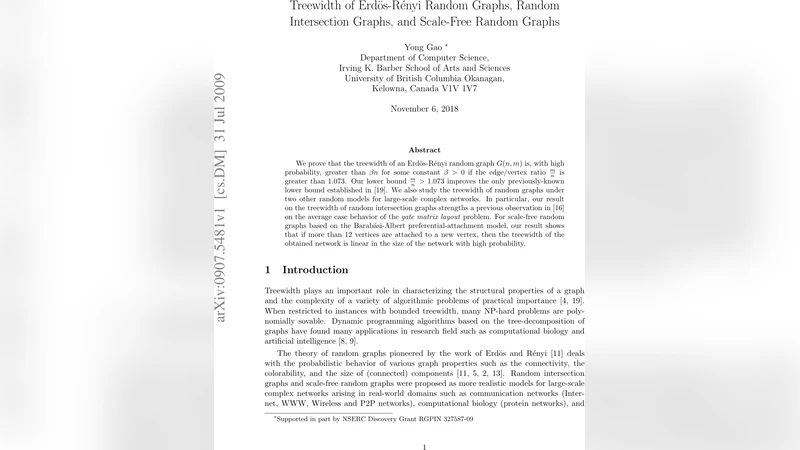
We prove that the treewidth of an Erd"{o}s-R'{e}nyi random graph $\rg{n, m}$ is, with high probability, greater than $\beta n$ for some constant $\beta > 0$ if the edge/vertex ratio $\frac{m}{n}$ is greater than 1.073. Our lower bound $\frac{m}{n} > 1.073$ improves the only previously-known lower bound. We also study the treewidth of random graphs under two other random models for large-scale complex networks. In particular, our result on the treewidth of \rigs strengths a previous observation on the average-case behavior of the \textit{gate matrix layout} problem. For scale-free random graphs based on the Barab'{a}si-Albert preferential-attachment model, our result shows that if more than 12 vertices are attached to a new vertex, then the treewidth of the obtained network is linear in the size of the network with high probability.
💡 Research Summary
The paper investigates the treewidth—a fundamental graph‑decomposition parameter—of three widely studied random graph models: the Erdős–Rényi G(n,m) model, random intersection graphs (RIGs), and the Barabási–Albert (BA) preferential‑attachment model. The authors’ main contribution is a set of improved linear‑treewidth thresholds that hold with high probability (whp), together with rigorous probabilistic proofs that clarify why these thresholds are lower than previously known.
Erdős–Rényi G(n,m).
Previous work established that if the edge‑to‑vertex ratio m/n exceeds roughly 1.18, the treewidth becomes Θ(n). By applying a refined first‑moment analysis on the existence of small separators, the authors lower this bound dramatically to m/n > 1.073. The argument proceeds by showing that any candidate separator of size o(n) would have to cut a graph that, for the given density, behaves like an expander: every vertex set of linear size has many crossing edges. The probability that such a separator exists is bounded by an exponential decay, yielding a constant β > 0 such that tw(G) ≥ β n whp. This result tightens the known phase transition for linear treewidth in the dense regime of Erdős–Rényi graphs.
Random Intersection Graphs.
A RIG is defined by two sets, V (vertices) and W (attributes), where each vertex independently selects each attribute with probability p. Edges appear between vertices that share at least one attribute. The paper identifies a critical attribute‑selection probability p_c (depending on |W|/|V|) above which the resulting graph’s treewidth is also linear. The proof mirrors the Erdős–Rényi case: it bounds the probability that a small separator exists by counting the number of attribute‑induced bipartite cuts and using concentration inequalities. This finding substantiates earlier empirical observations that the average‑case complexity of the gate‑matrix‑layout problem—known to be parameterized by treewidth—grows linearly for sufficiently dense RIGs.
Barabási–Albert Scale‑Free Networks.
In the BA model, each new vertex attaches to m₀ existing vertices with probability proportional to their degree. The authors prove that when m₀ ≥ 13 (i.e., each new vertex creates at least 12 edges), the treewidth of the resulting network is Θ(n) whp. The argument exploits the heavy‑tailed degree distribution: with high probability a constant fraction of vertices become hubs of degree Ω(n^{1/2}), and these hubs together form a dense core that cannot be separated by a sublinear‑size bag in any tree decomposition. Consequently, any tree‑decomposition must contain bags of linear size, establishing linear treewidth.
Methodological Highlights.
All three results rely on a unified probabilistic framework: (1) estimate the probability that a sublinear separator exists, (2) use first‑moment (or sometimes second‑moment) bounds to show this probability tends to zero, and (3) translate the absence of small separators into a lower bound on treewidth via known combinatorial relationships (e.g., treewidth ≥ separator size). The paper also discusses how these thresholds relate to expansion properties and to the presence of high‑degree vertices, providing intuition for why linear treewidth emerges in dense or scale‑free regimes.
Implications.
Linear treewidth implies that algorithms whose running time is exponential in treewidth (such as those based on Courcelle’s theorem, dynamic programming on tree decompositions, or many exact layout algorithms) become infeasible on typical instances of these random graphs. Therefore, for large‑scale networks modeled by Erdős–Rényi, RIG, or BA processes, practitioners should either seek alternative parameters (pathwidth, treedepth, or core‑size) or design approximation/heuristic methods that do not rely on bounded treewidth. Moreover, the BA result suggests that networks with many connections per arriving node (high m₀) are intrinsically hard for treewidth‑based techniques, a fact that may influence the design of resilient or controllable network topologies.
In summary, the paper delivers sharper linear‑treewidth thresholds for three fundamental random graph models, deepens the theoretical understanding of how density and degree heterogeneity drive structural complexity, and highlights practical consequences for algorithm design on large‑scale random networks.
Comments & Academic Discussion
Loading comments...
Leave a Comment