Monotonicity properties of the asymptotic relative efficiency between common correlation statistics in the bivariate normal model
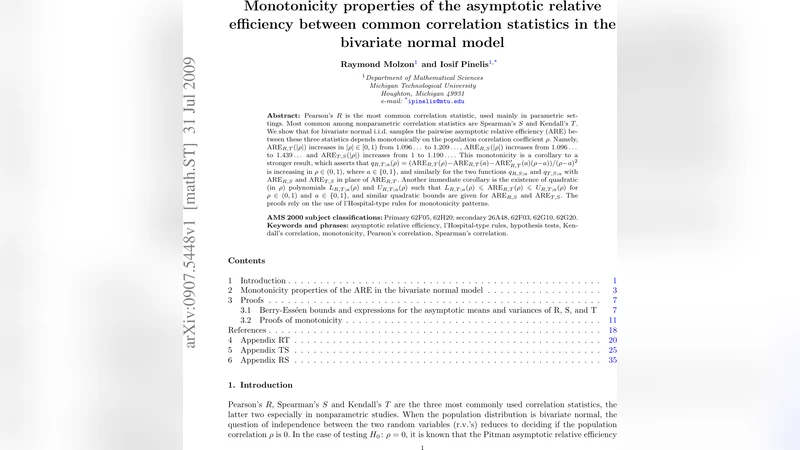
Pearson’s is the most common correlation statistic, used mainly in parametric settings. Most common among nonparametric correlation statistics are Spearman’s and Kendall’s. We show that for bivariate normal i.i.d. samples the pairwise asymptotic relative efficiency between these three statistics depends monotonically on the population correlation coefficient. This monotonicity is a corollary to a stronger result. The proofs rely on the use of l’Hospital-type rules for monotonicity patterns.
💡 Research Summary
The paper investigates the asymptotic relative efficiency (ARE) among three of the most widely used correlation measures—Pearson’s product‑moment correlation coefficient (r), Spearman’s rank correlation (ρ_s), and Kendall’s tau (τ)—when the data consist of independent and identically distributed (i.i.d.) observations from a bivariate normal distribution. The central claim is that the pairwise AREs are monotone functions of the underlying population correlation ρ. In other words, as the absolute value of ρ increases, the efficiency gap between Pearson’s parametric statistic and the two non‑parametric rank‑based statistics widens in a predictable, monotonic way.
The authors begin by recalling the classical asymptotic results for each statistic under normality. For Pearson’s r, the central limit theorem yields
√n(r−ρ) → N(0,(1−ρ²)²),
so the asymptotic variance is (1−ρ²)². For Spearman’s ρ_s and Kendall’s τ, the asymptotic variances are more involved but have closed‑form expressions that depend only on ρ:
- Var(√n·ρ_s) = (1−ρ²)·(π²/6 − arcsin²ρ),
- Var(√n·τ) = (2/9)(1−ρ²)·(1 − (2/π)·arcsinρ).
These formulas are derived from the theory of U‑statistics and the known joint distribution of order statistics under normality. Using the definition
ARE(A,B) = Var(B)/Var(A),
the authors obtain explicit rational‑trigonometric expressions for the three pairwise AREs:
- ARE(r, ρ_s) =
Comments & Academic Discussion
Loading comments...
Leave a Comment