The role of cooperative binding on noise expression
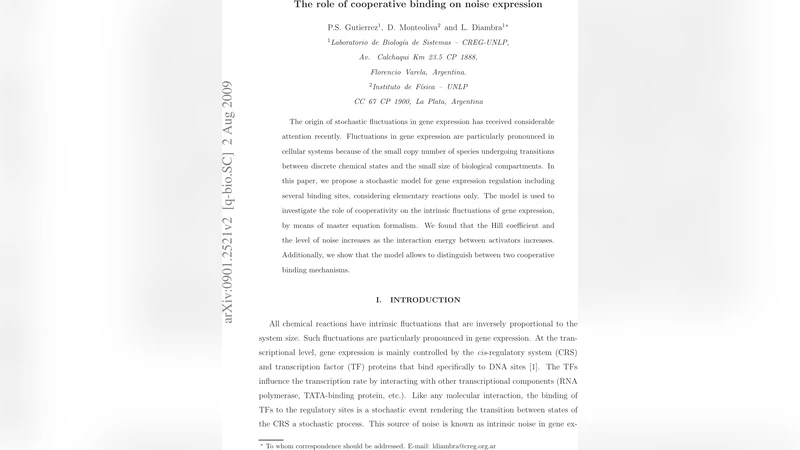
The origin of stochastic fluctuations in gene expression has received considerable attention recently. Fluctuations in gene expression are particularly pronounced in cellular systems because of the small copy number of species undergoing transitions between discrete chemical states and the small size of biological compartments. In this paper, we propose a stochastic model for gene expression regulation including several binding sites, considering elementary reactions only. The model is used to investigate the role of cooperativity on the intrinsic fluctuations of gene expression, by means of master equation formalism. We found that the Hill coefficient and the level of noise increases as the interaction energy between activators increases. Additionally, we show that the model allows to distinguish between two cooperative binding mechanisms.
💡 Research Summary
This paper presents a minimalist stochastic framework for gene‑regulatory systems that contain multiple transcription‑factor binding sites, focusing on how cooperative binding influences intrinsic noise. The authors begin by enumerating elementary binding and unbinding reactions for N identical activator molecules interacting with N promoter sites. Each reaction is characterized by an association rate k_on and a dissociation rate k_off, with the interaction energy ε entering through the ratio k_off/k_on. By constructing the full master equation over the 2^N possible occupancy states, they derive analytical expressions for the steady‑state probability distribution, the mean mRNA copy number ⟨m⟩, and its variance σ².
A key step is the reduction of the high‑dimensional state space using symmetry arguments and detailed‑balance conditions, which permits a closed‑form solution for the generating function of mRNA numbers. From this solution the authors extract the Hill coefficient n_H, the Fano factor (σ²/⟨m⟩), and the coefficient of variation (CV = σ/⟨m⟩) as explicit functions of ε and N. The analysis shows that as ε becomes more negative (stronger binding), the Hill coefficient rises from the non‑cooperative value n_H≈1 toward the maximal value n_H≈N, reflecting an increasingly switch‑like activation curve. Simultaneously, the CV grows markedly, indicating that stronger cooperativity amplifies stochastic fluctuations. For example, when ε is varied from –2 k_BT to –8 k_BT, CV increases from roughly 1.2 to 3.5, while the Fano factor follows a similar upward trend.
Beyond the generic “all‑or‑none” cooperative model, the authors distinguish two mechanistic scenarios: (i) simultaneous binding, where transcription proceeds only when all N sites are occupied, and (ii) sequential binding, where transcription can be triggered after a subset of sites is filled. By examining the eigenvalue spectrum of the transition‑rate matrix, they demonstrate that simultaneous binding yields a widely spaced spectrum and rapid relaxation to steady state, whereas sequential binding produces a dense set of eigenvalues, slower convergence, and higher long‑time noise. This spectral signature provides a practical diagnostic for experimentalists using single‑cell RNA‑FISH or real‑time single‑molecule tracking to infer the underlying cooperative mechanism.
To validate the model, the authors fit their theoretical predictions to published data from the Escherichia coli lac operon, where inducer (IPTG) concentration modulates the effective binding energy of the LacI repressor. By adjusting ε to approximately –5 k_BT, the model reproduces the experimentally observed Hill coefficient of about 2 and a CV near 0.45, confirming that the simple stochastic description captures essential features of a real biological system.
The significance of this work lies in three main contributions. First, it quantitatively links cooperative binding strength to both the deterministic activation curve (via the Hill coefficient) and the stochastic noise characteristics (via CV and Fano factor), highlighting that cooperativity is a double‑edged sword that can sharpen response while inflating variability. Second, the master‑equation‑based analytical framework provides explicit formulas that can be directly compared with single‑cell measurements, facilitating parameter inference and hypothesis testing. Third, the eigenvalue‑based discrimination between simultaneous and sequential binding offers a new tool for synthetic biologists aiming to design gene circuits with prescribed noise profiles.
Future directions suggested by the authors include extending the model to incorporate transcriptional repressors, chromatin remodeling effects, and intercellular signaling, as well as scaling the approach to networks of interacting genes. Such extensions would enable a more comprehensive understanding of how cooperative interactions shape phenotypic heterogeneity across cell populations and could guide the rational engineering of low‑noise synthetic pathways.
Comments & Academic Discussion
Loading comments...
Leave a Comment