Benchmarks for testing community detection algorithms on directed and weighted graphs with overlapping communities
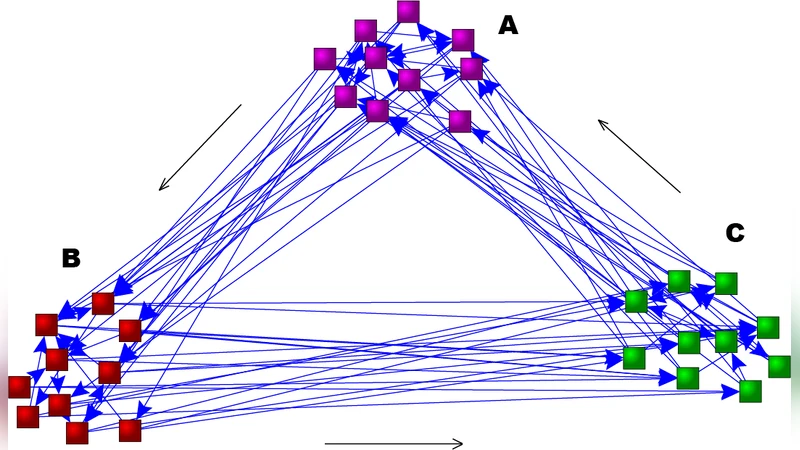
Many complex networks display a mesoscopic structure with groups of nodes sharing many links with the other nodes in their group and comparatively few with nodes of different groups. This feature is known as community structure and encodes precious information about the organization and the function of the nodes. Many algorithms have been proposed but it is not yet clear how they should be tested. Recently we have proposed a general class of undirected and unweighted benchmark graphs, with heterogenous distributions of node degree and community size. An increasing attention has been recently devoted to develop algorithms able to consider the direction and the weight of the links, which require suitable benchmark graphs for testing. In this paper we extend the basic ideas behind our previous benchmark to generate directed and weighted networks with built-in community structure. We also consider the possibility that nodes belong to more communities, a feature occurring in real systems, like, e. g., social networks. As a practical application, we show how modularity optimization performs on our new benchmark.
💡 Research Summary
The paper addresses a critical gap in the evaluation of community‑detection methods: the lack of realistic benchmark graphs that simultaneously incorporate edge direction, edge weight, and overlapping community membership. Building on the well‑known LFR (Lancichinetti‑Fortunato‑Radicchi) benchmark, the authors propose a comprehensive extension that preserves the heterogeneous degree distribution and community‑size distribution of the original model while adding three new dimensions of realism.
First, directionality is introduced by assigning a direction to each undirected edge generated by the standard LFR process. Two parameters, μ_in and μ_out, control the proportion of inbound and outbound edges that cross community boundaries, and a “reverse‑edge suppression” factor allows the user to reduce the frequency of reciprocal links, thereby mimicking the asymmetry observed in many real networks (e.g., citation or follower graphs). A global “directional mixing parameter” μ_dir quantifies the overall fraction of inter‑community directed edges.
Second, edge weights are modeled with two distinct probability distributions: one for intra‑community edges (high‑mean, low‑variance) and another for inter‑community edges (low‑mean, higher variance). The weight mixing parameter μ_w determines how much the two distributions overlap; a larger μ_w reduces the contrast between internal and external weights, making community boundaries harder to detect. The authors also enforce a correlation between node degree and total incident weight, reproducing the empirical observation that high‑degree nodes tend to carry larger total weight.
Third, overlapping community structure is incorporated by allowing each node to belong to up to O_max communities. The fraction of overlapping nodes (O_n) and the distribution of the number of memberships per node are explicitly controllable. Overlapping nodes receive edges in the same way as non‑overlapping nodes, ensuring that their degree and weight statistics remain consistent with the overall network.
The benchmark thus offers a high‑dimensional parameter space (μ, μ_dir, μ_w, O_n, O_max, degree exponent, community‑size exponent, etc.) that can be tuned to generate graphs ranging from easy (strong internal connectivity, clear weight contrast, few overlaps) to extremely challenging (high mixing, weak weight contrast, many overlaps).
To demonstrate the utility of the new benchmark, the authors evaluate two representative community‑detection algorithms: the Louvain method (modularity optimization) and a directed‑weighted version of Infomap. Performance is measured using standard metrics (precision, recall, Normalized Mutual Information) and an overlapping‑specific metric (Omega Index). The experiments reveal several key findings:
- As the traditional mixing parameter μ increases, both algorithms degrade, but the decline is steeper for Louvain, which does not natively handle direction or weight.
- When μ_dir is moderate, Infomap’s ability to exploit directionality yields higher NMI than Louvain; however, extremely high μ_dir (many inter‑community directed edges) erodes this advantage.
- Increasing μ_w reduces the separation between intra‑ and inter‑community weights; algorithms that incorporate weight information (weighted Infomap) maintain a performance edge of roughly 10 % in NMI over their unweighted counterparts when μ_w ≤ 0.5.
- Overlap proportion O_n strongly penalizes Louvain: the method tends to merge overlapping nodes into a single community, resulting in low Omega Index scores. A modified Louvain that allows overlapping assignments performs considerably better, highlighting the necessity of overlap‑aware techniques.
The authors conclude that their directed‑weighted‑overlapping benchmark provides a more faithful testbed for modern community‑detection algorithms. It can expose weaknesses that remain hidden when using traditional undirected, unweighted benchmarks, such as the inability to handle asymmetric link patterns or to distinguish communities when weight signals are weak.
Nevertheless, the paper acknowledges limitations. The generation process involves several sequential steps and a large number of parameters, which may require careful calibration to achieve a desired network profile. Moreover, the weight model is limited to Gaussian‑type distributions; extending it to power‑law weight distributions observed in some empirical systems would increase realism.
Overall, this work supplies the network‑science community with a versatile, reproducible benchmark suite that can drive the development and rigorous evaluation of next‑generation community‑detection algorithms capable of handling direction, weight, and overlapping structures simultaneously.
Comments & Academic Discussion
Loading comments...
Leave a Comment