Complexity of Fractran and Productivity
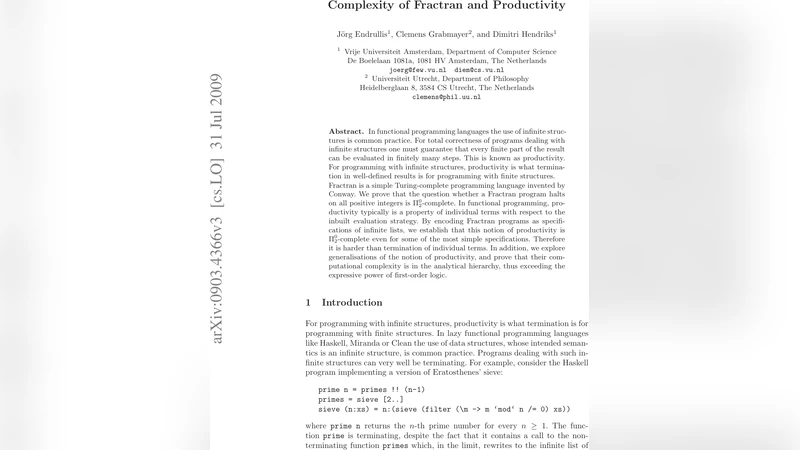
In functional programming languages the use of infinite structures is common practice. For total correctness of programs dealing with infinite structures one must guarantee that every finite part of the result can be evaluated in finitely many steps. This is known as productivity. For programming with infinite structures, productivity is what termination in well-defined results is for programming with finite structures. Fractran is a simple Turing-complete programming language invented by Conway. We prove that the question whether a Fractran program halts on all positive integers is Pi^0_2-complete. In functional programming, productivity typically is a property of individual terms with respect to the inbuilt evaluation strategy. By encoding Fractran programs as specifications of infinite lists, we establish that this notion of productivity is Pi^0_2-complete even for the most simple specifications. Therefore it is harder than termination of individual terms. In addition, we explore possible generalisations of the notion of productivity in the framework of term rewriting, and prove that their computational complexity is Pi^1_1-complete, thus exceeding the expressive power of first-order logic.
💡 Research Summary
The paper investigates two closely related decision problems that arise at the intersection of computability theory, term rewriting, and functional programming: (1) the global halting problem for Conway’s Fractran programs, and (2) the productivity problem for specifications of infinite data structures, most notably infinite streams. Both problems are examined through the lens of the arithmetical and analytical hierarchies, and the authors establish precise completeness results that locate each problem at a distinct level of logical complexity.
Fractran is a minimalist Turing‑complete language. A program consists of a finite list of rational numbers (fractions). Starting from a positive integer n, the interpreter scans the list, multiplies n by the first fraction that yields an integer, and repeats. The computation stops when no fraction produces an integer. Although the operational description is extremely simple, Fractran can simulate any Turing machine, which immediately suggests that many decision problems about Fractran are undecidable. The authors focus on the global halting problem: “Does a given Fractran program halt on all positive integer inputs?” Formally this is the predicate ∀x∈ℕ⁺ ∃t R(P,x,t), where R(P,x,t) expresses that program P terminates on input x within t steps. Because R is recursively enumerable, the predicate belongs to the class Π⁰₂ of the arithmetical hierarchy. To prove Π⁰₂‑completeness, the paper constructs a polynomial‑time many‑one reduction from the canonical Π⁰₂‑complete problem “∀x ∃y M(x,y) halts” (the universal halting problem for Turing machines) to the Fractran global halting problem. The reduction encodes the universal quantifier over inputs into the choice of initial integer and the existential quantifier over the number of steps into the length of the Fractran computation. Consequently, deciding whether a Fractran program halts on every input is Π⁰₂‑complete. This result shows that, despite Fractran’s syntactic simplicity, its global termination behavior is as hard as any problem at the second level of the arithmetical hierarchy.
The second part of the paper turns to functional programming, where infinite structures such as streams are commonplace. A stream is productive if every finite prefix can be produced in a finite number of evaluation steps. Productivity is the analogue of termination for infinite data: it guarantees that a program does not get “stuck” producing an undefined tail. Traditionally, productivity has been studied for a single term under a fixed evaluation strategy (e.g., call‑by‑need). The authors adopt a more global viewpoint: they consider specifications that define an entire infinite list and ask whether the specification is productive as a whole.
To relate this to Fractran, the authors encode any Fractran program P as a stream specification S(P). Each fraction in P becomes a rewrite rule that either emits a concrete stream element or skips to the next rule, mimicking the multiplication step. The entire program thus defines a recursive equation of the form
L = a₁ :: a₂ :: a₃ :: …
where the i‑th element a_i is produced exactly when the Fractran computation on input i yields an integer. Consequently, the stream S(P) is productive if and only if P halts on every positive integer. This tight correspondence yields an immediate transfer of the Π⁰₂‑completeness result: the productivity problem for such stream specifications is Π⁰₂‑complete. Notably, this is strictly harder than the classic termination problem for individual terms, which is Π⁰₁‑complete (i.e., co‑recursively enumerable). The paper therefore establishes that checking productivity of even the simplest infinite‑list specifications sits at a higher level of logical difficulty than ordinary termination.
Finally, the authors explore generalised notions of productivity within the framework of term rewriting systems (TRSs). They consider properties such as “for every infinite rewrite sequence there exists a finite prefix that can be normalised after applying a prescribed pre‑processing” and similar variants that quantify over infinite derivations. These formulations naturally lead to statements of the form ∀∞‑paths ∃finite … , which belong to the analytical hierarchy rather than the arithmetical one. By constructing a reduction from the well‑known Π¹₁‑complete problem “does every infinite binary tree contain a path satisfying a given MSO formula?” they prove that these generalized productivity problems are Π¹₁‑complete. This result demonstrates that once productivity is lifted from concrete evaluation strategies to abstract rewriting properties, its complexity can exceed the expressive power of first‑order logic.
In summary, the paper makes three major contributions:
-
It proves that the global halting problem for Fractran programs is Π⁰₂‑complete, establishing a precise complexity classification for a deceptively simple Turing‑complete language.
-
It shows that productivity of infinite‑list specifications, when encoded via Fractran, inherits the same Π⁰₂‑completeness, thereby revealing that productivity is inherently more difficult than ordinary termination.
-
It extends the analysis to broader notions of productivity in term rewriting, demonstrating Π¹₁‑completeness and thus locating these problems in the analytical hierarchy.
These findings have practical implications for the design of static analysis and verification tools for functional languages. Any automated system that aims to guarantee productivity of user‑defined infinite data structures must contend with a problem that is, in the worst case, as hard as any Π⁰₂‑complete problem, and possibly as hard as Π¹₁‑complete when more expressive rewriting frameworks are considered. The paper therefore provides a rigorous theoretical baseline that clarifies the limits of algorithmic productivity checking and guides future research toward feasible approximations or restricted subclasses where decidability may be regained.
Comments & Academic Discussion
Loading comments...
Leave a Comment