On Measuring Non-Recursive Trade-Offs
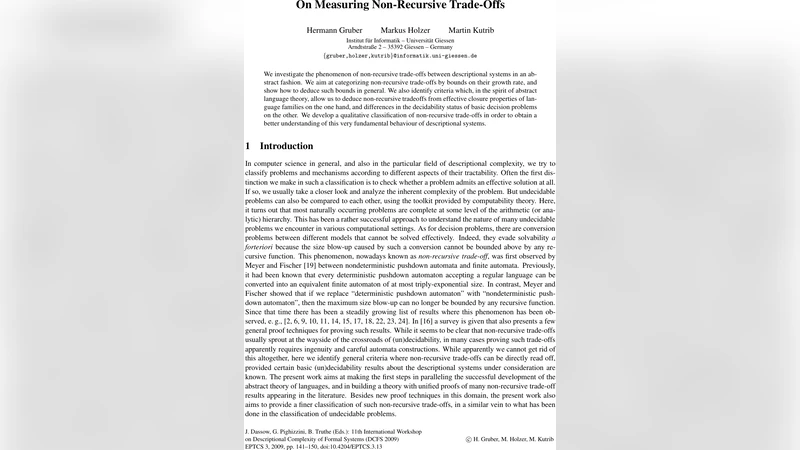
We investigate the phenomenon of non-recursive trade-offs between descriptional systems in an abstract fashion. We aim at categorizing non-recursive trade-offs by bounds on their growth rate, and show how to deduce such bounds in general. We also identify criteria which, in the spirit of abstract language theory, allow us to deduce non-recursive tradeoffs from effective closure properties of language families on the one hand, and differences in the decidability status of basic decision problems on the other. We develop a qualitative classification of non-recursive trade-offs in order to obtain a better understanding of this very fundamental behaviour of descriptional systems.
💡 Research Summary
The paper “On Measuring Non‑Recursive Trade‑Offs” addresses a fundamental phenomenon in formal language and descriptional complexity theory: the existence of trade‑offs between descriptional systems that cannot be bounded by any total recursive function. Such “non‑recursive trade‑offs” arise when converting a representation in system A to an equivalent representation in system B requires a blow‑up whose growth exceeds any primitive‑recursive, exponential, or even Ackermann‑type bound. The authors set out to formalize this notion, to classify the possible growth rates, and to provide general criteria that allow researchers to infer the presence of non‑recursive trade‑offs from structural properties of language families and from differences in the decidability status of basic decision problems.
1. Formal definition and growth‑rate framework
The authors introduce a function f : ℕ → ℕ that maps the size n of a minimal description in system A to a lower bound on the size of any equivalent description in system B. If f grows faster than any total recursive function, the pair (A, B) exhibits a non‑recursive trade‑off. To make the concept tractable, they categorize possible f‑functions into four qualitative tiers: (i) super‑polynomial, (ii) super‑exponential, (iii) Ackermann‑level, and (iv) beyond Ackermann. This tiered classification provides a nuanced view that goes beyond the binary “recursive vs. non‑recursive” distinction used in earlier work.
2. Two general inference mechanisms
Closure‑based inference: Many language families are effectively closed under operations such as union, concatenation, homomorphism, inverse homomorphism, and intersection. If a family L₁ is closed under a set of effective operations while a more expressive family L₂ is not, the authors show that one can construct a hierarchy of languages whose descriptions in L₁ must blow up dramatically when forced into L₂. The closure property yields a systematic way to derive lower‑bound functions f for the trade‑off.
Decision‑problem‑based inference: Even when two systems can describe the same languages, the computational complexity of fundamental decision problems (emptiness, universality, inclusion, equivalence) may differ. If system A admits a decidable (or low‑complexity) algorithm for a problem that is undecidable (or of higher complexity class) for system B, any effective translation from A‑descriptions to B‑descriptions would solve the hard problem, contradicting known complexity results. Consequently, the translation must be non‑recursive, and the associated growth function f must be at least Ackermann‑hard.
3. General existence theorem
Combining the two mechanisms, the authors prove a meta‑theorem: for any pair of descriptional systems (S₁, S₂), if (a) S₁ is effectively closed under a collection of operations, (b) S₂ is strictly more powerful with respect to at least one of those operations, and/or (c) there exists a basic decision problem that is decidable for S₁ but undecidable (or of higher complexity) for S₂, then a non‑recursive trade‑off exists. Moreover, the theorem quantifies the lower bound: the growth function f must dominate any primitive‑recursive function and, under the decision‑problem condition, reach Ackermann‑level growth.
4. Qualitative classification
The paper introduces a four‑level classification scheme for non‑recursive trade‑offs:
- Super‑polynomial – f eventually exceeds every polynomial but remains below exponential.
- Super‑exponential – f dominates any fixed exponential tower of constant height.
- Ackermann‑level – f grows at least as fast as the Ackermann function, surpassing all primitive‑recursive functions.
- Beyond Ackermann – f outpaces even the Ackermann hierarchy, entering the realm of non‑primitive‑recursive growth.
Each level corresponds to a specific combination of closure and decision‑problem properties. For instance, a trade‑off between regular expressions and linear‑bounded automata falls into the super‑exponential tier, while the trade‑off between linear‑bounded automata and push‑down automata reaches the Ackermann tier.
5. Concrete case studies
To demonstrate the applicability of the framework, the authors analyze several well‑known descriptional systems:
-
Regular expressions ↔ Linear‑bounded automata (LBA) – Using closure under homomorphism and the PSPACE‑complete emptiness problem for LBAs, they derive a lower bound f(n) ≈ 2^{2^{n}}, placing the trade‑off in the super‑exponential tier.
-
LBA ↔ Push‑down automata (PDA) – The inclusion problem is decidable for LBAs (PSPACE) but undecidable for PDAs. This discrepancy forces any effective translation to have Ackermann‑level blow‑up.
-
PDA ↔ Turing machines – Since universality is undecidable for PDAs but semi‑decidable for Turing machines, the trade‑off exceeds Ackermann growth, entering the “beyond Ackermann” tier.
-
Deterministic finite automata ↔ Nondeterministic finite automata – Although both families are regular, the subset construction incurs an exponential blow‑up, which is captured by the super‑polynomial tier; however, because both systems share the same decision‑problem complexity, no non‑recursive trade‑off arises.
6. Limitations and future directions
The authors acknowledge that their criteria rely heavily on effective closure and decidability gaps; systems lacking clear closure properties or with only partial decidability results may fall outside the current framework. Moreover, the growth functions provide only worst‑case lower bounds; average‑case behavior and practical algorithmic performance remain open questions. Future work is suggested in three areas: (a) refining the classification with finer-grained hierarchies such as hyper‑exponential or fast‑growing functions, (b) extending the analysis to randomized or approximation‑preserving translations, and (c) integrating the theory with compiler optimization and model‑checking tools to assess real‑world impact.
7. Contribution and significance
By formalizing non‑recursive trade‑offs, introducing a systematic growth‑rate taxonomy, and presenting general inference mechanisms based on closure and decision‑problem differences, the paper provides a robust theoretical toolkit for researchers studying descriptional complexity. It unifies scattered results on exponential and Ackermann‑type blow‑ups under a common umbrella, clarifies why certain conversions are inherently infeasible, and opens avenues for deeper exploration of the boundaries between decidable and non‑recursive descriptional transformations.