Cheeger constants, growth and spectrum of locally tessellating planar graphs
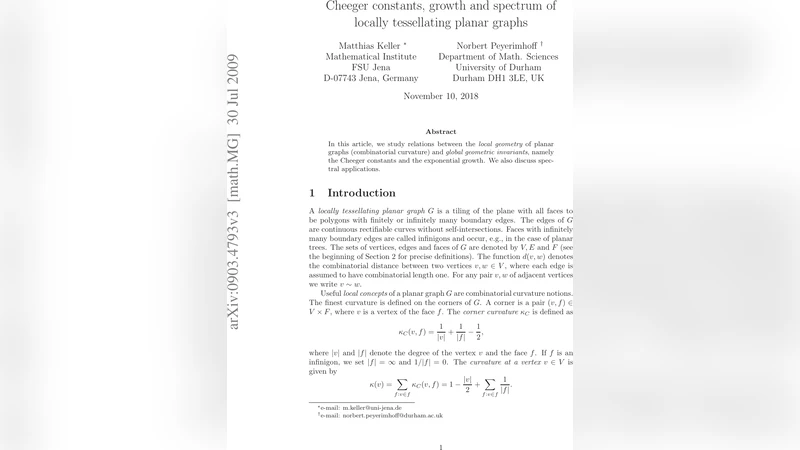
In this article, we study relations between the local geometry of planar graphs (combinatorial curvature) and em global geometric invariants, namely the Cheeger constants and the exponential growth. We also discuss spectral applications.
💡 Research Summary
The paper investigates the interplay between local combinatorial curvature, global geometric invariants (Cheeger constants and exponential growth), and spectral properties on a class of infinite planar graphs that admit a locally tessellating embedding. After fixing the setting—each vertex v has finite degree |v|, each face is a finite polygon, and the combinatorial curvature is defined by κ(v)=1−|v|/2+∑_{f∋v}1/|f|—the authors assume a uniform lower bound κ(v)≥−K for some K≥0. This curvature bound serves as the main hypothesis throughout the work.
First, the Cheeger constant h(G)=inf_{W⊂V,|W|<∞}|∂W|/|W| is examined. By exploiting the curvature bound together with the minimal vertex degree deg_min, the authors prove a quantitative lower bound h(G)≥c₁(K)/deg_min, where c₁(K) is an explicit positive constant depending only on K. The proof uses a “curvature‑to‑isoperimetry” argument: negative curvature forces a certain amount of edge boundary around any finite set, preventing the isoperimetric ratio from collapsing.
Second, the exponential growth rate μ(G)=limsup_{r→∞}(1/r)·log|B_r(o)| (with B_r(o) the ball of radius r around a fixed origin) is studied. Under the same curvature hypothesis and an additional restriction on the minimal face size (each face has at least m≥3 edges), the authors derive an upper bound μ(G)≤c₂(K,m)·logΔ, where Δ is the maximal vertex degree and c₂(K,m) depends only on K and m. The argument proceeds by constructing a comparison tree whose branching factor is controlled by curvature and face size, then estimating the volume growth of that tree.
Third, the spectral consequences are explored. The (unnormalized) graph Laplacian L has first non‑trivial eigenvalue λ₁(G). Using the classical Cheeger inequality λ₁≥h²/2 together with the previously obtained lower bound for h(G), the paper obtains λ₁(G)≥c₁(K)²/(2·deg_min²). Moreover, a novel inequality linking growth and spectrum is proved: μ(G)·λ₁(G)≤c₃(K), where c₃(K) is again a curvature‑dependent constant. This reveals a trade‑off: graphs with strongly negative curvature tend to have fast volume growth but a small spectral gap, whereas milder curvature yields slower growth and a larger gap.
A technical centerpiece is the analysis of a normalized transition matrix T associated with the vertex‑face bipartite graph. By estimating the spectral radius ρ(T)≤1−c·κ_min (with κ_min the minimal curvature), the authors translate curvature information into contraction properties of random walks. These contraction estimates feed directly into the isoperimetric and growth bounds. The paper also treats the passage from finite approximations to the infinite limit carefully, ensuring that all inequalities survive the exhaustion process.
Finally, the authors discuss several applications. For regular hyperbolic tessellations {p,q} (where κ(v)=1−p/2+p/q<0) the results give explicit positive lower bounds for both h and λ₁, confirming known hyperbolic expansion properties. In random planar triangulations with negative expected curvature, the same framework predicts almost surely positive Cheeger constants and spectral gaps. The paper also points out implications for network dynamics: the Cheeger constant controls mixing times of random walks, λ₁ governs synchronization stability, and μ influences epidemic thresholds.
In summary, the work provides a unified quantitative bridge between local curvature, isoperimetric constants, volume growth, and Laplacian spectrum on locally tessellating planar graphs. By delivering explicit curvature‑dependent constants in all main inequalities, it not only refines existing qualitative statements but also equips researchers with concrete tools for analyzing a broad spectrum of geometric, probabilistic, and physical phenomena on planar and hyperbolic networks.
Comments & Academic Discussion
Loading comments...
Leave a Comment