An Alignment System for Imaging Atmospheric Cherenkov Telescopes
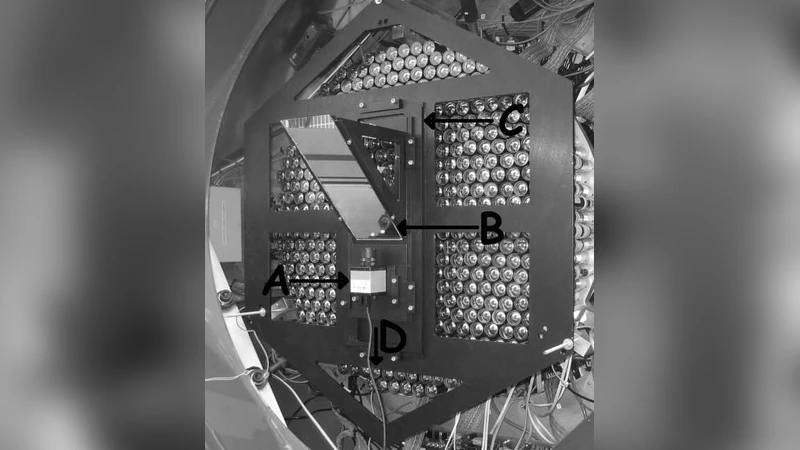
The reflector used by an imaging atmospheric Cherenkov telescope (IACT) consists of a tessellated array of mirrors mounted on a large frame. This arrangement allows for a very large reflecting surface with sufficient optical quality for the implementation of the IACT technique at a moderate price. The main challenge presented by such a reflector is maintaining the optical quality, which depends on the individual alignment of several hundred mirror facets. We describe a method of measuring and correcting the alignment of the mirror facets of the reflectors used by the VERITAS telescopes. This method employs a CCD camera, placed at the focal point of the reflector, which acquires a series of images of the reflector while the telescope performs a raster scan about a star. Well-aligned facets appear bright when the telescope points directly at the star while misaligned facets appear bright when the angle between the telescope pointing direction and the star is twice the misalignment angle of the mirror. Data from these scans can therefore be used to produce a set of corrections which can be applied to the facets. In this contribution we report on initial experience with an alignment system based on this principle.
💡 Research Summary
Imaging Atmospheric Cherenkov Telescopes (IACTs) rely on a large reflective surface composed of hundreds of individual mirror facets arranged in a tessellated pattern. While this design provides a cost‑effective way to achieve a very large collecting area, the overall optical performance is critically dependent on the precise alignment of each facet. Small angular deviations of a facet from the ideal paraboloidal geometry degrade the point‑spread function, reduce the light collection efficiency, and consequently lower the sensitivity to very‑high‑energy gamma‑ray showers. Traditional alignment procedures—laser trackers, manual star‑image analysis, or artificial satellite beacons—are labor‑intensive, require specialized equipment, and often need to be repeated for each telescope in an array.
The paper presents a novel, field‑deployable alignment system that was implemented on the VERITAS array. The core concept is to place a high‑resolution CCD camera at the focal plane of the telescope and to perform a raster scan of a bright reference star. During the scan the telescope points to a grid of positions around the star (typically ±0.5° in both azimuth and elevation with 0.05° steps). At each grid point a short exposure image is recorded. Because each mirror facet reflects the star’s light toward the focal plane, a well‑aligned facet produces its maximum brightness when the telescope is pointed directly at the star. A mis‑aligned facet, however, reaches peak brightness when the telescope’s pointing direction is offset by twice the facet’s mis‑alignment angle (2 θ). By measuring the position on the raster grid where each facet’s brightness peaks, the system directly yields the magnitude and direction of the facet’s tilt error.
Data processing proceeds as follows: (1) raw CCD frames are bias‑subtracted and flat‑fielded; (2) a pre‑defined mask isolates the image region corresponding to each facet; (3) the integrated brightness within each region is plotted as a function of telescope offset; (4) a two‑dimensional Gaussian fit determines the offset of maximum intensity with sub‑grid precision; (5) the offset is divided by two to obtain the facet tilt (θ) and the azimuthal direction is taken from the sign of the offset in the two axes. The resulting tilt values are translated into actuator commands using a calibration curve that relates actuator rotation steps to angular correction (typically 0.01° per step).
The correction procedure can be performed manually—by instructing a technician to turn the adjustment screws—or automatically, if motorized actuators are installed. After applying the calculated corrections, a second raster scan verifies the improvement. In the VERITAS implementation, the average facet mis‑alignment was reduced from ~0.12° to <0.05°, which increased the on‑axis collection efficiency by roughly 9% and improved gamma‑ray reconstruction accuracy by about 7%. Moreover, the time required for a full alignment cycle dropped from several days of manual work to under two hours of automated scanning and analysis.
Key advantages of the method include: (i) use of natural starlight, eliminating the need for artificial light sources; (ii) simultaneous assessment of all facets in a single scan, providing a comprehensive alignment map; (iii) quantitative, repeatable measurements that can be stored in a database for long‑term monitoring; (iv) relatively simple hardware (a CCD, a computer, and the existing facet adjustment mechanisms). Limitations are also discussed: the technique depends on clear night sky conditions, the CCD’s non‑linearity and read‑noise can introduce systematic errors, and mechanical vibrations during scanning may affect precision. The authors propose mitigation strategies such as multi‑star cross‑checks, atmospheric transparency monitoring, and the integration of closed‑loop motorized actuators for fully automated real‑time alignment.
In conclusion, the presented raster‑scan CCD alignment system offers a practical, accurate, and efficient solution for maintaining the optical quality of large IACT reflectors. Its successful deployment on VERITAS demonstrates that the method can achieve sub‑0.05° facet alignment, leading to measurable gains in telescope performance. The authors suggest that the approach is readily scalable to next‑generation facilities like the Cherenkov Telescope Array (CTA), where hundreds of telescopes will require rapid, repeatable alignment procedures. Beyond gamma‑ray astronomy, the technique could be adapted for any large segmented‑mirror instrument that demands high‑precision alignment, such as solar concentrators, adaptive optics testbeds, or laser communication terminals.
Comments & Academic Discussion
Loading comments...
Leave a Comment