Tate cohomology with respect to semidualizing modules
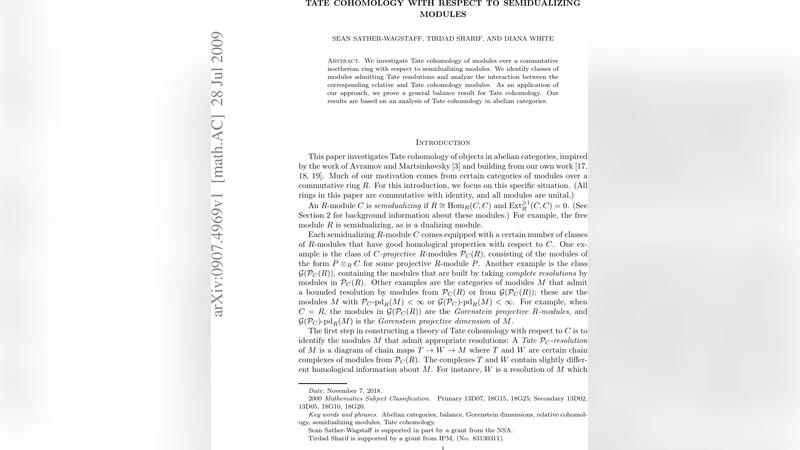
We investigate Tate cohomology of modules over a commutative noetherian ring with respect to semidualizing modules. We identify classes of modules admitting Tate resolutions and analyze the interaction between the corresponding relative and Tate cohomology modules. As an application of our approach, we prove a general balance result for Tate cohomology. Our results are based on an analysis of Tate cohomology in abelian categories.
💡 Research Summary
The paper develops a comprehensive theory of Tate cohomology for modules over a commutative Noetherian ring R with respect to a semidualizing module C. A semidualizing module is defined by the conditions Hom_R(C,C)≅R and Ext_R^{>0}(C,C)=0, and it provides a relative homological framework that generalizes the classical Gorenstein setting. The authors begin by establishing C‑relative projective and injective dimensions, showing that every C‑reflexive (or C‑compatible) module admits both a finite C‑projective resolution and an infinite C‑injective coresolution.
Using these ingredients they construct “C‑complete” complexes: exact complexes that are simultaneously built from C‑projective modules on the left and C‑injective modules on the right. When a module M belongs to the class of C‑reflexive modules, such a complex yields a Tate resolution T→M. This resolution is unique up to homotopy and contains an infinite tail of C‑projective terms as well as an infinite head of C‑injective terms.
With a Tate resolution in hand, the authors define Tate cohomology groups (\widehat{\operatorname{Ext}}_R^i(M,N)) for pairs of modules (M,N) where at least one of them admits a Tate resolution. They prove that for sufficiently large i the Tate groups coincide with the ordinary relative Ext groups, (\widehat{\operatorname{Ext}}_R^i(M,N) \cong \operatorname{Ext}_R^i(M,N)), while for very negative i they are computed via C‑injective dimensions, giving a dual description in terms of C‑torsion. Moreover, they establish long exact sequences linking relative Ext, Tate Ext, and the connecting morphisms that arise from short exact sequences of modules.
The central result is a balance theorem: if both M and N are C‑reflexive, then the Tate cohomology can be computed either by applying Hom_R(–,N) to a Tate resolution of M or by applying Hom_R(M,–) to a Tate coresolution of N. Formally, (\widehat{\operatorname{Ext}}_R^i(M,N) \cong H^i(\operatorname{Hom}_R(T_M,N)) \cong H^i(\operatorname{Hom}_R(M,T^N))). This extends the classical projective–injective balance for Gorenstein homological algebra to the relative setting determined by C.
Beyond the module category, the authors abstract the construction to any abelian category (\mathcal{A}) possessing enough projectives and injectives. They define C‑complete objects, develop the associated Tate cohomology, and show that the balance theorem persists in this broader context. The machinery relies on the notions of complete dimension and G‑dimension, thereby linking the new theory to existing Gorenstein dimensions and demonstrating that the relative Tate cohomology behaves well under change of categories.
As an application, the paper proves a general balance result for Tate cohomology, which subsumes earlier results for Gorenstein projective and injective modules as special cases. The authors also discuss potential applications to the study of homological invariants in non‑regular rings, to the classification of semidualizing modules, and to the development of new invariants derived from Tate cohomology.
In summary, the work provides a systematic framework for Tate cohomology relative to semidualizing modules, identifies precisely the class of modules admitting Tate resolutions, clarifies the relationship between relative and Tate cohomology, and establishes a robust balance theorem both in module categories and in general abelian settings. This significantly broadens the scope of Tate cohomology and opens avenues for further research in relative homological algebra and its applications.
Comments & Academic Discussion
Loading comments...
Leave a Comment