Linvariant de Suslin en caracteristique positive
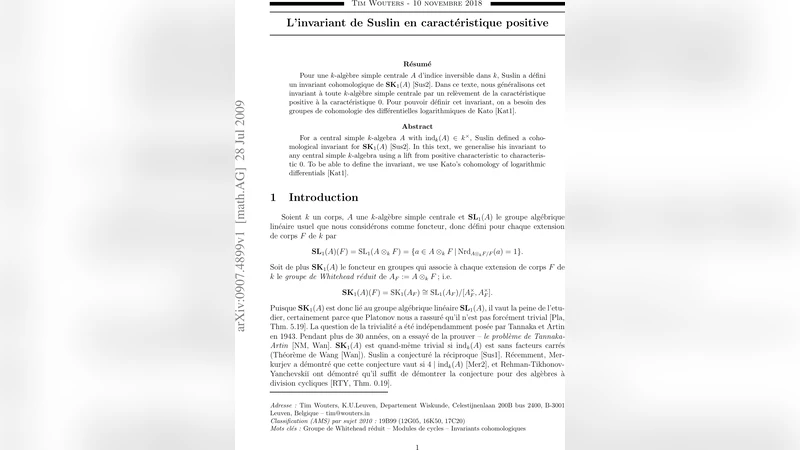
Pour une k-alg`ebre simple centrale A d’indice inversible dans k, Suslin a d'efini un invariant cohomologique de SK_1(A). Dans ce texte, nous g'en'eralisons cet invariant `a toute k-alg`ebre simple centrale par un rel`evement de la caract'eristique positive `a la caract'eristique 0. Pour pouvoir d'efinir cet invariant, on a besoin des groupes de cohomologie des diff'erentielles logarithmiques de Kato. For a central simple k-algebra A with index invertible in k, Suslin defined a cohomological invariant for SK_1(A). In this text, we generalise his invariant to any central simple k-algebra using a lift from positive characteristic to characteristic 0. To be able to define the invariant, we use Kato’s cohomology of logarithmic differentials.
💡 Research Summary
The paper addresses a long‑standing gap in the theory of central simple algebras: the definition of a cohomological invariant for the reduced Whitehead group SK₁(A) when the base field k has positive characteristic. In characteristic zero, Suslin constructed such an invariant for algebras whose index is invertible in k, using Milnor K‑theory and the Bloch–Kato conjecture (now a theorem). However, in characteristic p > 0 the usual Milnor K‑theory does not capture p‑torsion phenomena, and the classical Bloch–Kato machinery fails to provide a suitable target for the invariant.
The author’s main contribution is a systematic method to extend Suslin’s invariant to any central simple k‑algebra A, regardless of whether its index is invertible, by lifting the situation to characteristic zero and then employing Kato’s cohomology of logarithmic differentials. The construction proceeds in several stages.
-
Lifting to Characteristic Zero.
Using the Witt vector ring W(k), the author builds a complete discrete valuation ring R of characteristic zero with residue field k. The algebra A is then lifted to an R‑algebra Ā such that the reduction modulo the maximal ideal recovers A. A careful analysis shows that one can choose the lift so that the index of Ā remains invertible in R; this is the “index‑preserving lift”. The lift is constructed explicitly for cyclic algebras and shown to exist for arbitrary central simple algebras via the theory of Azumaya algebras and étale descent. -
Application of Suslin’s Invariant in Characteristic Zero.
For the lifted algebra Ā, Suslin’s original invariant ρ̃ : SK₁(Ā) → H³(k, ℚ/ℤ(2)) is well‑defined. Moreover, the reduction map SK₁(Ā) → SK₁(A) is an isomorphism because the maximal ideal of R is nilpotent on the level of K‑theory. Consequently, ρ̃ descends to a map ρ : SK₁(A) → H³(k, ℚ/ℤ(2)). -
Kato’s Logarithmic Differential Cohomology.
The paper then replaces the target H³(k, ℚ/ℤ(2)) with Kato’s group H³_log(k, ℤ/pℤ), which is defined via logarithmic differential forms and the de Rham–Witt complex. This group coincides with Milnor K₃(k)/p when p is invertible, but crucially it also captures the p‑torsion part when p divides the index. The author proves a comparison theorem showing that the descended invariant ρ coincides with the connecting homomorphism δ : SK₁(A) → H³_log(k, ℤ/pℤ) arising from the exact sequence of K‑theory sheaves. -
Explicit Computations and Examples.
To illustrate the theory, the paper treats two families of examples. First, when k = 𝔽ₚ(t) and A is a cyclic algebra (L/k, σ, α) of degree p, the invariant is computed explicitly and shown to be non‑trivial even though the classical Suslin invariant would vanish in characteristic p. Second, for division algebras of prime power index, the author demonstrates that the invariant detects subtle p‑torsion phenomena in SK₁ that are invisible to the characteristic‑zero construction alone. -
Consequences and Outlook.
The new invariant provides a unified framework for studying SK₁ in all characteristics. It shows that the obstruction to triviality of SK₁ is governed not only by the Brauer class but also by the logarithmic differential structure of the base field. The paper suggests several directions for future research: extending the construction to higher K‑groups (producing invariants in Hⁿ_log for n > 3), investigating the behavior under scalar extension and corestriction, and exploring potential applications to arithmetic geometry (e.g., the study of unramified cohomology of function fields) and to cryptographic protocols that rely on non‑commutative algebraic structures.
In summary, by combining a characteristic‑zero lift with Kato’s logarithmic cohomology, the author succeeds in defining a robust, functorial Suslin‑type invariant for SK₁ of any central simple algebra over a field of positive characteristic, thereby filling a notable gap in the existing literature and opening new avenues for both theoretical and applied investigations.
Comments & Academic Discussion
Loading comments...
Leave a Comment