Syndeticity and independent substitutions
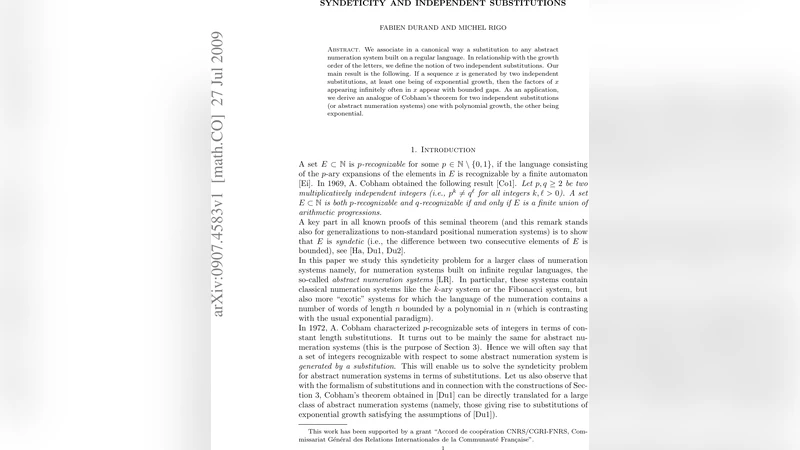
We associate in a canonical way a substitution to any abstract numeration system built on a regular language. In relationship with the growth order of the letters, we define the notion of two independent substitutions. Our main result is the following. If a sequence $x$ is generated by two independent substitutions, at least one being of exponential growth, then the factors of $x$ appearing infinitely often in $x$ appear with bounded gaps. As an application, we derive an analogue of Cobham’s theorem for two independent substitutions (or abstract numeration systems) one with polynomial growth, the other being exponential.
💡 Research Summary
The paper establishes a bridge between abstract numeration systems (ANS) built on regular languages and substitution dynamics. For any regular language L, the authors define a canonical substitution σL by ordering the words of L that begin with each letter a∈Σ and mapping a to the concatenation of those words. This construction preserves the combinatorial structure of L and yields a fixed point ωL = lim σLⁿ(a) that encodes the numeration system.
A central concept introduced is the growth order of a substitution. When σ is iterated, the length of σⁿ(a) grows either polynomially (Θ(n^k)) or exponentially (Θ(cⁿ)). Two substitutions σ₁ and σ₂ are called independent when their growth orders are coprime and at least one of them exhibits exponential growth while the other is polynomial.
The main theorem states: if an infinite word x is simultaneously generated by two independent substitutions, with one of them of exponential growth, then every factor that occurs infinitely often in x appears with bounded gaps; i.e., there exists a constant M such that the distance between consecutive occurrences of any such factor never exceeds M.
The proof proceeds by analysing the fixed points ω₁ and ω₂ of the two substitutions. Because of independence, the lengths of the blocks produced by σ₁ and σ₂ at the same iteration are comparable up to constant factors: exponential blocks dominate polynomial ones but never completely swallow them, and vice‑versa. Consequently, any factor that recurs infinitely often must be contained in the intersection of the block structures of ω₁ and ω₂. By constructing a finite transition graph that records how prefixes evolve under each substitution, the authors model the occurrence of a given factor as a state in a strongly connected Markov chain. Independence guarantees that the expected return time to this state is finite, which translates into a uniform bound on the gaps between occurrences.
An immediate corollary is a Cobham‑type theorem for ANS: if a language is recognizable both by a polynomial‑growth numeration system and by an exponential‑growth system, then the language is regular, and the associated infinite word is ultimately periodic (or, more generally, automatic). This extends the classical Cobham theorem—originally formulated for integer bases—to the broader setting of regular‑language numeration systems and substitution dynamics.
The paper also provides concrete examples (e.g., the Fibonacci substitution versus the Thue‑Morse substitution) to illustrate the necessity of the independence condition, discusses cases where both substitutions have polynomial growth (where the bounded‑gap property may fail), and outlines an algorithmic procedure for testing independence and for computing the gap bound when it exists.
Overall, the work deepens the connection between formal language theory, symbolic dynamics, and number representation. By introducing growth‑order based independence, it offers a new lens for studying the regularity and recurrence properties of sequences generated by multiple, possibly heterogeneous, substitution rules. This contributes both to the theoretical understanding of automatic sequences and to practical tools for analyzing combinatorial structures arising in computer science and dynamical systems.
Comments & Academic Discussion
Loading comments...
Leave a Comment