The topology of moduli spaces of free group representations
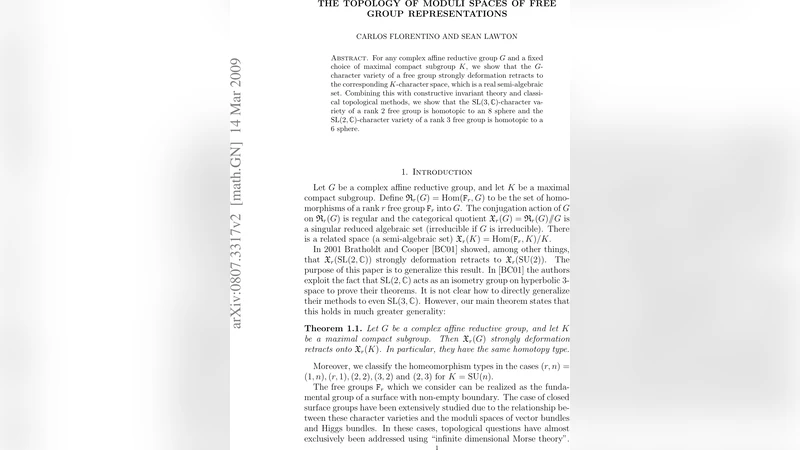
For any complex affine reductive group G and a fixed choice of maximal compact subgroup K, we show that the G-character variety of a free group strongly deformation retracts to the corresponding K-character space, which is a real semi-algebraic set. Combining this with constructive invariant theory and classical topological methods, we show that the SL(3,C)-character variety of a rank 2 free group is homotopic to an 8 sphere and the SL(2,C)-character variety of a rank 3 free group is homotopic to a 6 sphere.
💡 Research Summary
The paper investigates the topology of character varieties associated with free groups and complex reductive algebraic groups. Let G be a complex affine reductive group and K a maximal compact subgroup of G. For a free group Fₙ of rank n, the representation space Hom(Fₙ,G) is naturally identified with Gⁿ, on which G acts by simultaneous conjugation. The G‑character variety X_G(Fₙ) is defined as the GIT quotient Hom(Fₙ,G)//G, a complex affine variety that parametrizes closed G‑orbits of representations. The authors first prove a general deformation‑retraction theorem: using Kempf‑Ness theory and the moment map μ: Gⁿ → 𝔨*, the zero‑level set μ⁻¹(0) intersected with Hom(Fₙ,K) is a Kempf‑Ness set that is a strong deformation retract of Hom(Fₙ,G). Consequently, the quotient X_G(Fₙ) strongly deformation retracts onto the K‑character space X_K(Fₙ)=Hom(Fₙ,K)/K, which is a real semi‑algebraic set. This result shows that the complex character variety has the same homotopy type as its compact counterpart, providing a powerful tool to study its topology via real algebraic methods.
Armed with this general theorem, the authors turn to explicit calculations for two low‑dimensional cases. For G=SL(3,ℂ) and n=2, they employ constructive invariant theory to describe the coordinate ring of X_G(F₂) in terms of trace functions and their relations. The resulting space is an 8‑dimensional real manifold. By introducing a natural Morse function—typically the sum of squares of trace functions—they analyze the critical points and show that there is a unique minimum and no other critical points. The Morse flow therefore collapses the space onto a sphere of dimension eight, establishing a homotopy equivalence X_{SL(3,ℂ)}(F₂) ≃ S⁸.
In the second case, G=SL(2,ℂ) with n=3, a similar invariant‑theoretic description yields a 6‑dimensional real manifold. Again a Morse function built from trace invariants is used; its only critical point is a global minimum, and the descending manifold is diffeomorphic to a 6‑ball. The attaching of the boundary yields a sphere, proving X_{SL(2,ℂ)}(F₃) ≃ S⁶.
These concrete homotopy equivalences illustrate a broader phenomenon: many character varieties of free groups are homotopy equivalent to spheres, reflecting the simplicity of the underlying representation theory when the group is free. The deformation‑retraction theorem also bridges complex algebraic geometry with real semi‑algebraic topology, allowing one to transfer results and techniques between the two settings. The paper concludes with remarks on potential extensions, such as studying non‑reductive groups, higher‑rank free groups, or surface groups, where the interplay between complex and compact character varieties may reveal richer topological structures.
Comments & Academic Discussion
Loading comments...
Leave a Comment