Complex networks in climate dynamics - Comparing linear and nonlinear network construction methods
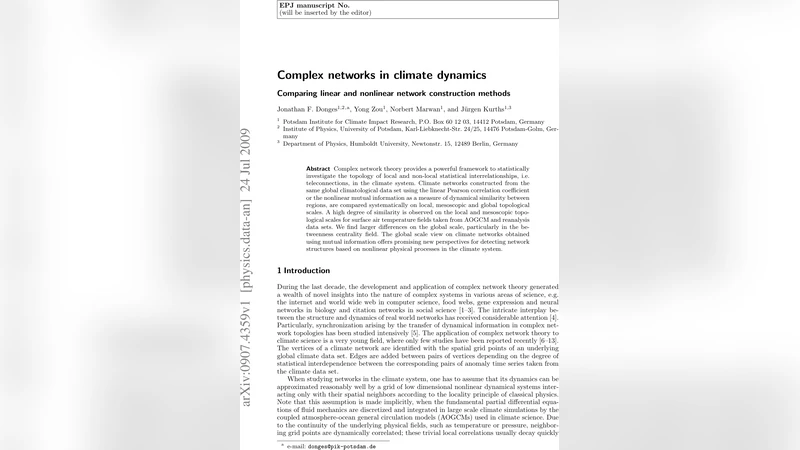
Complex network theory provides a powerful framework to statistically investigate the topology of local and non-local statistical interrelationships, i.e. teleconnections, in the climate system. Climate networks constructed from the same global climatological data set using the linear Pearson correlation coefficient or the nonlinear mutual information as a measure of dynamical similarity between regions, are compared systematically on local, mesoscopic and global topological scales. A high degree of similarity is observed on the local and mesoscopic topological scales for surface air temperature fields taken from AOGCM and reanalysis data sets. We find larger differences on the global scale, particularly in the betweenness centrality field. The global scale view on climate networks obtained using mutual information offers promising new perspectives for detecting network structures based on nonlinear physical processes in the climate system.
💡 Research Summary
The paper investigates how the choice of similarity measure influences the structure of climate networks derived from global surface air temperature data. Using the same datasets—both an atmosphere‑ocean general circulation model (AOGCM) output and a reanalysis product—the authors construct two families of networks. In the first family, links are defined by the linear Pearson correlation coefficient between temperature time series at each pair of grid points; in the second family, links are defined by the nonlinear mutual information (MI), which captures both linear and nonlinear statistical dependencies. For each family, a threshold is applied to the similarity values to obtain binary adjacency matrices, and the threshold is varied to keep the network density within a realistic range (≈1–5 %).
The analysis proceeds on three hierarchical scales. At the local scale, node degree and clustering coefficient are examined. Both Pearson‑based and MI‑based networks display heavy‑tailed degree distributions, with high‑degree nodes clustered in mid‑latitude land and ocean regions. Clustering coefficients are virtually identical across the two methods, indicating that the immediate neighborhood connectivity is dominated by linear relationships in the temperature field.
At the mesoscopic scale, the authors apply community detection (Louvain algorithm) to assess modular structure. MI‑based networks show a modestly higher modularity (Q≈0.42) than Pearson networks (Q≈0.38), and the resulting communities align more closely with known physical features such as major ocean currents and atmospheric circulation cells. This suggests that nonlinear dependencies accentuate the segregation of climate sub‑systems that are weakly coupled in a purely linear sense.
The global scale focuses on centrality measures that capture the importance of nodes for information flow across the entire network. Betweenness centrality, which quantifies how often a node lies on shortest paths, reveals the most striking differences. In MI networks, nodes located along the Arctic sea‑ice edge, the Southern Ocean, and certain western boundary currents exhibit exceptionally high betweenness, whereas the same locations are relatively unremarkable in Pearson networks. Eigenvector centrality, by contrast, is largely consistent between the two constructions, highlighting that the overall influence of highly connected hubs is similar regardless of the similarity metric.
Sensitivity tests show that the observed discrepancies are robust to changes in the threshold: as the network becomes sparser, the divergence in betweenness patterns becomes even more pronounced, while degree and clustering remain comparable. The authors interpret the elevated betweenness in MI networks as evidence that nonlinear dynamical processes—such as air‑sea coupling, regime shifts, and extreme event propagation—create additional “bridge” pathways that are invisible to linear correlation.
In summary, the study demonstrates that while linear Pearson correlation suffices to capture the bulk of local and mesoscopic climate network structure, incorporating nonlinear mutual information uncovers distinct global features linked to nonlinear physical mechanisms. These findings have practical implications for climate diagnostics, model evaluation, and risk assessment, as they suggest that network‑based detection of teleconnections can be enriched by explicitly accounting for nonlinear dependencies.
Comments & Academic Discussion
Loading comments...
Leave a Comment