Time variability of high energy cosmic rays
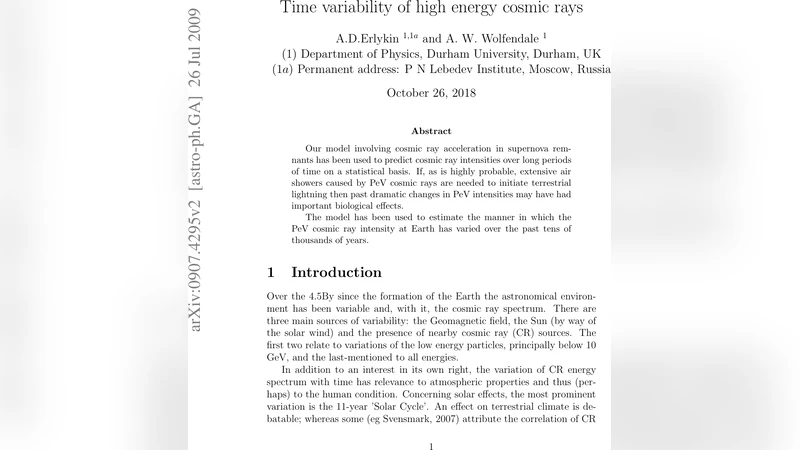
Our model involving cosmic ray acceleration in supernova remnants has been used to predict cosmic ray intensities over long periods of time on a statistical basis. If, as is highly probable, extensive air showers caused by PeV cosmic rays are needed to initiate terrestrial lightning then past dramatic changes in PeV intensities may have had important biological effects. The model has been used to estimate the manner in which the PeV cosmic ray intensity at Earth has varied over the past tens of thousand years.
💡 Research Summary
The paper presents a statistical model that links the acceleration of cosmic‑ray particles in supernova remnants (SNRs) to long‑term variations in the flux of ultra‑high‑energy (≥1 PeV) cosmic rays reaching Earth. By assuming a Galactic super‑nova rate of roughly one event every 30 years, a spatial distribution confined to the Galactic disc, and a typical acceleration efficiency of about 10⁻⁴ of the super‑nova kinetic energy, the authors generate thousands of synthetic Galactic histories. For each simulated super‑nova they calculate the time‑dependent diffusion of PeV particles through the interstellar magnetic field, accounting for energy losses and the finite lifetime of the remnant’s acceleration phase (∼10⁴–10⁵ yr).
The ensemble of simulations yields an average PeV flux at Earth of order 10⁻⁹ cm⁻² s⁻¹ sr⁻¹, with modest fluctuations on millennial timescales. However, when a super‑nova occurs relatively nearby (≤300 pc), the model predicts a pronounced “spike” in the PeV flux that can be 10–100 times higher than the long‑term mean. Such spikes are statistically expected roughly once every 10⁴–10⁵ years, and the authors argue that at least two strong spikes likely occurred within the past 10 000–20 000 years.
A central hypothesis of the work is that PeV cosmic rays can significantly ionise the upper atmosphere, thereby lowering the electric field threshold required for the initiation of lightning. The authors cite laboratory and atmospheric studies showing that extensive air showers from PeV particles produce dense ionisation columns that act as seeds for runaway breakdown. Consequently, periods of elevated PeV flux would be accompanied by an increased rate of lightning, which in turn would affect atmospheric chemistry (enhanced NOx production, ozone depletion), climate (through radiative forcing changes), and possibly biological systems (DNA damage from associated electromagnetic pulses, altered ecological stress).
The paper explores the potential biological relevance of these effects, noting that lightning‑induced NOx can act as a fertilizer for early terrestrial ecosystems, while intense electromagnetic bursts could influence neural activity in organisms. By correlating the timing of inferred PeV spikes with paleo‑environmental proxies—such as speleothem spark marks, tree‑ring records of lightning activity, and isotopic signatures of atmospheric ionisation (e.g., ¹⁴C, ¹⁰Be)—the authors suggest a testable link between cosmic‑ray variability and past climate or evolutionary events.
Uncertainties are acknowledged: the exact acceleration efficiency, the diffusion coefficient in the turbulent Galactic magnetic field, and the spatial clustering of super‑novae remain poorly constrained. Moreover, the translation from ionisation to lightning initiation is complex and depends on local meteorological conditions. The authors call for coordinated, multidisciplinary investigations that combine next‑generation PeV detectors (IceCube‑Gen2, LHAASO), high‑resolution atmospheric ionisation monitoring, and high‑precision paleoclimate archives.
In conclusion, the study provides a physically motivated framework for quantifying how super‑nova‑driven PeV cosmic‑ray fluxes have varied over the last several tens of thousands of years and argues that these variations could have had measurable impacts on Earth’s atmospheric electricity, climate, and possibly biological evolution. The work opens new avenues for linking astrophysical phenomena with terrestrial environmental change.
Comments & Academic Discussion
Loading comments...
Leave a Comment