Domination Problems in Nowhere-Dense Classes of Graphs
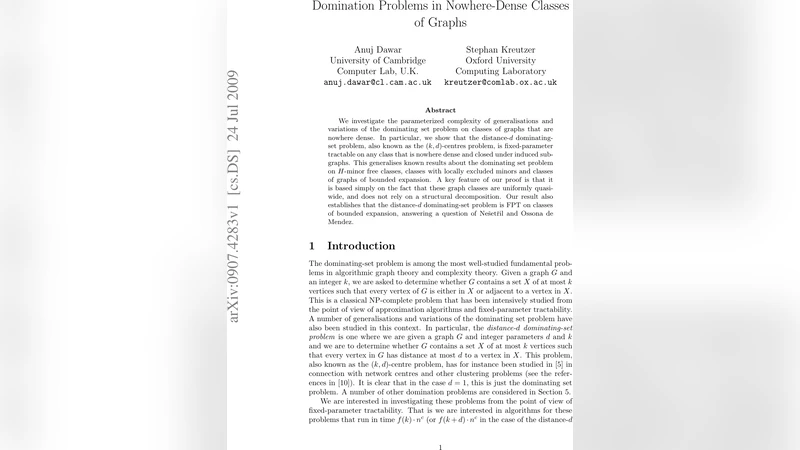
We investigate the parameterized complexity of generalisations and variations of the dominating set problem on classes of graphs that are nowhere dense. In particular, we show that the distance-d dominating-set problem, also known as the (k,d)-centres problem, is fixed-parameter tractable on any class that is nowhere dense and closed under induced subgraphs. This generalises known results about the dominating set problem on H-minor free classes, classes with locally excluded minors and classes of graphs of bounded expansion. A key feature of our proof is that it is based simply on the fact that these graph classes are uniformly quasi-wide, and does not rely on a structural decomposition. Our result also establishes that the distance-d dominating-set problem is FPT on classes of bounded expansion, answering a question of Ne{\v s}et{\v{r}}il and Ossona de Mendez.
💡 Research Summary
The paper investigates the parameterized complexity of domination‑type problems on nowhere‑dense graph classes, focusing on the distance‑d dominating set (also known as the (k,d)‑centers problem). The authors prove that this problem is fixed‑parameter tractable (FPT) on any class of graphs that is nowhere dense and closed under taking induced subgraphs. Their result subsumes earlier FPT algorithms for dominating set on H‑minor‑free graphs, classes with locally excluded minors, and bounded‑expansion graphs.
The core of the proof relies on the uniform quasi‑wide property of nowhere‑dense classes. A class is uniformly quasi‑wide if, for every radius r and integer s, there exists a function f(r,s) such that any sufficiently large graph G in the class contains a set S of at most s vertices whose removal leaves a subgraph where any r‑neighbourhood contains at most f(r,s) vertices. In other words, after deleting a small “separator” S, the remaining graph decomposes into many r‑scattered clusters of bounded size.
Using this property, the authors transform the distance‑d dominating set problem into a covering problem. For a candidate centre set C, each vertex v must be covered by some centre within distance d, i.e., N_d(v)∩C≠∅. By removing the quasi‑wide separator S, the graph splits into clusters that are far apart with respect to distance d. Within each cluster, the covering requirement can be expressed as a small set‑cover instance. The authors apply a Brönnimann‑Goodrich ε‑net construction to each cluster, which yields a constant‑size representative set that suffices to dominate the whole cluster.
The algorithm proceeds as follows:
- Compute a quasi‑wide separator S for the given radius d and a suitable parameter s (depending on k).
- Decompose G−S into d‑scattered clusters.
- For each cluster, enumerate all possible centre candidates and compute an ε‑net that guarantees domination of the cluster.
- Unite the ε‑nets from all clusters to obtain a global candidate set D′.
- If |D′|≤k, output D′; otherwise, perform a bounded‑depth branching search on the remaining vertices to achieve an exact solution.
The running time is f(k,d)·n^{O(1)}, where f depends only on the parameters k and d, and n is the number of vertices. Consequently, distance‑d dominating set is FPT on any nowhere‑dense class closed under induced subgraphs.
Because bounded‑expansion graphs are a subclass of nowhere‑dense graphs, the result immediately answers an open question of Nešetřil and Ossona de Mendez: the distance‑d dominating set problem is FPT on bounded‑expansion classes. Moreover, the same algorithm applies unchanged to H‑minor‑free graphs and to classes with locally excluded minors, providing a unified proof that does not require intricate structural decompositions such as tree‑decompositions or graph minors theory.
The paper concludes with several avenues for future work: (i) designing explicit, efficient procedures for finding the quasi‑wide separator S; (ii) extending the technique to other domination variants such as connected, independent, or total domination; (iii) empirical evaluation on real‑world sparse networks to assess practical performance. Overall, the work demonstrates that the uniform quasi‑wide property alone is sufficient to obtain powerful FPT algorithms for domination problems across a broad spectrum of sparse graph classes, thereby simplifying and generalizing many earlier results.
Comments & Academic Discussion
Loading comments...
Leave a Comment