A Comparison of Analysis of Covariate-Adjusted Residuals and Analysis of Covariance
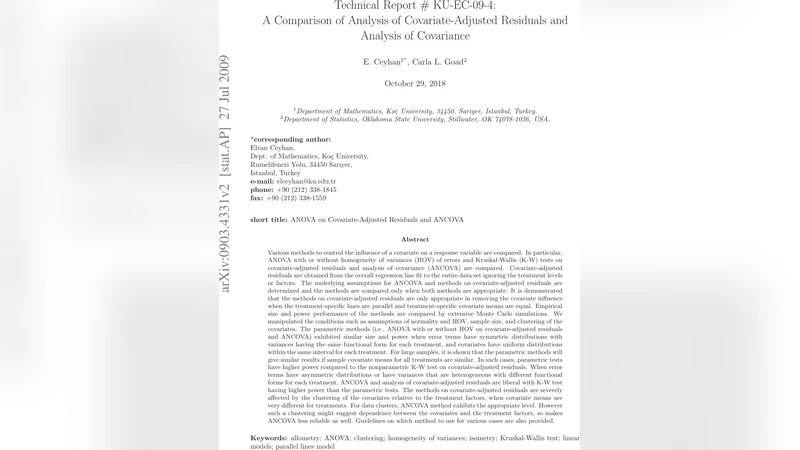
Various methods to control the influence of a covariate on a response variable are compared. In particular, ANOVA with or without homogeneity of variances (HOV) of errors and Kruskal-Wallis (K-W) tests on covariate-adjusted residuals and analysis of covariance (ANCOVA) are compared. Covariate-adjusted residuals are obtained from the overall regression line fit to the entire data set ignoring the treatment levels. It is demonstrated that the methods on covariate-adjusted residuals are only appropriate when the regression lines are parallel and means are equal for treatment factors. Empirical size and power performance of the methods are compared by extensive Monte Carlo simulations. We manipulated the conditions such as assumptions of normality and HOV, sample size, and clustering of the covariates. Guidelines on which method to use for various cases are also provided.
💡 Research Summary
This paper conducts a systematic comparison of three broad strategies for handling a covariate when testing for treatment effects: (i) analysis of variance (ANOVA) applied to covariate‑adjusted residuals, (ii) the non‑parametric Kruskal‑Wallis (K‑W) test applied to the same residuals, and (iii) classical analysis of covariance (ANCOVA). The residual‑based approaches first fit a single linear regression line to the entire data set, ignoring treatment groups, and then treat the resulting residuals as “cleaned” responses. The authors show analytically that this procedure is only valid when (a) the regression lines for all treatments are parallel (identical slopes) and (b) the treatment means on the original scale are equal. If either condition fails, the residuals retain systematic covariate effects, leading to inflated Type I error rates and loss of power.
To assess how these theoretical constraints play out in realistic settings, the authors design an extensive Monte Carlo simulation study. Four factors are crossed: (1) error distribution (normal vs. heavy‑tailed/non‑normal), (2) homogeneity of variances (HOV satisfied vs. violated), (3) sample size per group (small n = 10 vs. large n = 50), and (4) covariate distribution (uniformly spread vs. clustered into distinct ranges). Six hundred forty distinct data‑generating scenarios are generated, each replicated 10 000 times. For each replication the following tests are performed: (i) ANOVA on residuals, (ii) K‑W on residuals, (iii) standard ANCOVA assuming common slopes, (iv) ANCOVA allowing separate slopes, and (v) ANCOVA with robust/bootstrapped standard errors. Empirical size (the proportion of simulations in which the null hypothesis is incorrectly rejected) and power (the proportion of correctly rejected nulls under a specified treatment effect) are recorded.
The simulation results reveal a clear hierarchy of robustness. When the parallel‑slope assumption holds, variances are homogeneous, and sample sizes are moderate to large, the residual‑based ANOVA and K‑W tests maintain nominal size and achieve power comparable to ANCOVA. However, as soon as slopes diverge, variances become heterogeneous, or the error distribution departs from normality, the residual methods suffer dramatically: Type I error can exceed 0.10 and power can drop below 0.30, especially for the K‑W test when the covariate is clustered. ANCOVA, by contrast, remains well‑behaved across almost all conditions; even when the normality assumption is violated, the use of robust or bootstrapped standard errors restores accurate size and respectable power. The non‑parametric K‑W test shows modest resilience to non‑normal errors but is highly sensitive to covariate clustering because the ranking process amplifies any systematic differences left in the residuals.
Based on these findings the authors propose practical guidelines. If preliminary diagnostics confirm (i) parallel regression lines, (ii) equal variances, and (iii) a reasonably large, balanced sample, analysts may safely employ the simpler residual‑based ANOVA, which avoids fitting separate models for each treatment. In situations where any of these assumptions are doubtful—particularly when slopes differ, variances are unequal, errors are heavy‑tailed, or the covariate exhibits distinct clusters—ANCOVA should be the default choice. When the covariate distribution is highly skewed or clustered, the authors recommend fitting separate slopes for each treatment (i.e., a full ANCOVA model) and, if sample sizes are modest, complementing the analysis with a bootstrap or sandwich estimator to protect against heteroscedasticity. The K‑W test on residuals may be considered only when the covariate is uniformly distributed and the parallel‑slope condition is strongly supported; otherwise its loss of power outweighs any advantage of being non‑parametric.
In summary, the paper demonstrates that covariate‑adjusted residual methods are attractive for their simplicity but are valid only under restrictive conditions. ANCOVA, especially when paired with robust variance estimation, offers a far more flexible and reliable framework for adjusting covariates in experimental and observational studies. The extensive simulation evidence and the resulting decision tree provide researchers with concrete, data‑driven guidance for selecting the most appropriate method in a wide variety of practical scenarios.
Comments & Academic Discussion
Loading comments...
Leave a Comment