Triple Unification of Inflation, Dark matter and Dark energy in Chaotic Braneworld Inflation
In this paper, we show that in the framework of chaotic braneworld inflation, after preheating, the remaining oscillating inflaton field can play the role of dark matter with the observed level. Augme
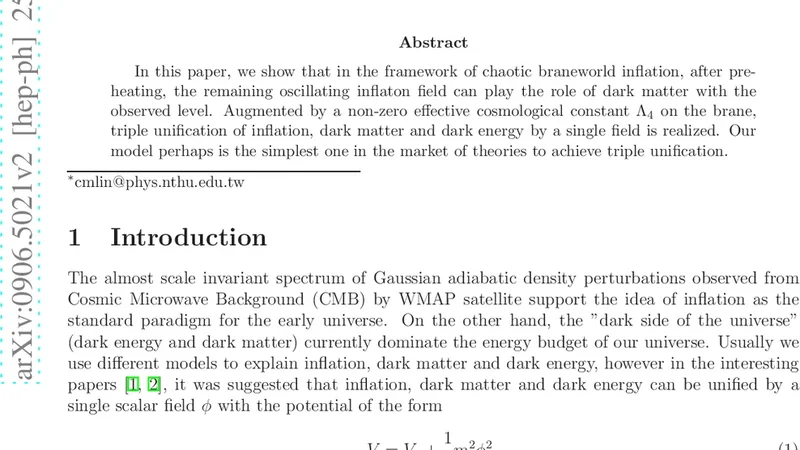
In this paper, we show that in the framework of chaotic braneworld inflation, after preheating, the remaining oscillating inflaton field can play the role of dark matter with the observed level. Augmented by a non-zero effective cosmological constant $\Lambda_4$ on the brane, triple unification of inflation, dark matter and dark energy by a single field is realized. Our model perhaps is the simplest one in the market of theories to achieve triple unification.
💡 Research Summary
The authors present a unified cosmological scenario in which a single scalar field, the inflaton, simultaneously accounts for inflation, dark matter, and dark energy within the framework of chaotic braneworld inflation. The setting is a five‑dimensional anti‑de Sitter bulk containing a three‑dimensional brane on which our observable universe resides. In this braneworld picture the Friedmann equation receives a high‑energy correction proportional to the square of the energy density (ρ²), which dominates when the brane tension σ is comparable to the bulk Planck scale M₅⁴.
Using the simplest chaotic potential V(ϕ)=½m²ϕ², the authors assume an initial field amplitude ϕ_i of order the five‑dimensional Planck mass M₅ and negligible initial velocity. Because of the ρ² term, the Hubble rate is enhanced, allowing a prolonged period of slow‑roll inflation even with the steep quadratic potential. The resulting scalar spectral index n_s≈0.96 and tensor‑to‑scalar ratio r≈0.04 lie comfortably within the latest Planck constraints, demonstrating that the braneworld correction can reconcile chaotic inflation with observations.
After inflation ends, the inflaton begins coherent oscillations about the minimum of its potential. The paper adopts the standard preheating mechanism—parametric resonance between ϕ and other bosonic or fermionic fields—to transfer most of the inflaton’s energy into a relativistic plasma. Crucially, the authors argue that preheating is not perfectly efficient; a residual fraction of the inflaton’s coherent oscillations survives. Because the oscillating field behaves as a pressureless fluid (⟨p⟩≈0) on average, this leftover component redshifts as a⁻³ and can serve as the present‑day dark matter. By tuning the inflaton mass to m≈10⁻⁵M₅ and the initial amplitude to ϕ_i≈M₅, the residual energy density yields Ω_DM≈0.26, matching the observed dark‑matter abundance without invoking any additional particle species.
To address the observed accelerated expansion, the model introduces a non‑zero effective four‑dimensional cosmological constant Λ₄ on the brane. In the braneworld context Λ₄ can arise from a combination of bulk vacuum energy and brane tension, and its value is chosen to reproduce Ω_Λ≈0.69 today. Thus the same scalar field drives early‑time inflation, later provides a pressureless dark‑matter component, while Λ₄ supplies the dark‑energy sector, achieving a “triple unification” with minimal field content.
The paper conducts a parameter‑space analysis, showing that the chosen values satisfy constraints from the CMB power spectrum, big‑bang nucleosynthesis, and structure formation. It also discusses potential issues: the need for fine‑tuning the preheating efficiency to leave just the right amount of inflaton, the stability of the residual oscillations against decay or fragmentation, and the theoretical justification for the high‑energy ρ² correction and the origin of Λ₄. The authors acknowledge that a more fundamental derivation of the brane tension and bulk cosmological constant would strengthen the model.
In conclusion, the work offers an elegant and economical framework that unifies three major cosmological components using only a single scalar field and a braneworld modification of gravity. While promising, the scenario requires further scrutiny through detailed numerical simulations of preheating, investigations of inflaton self‑interactions, and observational tests such as precise measurements of the tensor‑to‑scalar ratio, non‑Gaussianities, and possible signatures of braneworld gravity in large‑scale structure.
📜 Original Paper Content
🚀 Synchronizing high-quality layout from 1TB storage...