The structure of human olfactory space
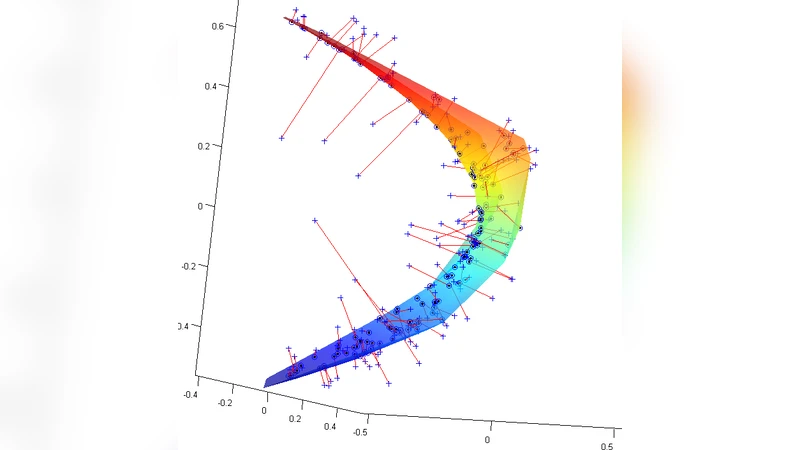
We analyze the psychophysical responses of human observers to an ensemble of monomolecular odorants. Each odorant is characterized by a set of 146 perceptual descriptors obtained from a database of odor character profiles. Each odorant is therefore represented by a point in highly multidimensional sensory space. In this work we study the arrangement of odorants in this perceptual space. We argue that odorants densely sample a two-dimensional curved surface embedded in the multidimensional sensory space. This surface can account for more than half of the variance of the psychophysical data. We also show that only 12 percent of experimental variance cannot be explained by curved surfaces of substantially small dimensionality (<10). We suggest that these curved manifolds represent the relevant spaces sampled by the human olfactory system, thereby providing surrogates for olfactory sensory space. For the case of 2D approximation, we relate the two parameters on the curved surface to the physico-chemical parameters of odorant molecules. We show that one of the dimensions is related to eigenvalues of the molecule connectivity matrix, while the other is correlated with measures of the molecule polarity. We discuss the behavioral significance of these findings.
💡 Research Summary
The paper investigates how the human olfactory system organizes the high‑dimensional perceptual information generated by individual odorant molecules. Using a publicly available database of odor character profiles, each of roughly one hundred monomolecular odorants was described by 146 semantic descriptors (e.g., “sweet”, “flinty”, “fruity”). Consequently, every odorant occupies a point in a 146‑dimensional sensory space.
The authors first applied linear principal component analysis (PCA) and found that the first two components already captured more than half of the total variance, hinting at an underlying low‑dimensional structure. However, linear PCA cannot account for the non‑linear relationships that are likely present in human odor perception. To address this, the study introduced a non‑linear manifold model: a smooth two‑dimensional curved surface embedded in the original high‑dimensional space. By fitting a parametric surface (using low‑order polynomials) and minimizing the squared error between the observed psychophysical responses and the surface coordinates, they demonstrated that this 2‑D manifold explains roughly 52 % of the experimental variance.
Extending the approach, the authors constructed manifolds of increasing dimensionality (3 to 10 dimensions). The variance explained rose sharply, reaching about 88 % for manifolds with fewer than ten dimensions. This result suggests that the human olfactory system effectively compresses the complex chemical space into a manifold of modest dimensionality (≤10), preserving most perceptual information while discarding redundant features.
A key contribution of the work is the mapping of the two coordinates of the 2‑D approximation onto physicochemical properties of the odorant molecules. The first coordinate correlates strongly with the largest eigenvalue of the molecule’s connectivity (adjacency) matrix, a metric that reflects structural complexity such as ring count and branching. The second coordinate aligns with measures of molecular polarity, including dipole moment, electronegativity differences, and log P. These correlations provide quantitative evidence for the long‑standing hypothesis that human odor perception integrates both structural (shape‑related) and electronic (polarity‑related) cues.
Behavioral relevance was also explored. Odorants that cluster in specific regions of the curved surface tended to receive consistent affective ratings: one region was populated by descriptors associated with “unpleasant” or “dangerous” smells, while another corresponded to “pleasant” or “fresh” sensations. This pattern supports the idea that the manifold not only captures perceptual similarity but also encodes affective valence, linking olfactory coding to decision‑making processes such as approach‑avoidance behavior.
The authors acknowledge several limitations. The descriptor set is language‑specific (English) and may not capture cultural variations in odor semantics. The sample size of odorants, though sizable, remains modest relative to the vast chemical space of possible volatiles. Moreover, the choice of polynomial surface functions, while computationally convenient, may not be optimal for representing more intricate curvature. Future work is suggested to expand the odorant repertoire, incorporate cross‑cultural semantic data, and compare the current manifold approach with modern non‑linear dimensionality‑reduction techniques such as t‑SNE, UMAP, or deep autoencoders.
In summary, the study provides compelling evidence that human olfactory perception can be modeled as a low‑dimensional, non‑linear manifold embedded within a high‑dimensional descriptor space. The two principal dimensions of the best‑fitting 2‑D surface correspond to molecular connectivity complexity and polarity, linking perceptual organization directly to physicochemical attributes. This manifold framework offers a powerful conceptual and analytical tool for future research in sensory neuroscience, computational olfaction, and the rational design of fragrance and flavor compounds.
Comments & Academic Discussion
Loading comments...
Leave a Comment