A note on the Penon definition of $n$-category
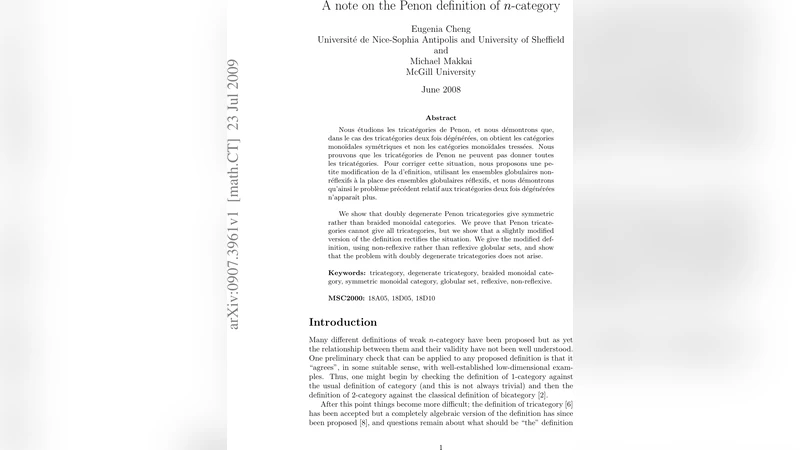
We show that doubly degenerate Penon tricategories give symmetric rather than braided monoidal categories. We prove that Penon tricategories cannot give all tricategories, but we show that a slightly modified version of the definition rectifies the situation. We give the modified definition, using non-reflexive rather than reflexive globular sets, and show that the problem with doubly degenerate tricategories does not arise.
💡 Research Summary
The paper investigates a subtle but important flaw in Penon’s original definition of weak n‑categories. Penon’s construction builds an n‑category on a reflexive globular set, i.e. a globular set equipped with distinguished identity cells at every dimension, and then freely adds the weak composition operations together with the required coherence cells. While this approach works well for many low‑dimensional examples, the authors show that it fails to capture the correct algebraic structure in the case of doubly degenerate tricategories—those in which the 0‑cells and 1‑cells each consist of a single object.
In the classical Penon setting, the presence of the reflexive identities forces the interchange (or braiding) 2‑cells to collapse: any braiding between two 2‑cells automatically becomes symmetric because the identities identify the two possible ways of swapping. Consequently, a doubly degenerate Penon tricategory yields a symmetric monoidal category rather than the expected braided monoidal category. The authors give a precise proof of this phenomenon by analysing the free construction on the reflexive globular set and showing that the coherence equations force the braiding to be its own inverse, which is exactly the definition of symmetry.
From this observation they deduce that Penon’s definition cannot be a model for all tricategories, because many tricategories (for instance those arising from non‑symmetric braided monoidal categories) would be excluded. The root cause is identified as the reflexivity condition: the mandatory identity cells at each level restrict the freedom of higher‑dimensional cells to express non‑trivial interchange.
To remedy the situation the authors propose a modified definition that replaces reflexive globular sets with non‑reflexive globular sets. In a non‑reflexive globular set the identity cells are not built‑in; instead they are generated freely together with the composition operations. This subtle change restores the ability to keep the braiding non‑symmetric while still preserving all the other weak‑category axioms. The paper spells out the new definition in detail:
- Underlying data – a plain globular set (no predetermined identities).
- Free weak operations – the same collection of composition, associativity, unit, and interchange operations as in Penon’s original construction, but now applied to the freely generated identities.
- Coherence cells – higher‑dimensional cells encoding the usual weak‑category equations, now formulated without the forced identification coming from reflexivity.
With this framework the authors revisit the doubly degenerate case. They construct the free tricategory on a non‑reflexive globular set with a single 0‑cell and a single 1‑cell, and they demonstrate that the resulting 2‑cell braiding is precisely the usual braiding of a braided monoidal category: it is invertible but not forced to be symmetric. Hence the modified definition recovers the expected braided monoidal structure.
The paper also verifies that the new definition does not break the existing results for Penon‑type categories. The authors show that the free construction still yields a left adjoint to the forgetful functor, that the coherence theorems continue to hold, and that the modification is conservative: any Penon‑category that already satisfies the non‑reflexive conditions is unchanged. They illustrate the theory with two concrete examples. The first example reproduces a symmetric monoidal category from the original Penon definition, confirming the identified problem. The second example builds a non‑symmetric braided monoidal category using the new definition, thereby demonstrating the added expressive power.
In conclusion, the paper makes three main contributions:
- It pinpoints a concrete failure of Penon’s original definition—namely, the forced symmetry in doubly degenerate tricategories.
- It provides a rigorous proof that this failure stems from the reflexive globular set framework.
- It proposes a minimal yet effective modification—adopting non‑reflexive globular sets—that restores the ability to model all tricategories, including those whose underlying monoidal structures are merely braided.
This work clarifies the landscape of algebraic definitions of higher categories, showing that the choice of underlying globular data is not a harmless technicality but a decisive factor in the expressive power of the theory. The modified definition is likely to become a standard reference point for future developments in weak higher‑category theory, especially in contexts where precise control over braiding and symmetry is essential.
Comments & Academic Discussion
Loading comments...
Leave a Comment