An approximation trichotomy for Boolean #CSP
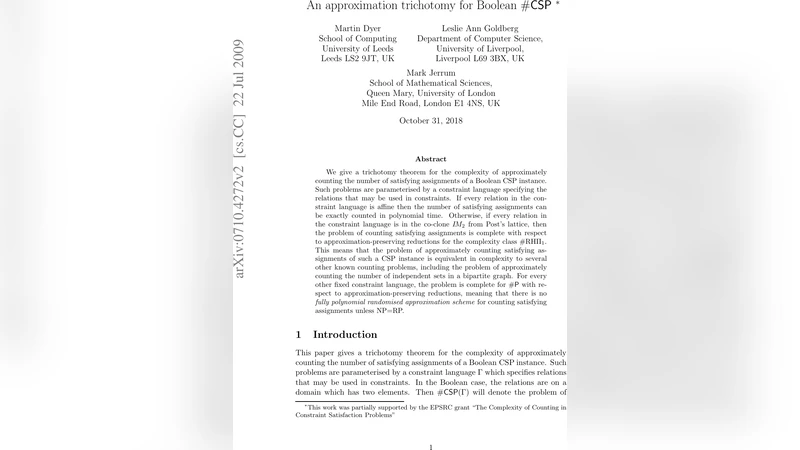
We give a trichotomy theorem for the complexity of approximately counting the number of satisfying assignments of a Boolean CSP instance. Such problems are parameterised by a constraint language specifying the relations that may be used in constraints. If every relation in the constraint language is affine then the number of satisfying assignments can be exactly counted in polynomial time. Otherwise, if every relation in the constraint language is in the co-clone IM_2 from Post’s lattice, then the problem of counting satisfying assignments is complete with respect to approximation-preserving reductions in the complexity class #RH\Pi_1. This means that the problem of approximately counting satisfying assignments of such a CSP instance is equivalent in complexity to several other known counting problems, including the problem of approximately counting the number of independent sets in a bipartite graph. For every other fixed constraint language, the problem is complete for #P with respect to approximation-preserving reductions, meaning that there is no fully polynomial randomised approximation scheme for counting satisfying assignments unless NP=RP.
💡 Research Summary
The paper establishes a complete trichotomy for the approximation complexity of counting satisfying assignments of Boolean constraint satisfaction problems (#CSP). A constraint language Γ, a fixed set of Boolean relations, determines the class #CSP(Γ) of counting problems. Building on the exact counting dichotomy of Creignou and Hermann (affine languages give polynomial‑time exact counting, otherwise #P‑complete), the authors investigate the finer question of approximate counting under the framework of approximation‑preserving (AP) reductions and fully polynomial‑time randomized approximation schemes (FPRAS).
The main theorem states that for any Boolean constraint language Γ exactly one of the following holds:
-
Affine case – Every relation in Γ is affine (i.e., the set of satisfying tuples forms a solution space of a system of linear equations over GF(2)). In this situation #CSP(Γ) is in FP; the exact count can be computed in polynomial time, and consequently an FPRAS trivially exists.
-
IM₂ case – Every relation in Γ belongs to the co‑clone IM₂, which consists of all relations definable as conjunctions of unary constants δ₀, δ₁ and the binary implication relation Implies(x,y) (equivalently x ∨ y). For such languages the problem #CSP(Γ) is AP‑equivalent to #BIS, the problem of approximately counting independent sets in a bipartite graph. #BIS is known to be complete for the class #RH Π₁ under AP‑reductions, a logically defined subclass of #P. Hence #CSP(Γ) lies in #RH Π₁ and inherits all known hardness results for #BIS (no FPRAS unless NP = RP).
-
General case – If Γ contains a relation that is neither affine nor in IM₂, then #CSP(Γ) is AP‑hard for #SAT (the problem of counting satisfying assignments of a Boolean formula). Since #SAT is #P‑complete and every #P problem AP‑reduces to #SAT, #CSP(Γ) is #P‑complete under AP‑reductions. Consequently, unless NP = RP, no FPRAS exists for such languages.
The proof combines several sophisticated tools:
- AP‑reduction machinery from the authors’ earlier work with Greenhill, allowing “pinning” of variables (forcing them to 0 or 1) within CSP instances while preserving approximation properties.
- Implementation results of Creignou, Khanna, and Sudan, which show how to construct the fundamental relations OR, NAND, and Implies from any non‑affine relation together with a unary constant. This enables reductions from arbitrary non‑affine languages to #SAT.
- Complexity class #RH Π₁, introduced in the earlier paper, captures exactly those counting problems AP‑interreducible with #BIS. The authors demonstrate that any Γ ⊆ IM₂ yields a problem in this class by reducing to the “down‑sets” counting problem, known to be AP‑equivalent to #BIS.
- Post’s lattice and co‑clones: IM₂ is identified as a co‑clone, and the inclusion relationships in Post’s lattice are used to argue that any language inside IM₂ can be expressed using only δ₀, δ₁, and Implies, which directly yields the AP‑reduction to #BIS.
The paper also provides a series of lemmas establishing basic reductions: #SAT ≤_AP #CSP({NAND}) and #CSP({OR}) ≤_AP #SAT, #BIS ≤_AP #CSP({Implies}), and that any #CSP(Γ) reduces to #SAT when Γ contains a non‑affine relation. Moreover, it shows that every #CSP(Γ) reduces to #SAT in general, confirming the upper bound of #P‑completeness.
Overall, the work delivers a clean, effective classification: affine languages give exact polynomial‑time counting, IM₂ languages are exactly as hard as #BIS (and thus sit in the intermediate class #RH Π₁), and all remaining languages are as hard as general #P counting. This trichotomy mirrors the classic Schaefer dichotomy for decision CSPs, extending it to the nuanced realm of approximate counting and providing a solid foundation for future investigations into higher‑arity domains or refined approximation hierarchies.
Comments & Academic Discussion
Loading comments...
Leave a Comment