The analysis of high-energy air shower data allows one to study the proton-air cross section at energies beyond the reach of fixed target and collider experiments. The mean depth of the first interaction point and its fluctuations are a measure of the proton-air particle production cross section. Since the first interaction point in air cannot be measured directly, various methods have been developed in the past to estimate the depth of the first interaction from air shower observables in combination with simulations. As the simulations depend on assumptions made for hadronic particle production at energies and phase space regions not accessible in accelerator experiments, the derived cross sections are subject to significant systematic uncertainties. The focus of this work is the development of an improved analysis technique that allows a significant reduction of the model dependence of the derived cross section at very high energy. Performing a detailed Monte Carlo study of the potential and the limitations of different measurement methods, we quantify the dependence of the measured cross section on the used hadronic interaction model. Based on these results, a general improvement to the analysis methods is proposed by introducing the actually derived cross section already in the simulation of reference showers. The reduction of the model dependence is demonstrated for one of the measurement methods.
Deep Dive into On the measurement of the proton-air cross section using air shower data.
The analysis of high-energy air shower data allows one to study the proton-air cross section at energies beyond the reach of fixed target and collider experiments. The mean depth of the first interaction point and its fluctuations are a measure of the proton-air particle production cross section. Since the first interaction point in air cannot be measured directly, various methods have been developed in the past to estimate the depth of the first interaction from air shower observables in combination with simulations. As the simulations depend on assumptions made for hadronic particle production at energies and phase space regions not accessible in accelerator experiments, the derived cross sections are subject to significant systematic uncertainties. The focus of this work is the development of an improved analysis technique that allows a significant reduction of the model dependence of the derived cross section at very high energy. Performing a detailed Monte Carlo study of the poten
The natural beam of cosmic ray particles extends to energies far beyond the reach of any Earth-based particle accelerator. Therefore cosmic ray data provide a unique window to study hadronic interaction phenomena at energies up to several Joules per particle, corresponding to an equivalent center-of-mass energy of up to 450 TeV.
On the other hand, direct observation of the first interaction of ultra-high energy cosmic rays in the upper atmosphere is impossible due to the very low flux of these particles. Only the cascades of secondary particles, called extensive air showers (EAS), can be measured with arrays of particle detectors or optical telescopes. To obtain information on the first interactions in an air shower it is necessary to link the measured air shower characteristics to that of high energy particle production in the shower. This can be done with detailed Monte Carlo simulations of the shower evolution and the corresponding shower observables, but inevitably causes a dependence of the results on hadronic interaction models needed for the shower description.
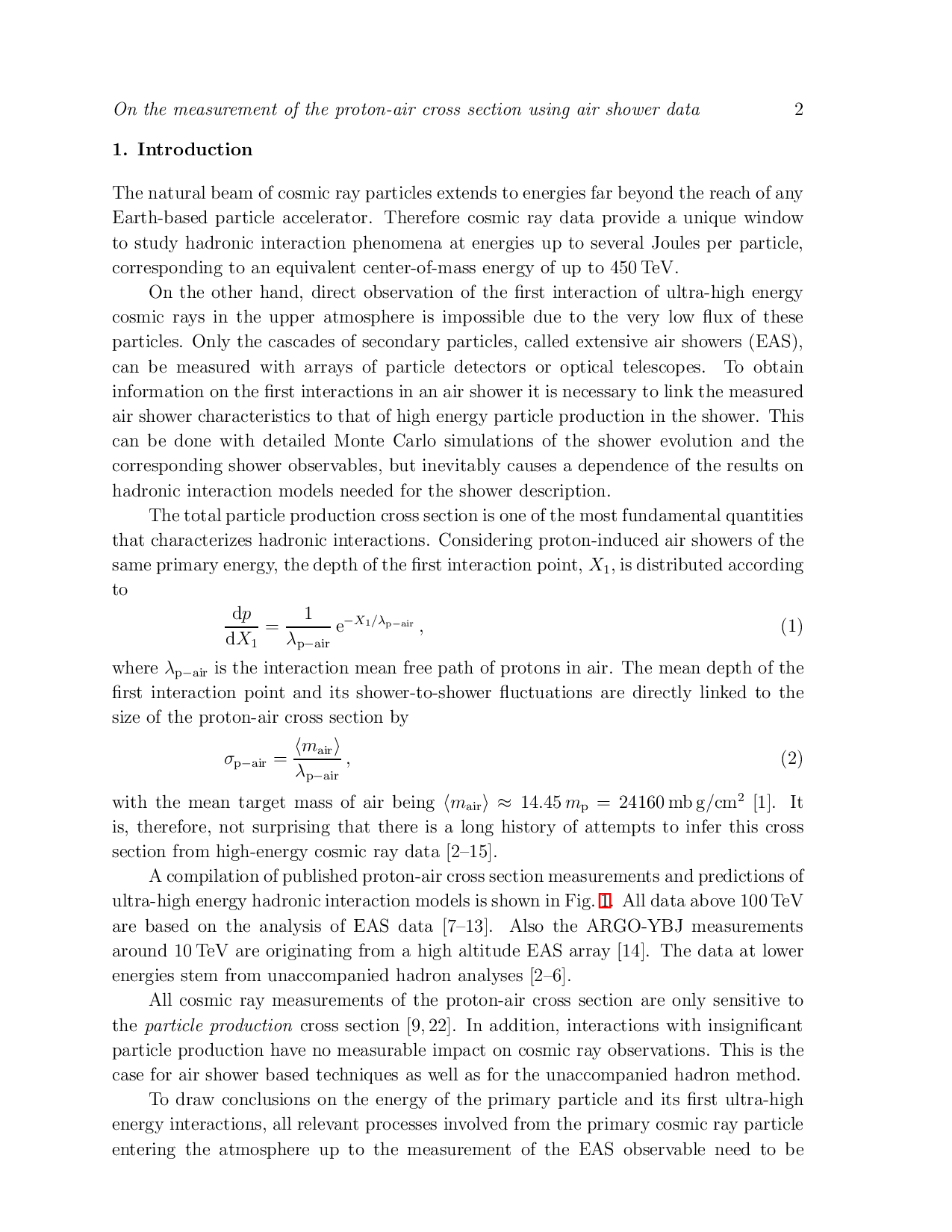
The total particle production cross section is one of the most fundamental quantities that characterizes hadronic interactions. Considering proton-induced air showers of the same primary energy, the depth of the first interaction point, X 1 , is distributed according to dp dX 1 = 1 λ p-air e -X 1 /λ p-air ,
where λ p-air is the interaction mean free path of protons in air. The mean depth of the first interaction point and its shower-to-shower fluctuations are directly linked to the size of the proton-air cross section by
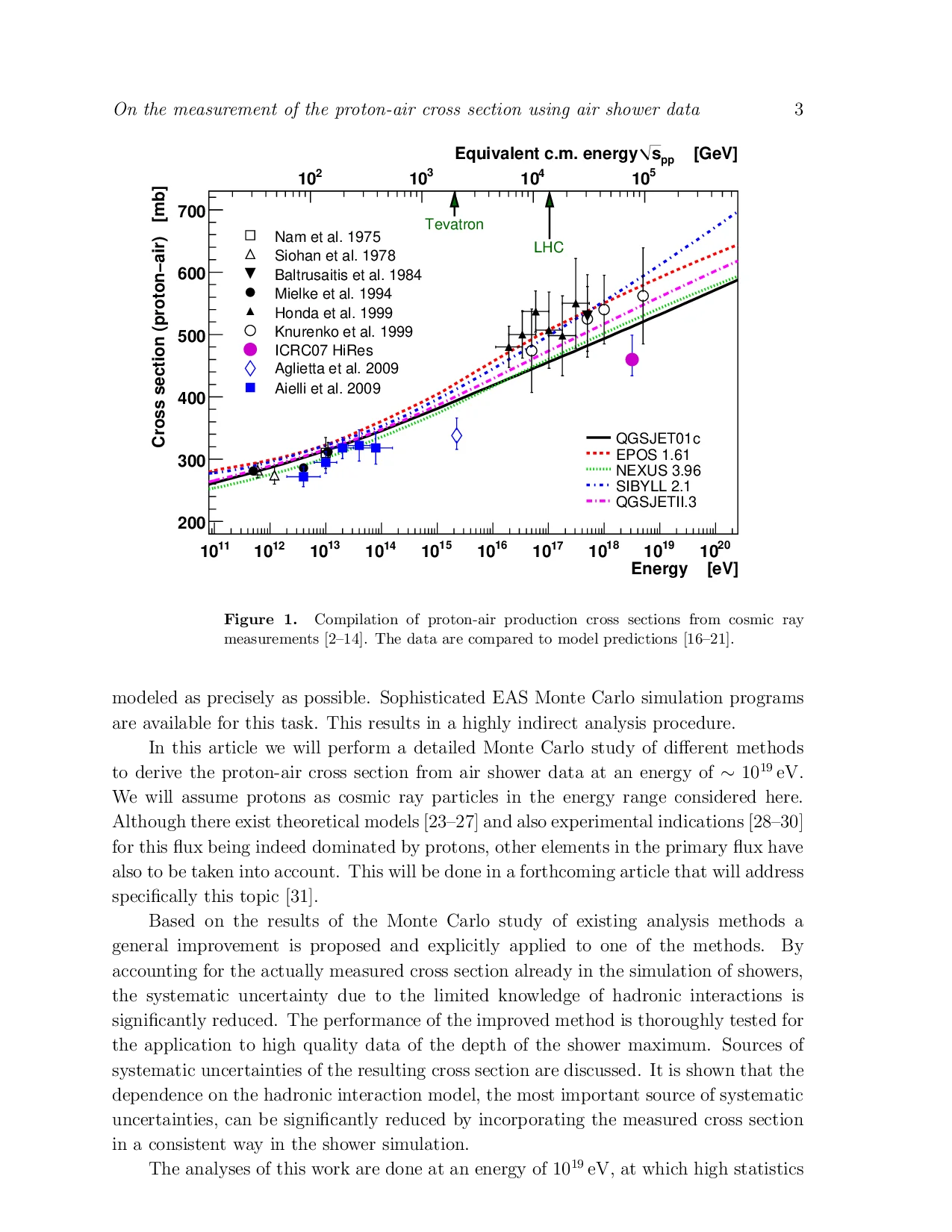
with the mean target mass of air being m air ≈ 14.45 m p = 24160 mb g/cm 2 [1]. It is, therefore, not surprising that there is a long history of attempts to infer this cross section from high-energy cosmic ray data [2][3][4][5][6][7][8][9][10][11][12][13][14][15]. A compilation of published proton-air cross section measurements and predictions of ultra-high energy hadronic interaction models is shown in Fig. 1. All data above 100 TeV are based on the analysis of EAS data [7][8][9][10][11][12][13]. Also the ARGO-YBJ measurements around 10 TeV are originating from a high altitude EAS array [14]. The data at lower energies stem from unaccompanied hadron analyses [2][3][4][5][6].
All cosmic ray measurements of the proton-air cross section are only sensitive to the particle production cross section [9,22]. In addition, interactions with insignificant particle production have no measurable impact on cosmic ray observations. This is the case for air shower based techniques as well as for the unaccompanied hadron method.
To draw conclusions on the energy of the primary particle and its first ultra-high energy interactions, all relevant processes involved from the primary cosmic ray particle entering the atmosphere up to the measurement of the EAS observable need to be 1. Compilation of proton-air production cross sections from cosmic ray measurements [2][3][4][5][6][7][8][9][10][11][12][13][14]. The data are compared to model predictions [16][17][18][19][20][21].
modeled as precisely as possible. Sophisticated EAS Monte Carlo simulation programs are available for this task. This results in a highly indirect analysis procedure.
In this article we will perform a detailed Monte Carlo study of different methods to derive the proton-air cross section from air shower data at an energy of ∼ 10 19 eV. We will assume protons as cosmic ray particles in the energy range considered here. Although there exist theoretical models [23][24][25][26][27] and also experimental indications [28][29][30] for this flux being indeed dominated by protons, other elements in the primary flux have also to be taken into account. This will be done in a forthcoming article that will address specifically this topic [31].
Based on the results of the Monte Carlo study of existing analysis methods a general improvement is proposed and explicitly applied to one of the methods. By accounting for the actually measured cross section already in the simulation of showers, the systematic uncertainty due to the limited knowledge of hadronic interactions is significantly reduced. The performance of the improved method is thoroughly tested for the application to high quality data of the depth of the shower maximum. Sources of systematic uncertainties of the resulting cross section are discussed. It is shown that the dependence on the hadronic interaction model, the most important source of systematic uncertainties, can be significantly reduced by incorporating the measured cross section in a consistent way in the shower simulation.
The analyses of this work are done at an energy of 10 19 eV, at which high statistics Definition of variables to characterize EAS longitudinal shower development. Zero slant depth is where the cosmic ray particle enters the atmosphere. The first interaction occurs at X 1 . At X max the shower reaches its maximum particle number N max . After
…(Full text truncated)…
This content is AI-processed based on ArXiv data.