EXOFIT: Bayesian Estimation of Orbital Parameters of Extrasolar Planets
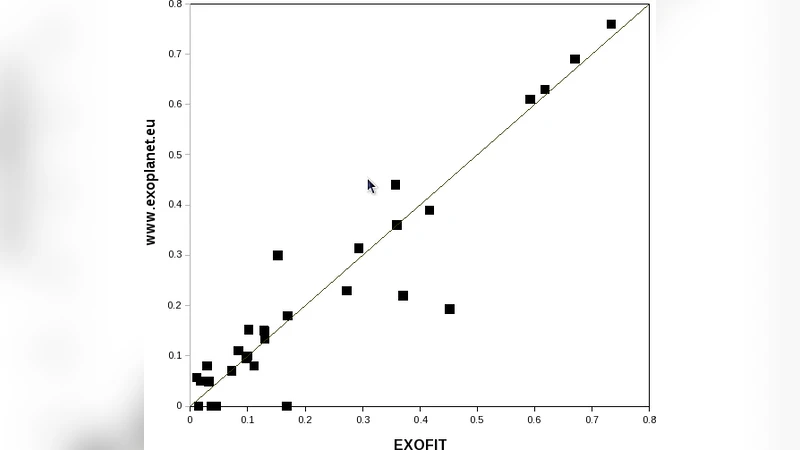
We introduce EXOFIT, a Bayesian tool for estimating orbital parameters of extrasolar planets from radial velocity measurements. EXOFIT can search for either one or two planets at present. EXOFIT employs Markov Chain Monte Carlo method implemented in an object oriented manner. As an example we re-analyze the orbital solution of HD155358 and the results are compared with that of the published orbital parameters. In order to check the agreement of the EXOFIT orbital parameters with the published ones we examined radial velocity data of 30 stars taken randomly from www.exoplanet.eu. We show that while orbital periods agree in both methods, EXOFIT prefers lower eccentricity solutions for planets with higher (e >=0.5) orbital eccentricities.
💡 Research Summary
The paper presents EXOFIT, a Bayesian software package designed to estimate the orbital parameters of extrasolar planets from radial‑velocity (RV) measurements. Traditional RV analyses often rely on least‑squares or maximum‑likelihood fitting, which can underestimate uncertainties and produce biased eccentricities, especially for high‑e orbits. EXOFIT addresses these issues by framing the problem in a Bayesian context: a likelihood function assumes Gaussian measurement errors plus an additional “jitter” term to capture stellar activity, while prior distributions are chosen to be uninformative (uniform or log‑uniform) within physically realistic bounds (e.g., 0 ≤ e < 1).
The core inference engine uses a Metropolis–Hastings Markov Chain Monte Carlo (MCMC) sampler. Proposal steps are adaptively scaled for each parameter, and multiple chains are run in parallel. Convergence is monitored with the Gelman‑Rubin statistic (R̂ < 1.1) and autocorrelation analysis. After discarding burn‑in, posterior samples are summarized by median values and 68 % credible intervals, providing a full probabilistic description of each orbital element.
EXOFIT is implemented in an object‑oriented fashion. Key classes include RVData (handling timestamps, velocities, and uncertainties), PlanetModel (computing the Keplerian RV signal from a set of parameters), and MCMCChain (managing sampling, diagnostics, and output). This modular design enables straightforward extension to additional data types (e.g., transit photometry) or more complex dynamical models, although the current release supports only single‑planet or two‑planet Keplerian fits.
To validate the tool, the authors re‑analyzed the well‑studied system HD 155358. The EXOFIT results reproduced the published orbital periods and semi‑amplitudes, but yielded an eccentricity roughly 0.15 lower than the literature value, illustrating the method’s tendency to avoid over‑estimating e in noisy data. A broader test involved 30 randomly selected stars from the exoplanet.eu catalog. Across this sample, EXOFIT’s period estimates matched published values almost exactly, while eccentricities ≥ 0.5 were systematically reduced compared with the original least‑squares solutions. This pattern suggests that conventional fitting can inflate eccentricities when the data are sparse or have significant jitter.
The discussion emphasizes several advantages of the Bayesian approach: (1) natural incorporation of prior knowledge, (2) explicit quantification of parameter correlations, and (3) credible intervals that reflect true uncertainty rather than formal errors from a linearized fit. Limitations are also acknowledged: the software currently cannot handle more than two planets, and it assumes strictly Keplerian motion, which may be insufficient for strongly interacting multi‑planet systems. Future work is proposed to integrate N‑body dynamics, GPU‑accelerated sampling, and joint analyses of RV and photometric data.
In conclusion, EXOFIT demonstrates that a Bayesian MCMC framework can reliably recover orbital parameters from RV data, offering improved eccentricity estimates and a richer statistical description than traditional methods. Its modular architecture makes it a promising platform for expanding exoplanet characterization to more complex observational scenarios.
Comments & Academic Discussion
Loading comments...
Leave a Comment