Common group dynamic drives modern epidemics across social, financial and biological domains
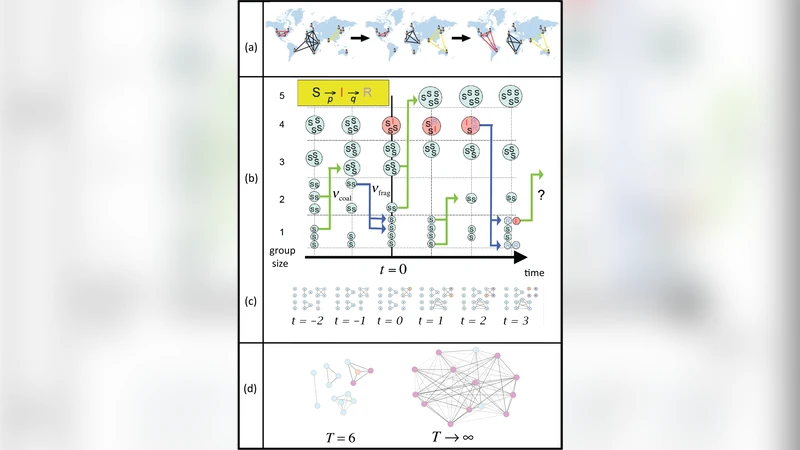
We show that qualitatively different epidemic-like processes from distinct societal domains (finance, social and commercial blockbusters, epidemiology) can be quantitatively understood using the same unifying conceptual framework taking into account the interplay between the timescales of the grouping and fragmentation of social groups together with typical epidemic transmission processes. Different domain-specific empirical infection profiles, featuring multiple resurgences and abnormal decay times, are reproduced simply by varying the timescales for group formation and individual transmission. Our model emphasizes the need to account for the dynamic evolution of multi-connected networks. Our results reveal a new minimally-invasive dynamical method for controlling such outbreaks, help fill a gap in existing epidemiological theory, and offer a new understanding of complex system response functions.
💡 Research Summary
The paper proposes a unified mathematical framework that can quantitatively describe epidemic‑like processes occurring in vastly different domains—financial market crashes, social‑media meme propagation, blockbuster product life cycles, and biological disease spread. The authors argue that traditional epidemiological models rely on static network structures and therefore fail to capture the recurrent surges, prolonged tails, and multi‑wave patterns frequently observed in real‑world data. To overcome this limitation, they introduce two time‑scale parameters: the group‑formation time (τ_f) and the group‑fragmentation time (τ_b). These parameters govern how quickly individuals aggregate into new clusters and how rapidly existing clusters dissolve, respectively.
In the model, the population is represented as a set of overlapping groups (multi‑connected network). Each individual may belong to several groups simultaneously, reflecting real social settings where people participate in work, family, online communities, etc. Within each group i, the infection dynamics follow a standard SIR formulation, but the transmission rate β is modulated by the current group size s_i and its internal connectivity κ_i (β ∝ s_i·κ_i). Recovery occurs at a constant rate γ. The stochastic evolution of group sizes follows a Markov process: new groups appear with an average rate τ_f⁻¹, and existing groups disintegrate with probability τ_b⁻¹, redistributing their members among other groups.
By varying τ_f and τ_b while keeping β and γ fixed, the authors reproduce a wide spectrum of empirical curves. For financial data, rapid group formation and slow fragmentation generate repeated bubbles and crashes. In Twitter hashtag data, alternating periods of fast regrouping (low τ_f) and moderate fragmentation (higher τ_b) produce an initial spike followed by several smaller resurgences. Blockbuster movie sales exhibit a primary peak and later “re‑release” peaks when marketing campaigns create fresh audience clusters. Epidemiological time series for influenza and COVID‑19 show that policy‑induced changes in social mixing (effectively increasing τ_f or decreasing τ_b) can flatten or delay subsequent waves.
Beyond explanation, the paper introduces a minimally invasive control strategy called “dynamic throttling.” Instead of removing nodes (individuals) from the network, the approach deliberately slows down group formation—e.g., by imposing limits on gathering sizes, restricting the creation of new online groups, or curbing high‑frequency trading. Simulations demonstrate that dynamic throttling achieves comparable or superior reduction in total infections while preserving a larger fraction of the underlying network connectivity, thereby reducing economic and social costs relative to classic node‑removal interventions.
Key contributions are: (1) a cross‑domain, time‑scale‑driven model that unifies disparate epidemic‑like phenomena; (2) evidence that the interplay between grouping and fragmentation timescales is the primary driver of multi‑wave dynamics and abnormal decay rates; (3) a practical, low‑cost control mechanism that leverages the same time‑scale parameters to mitigate outbreaks without heavy disruption. The work fills a gap in epidemiological theory by explicitly incorporating dynamic multi‑connected networks and offers a new lens for policymakers, financial regulators, marketers, and scientists to understand and manage complex contagion processes.
Comments & Academic Discussion
Loading comments...
Leave a Comment