TRIMOR - three-dimensional correlation technique to analyze multi-order spectra of triple stellar systems; Application to HD188753
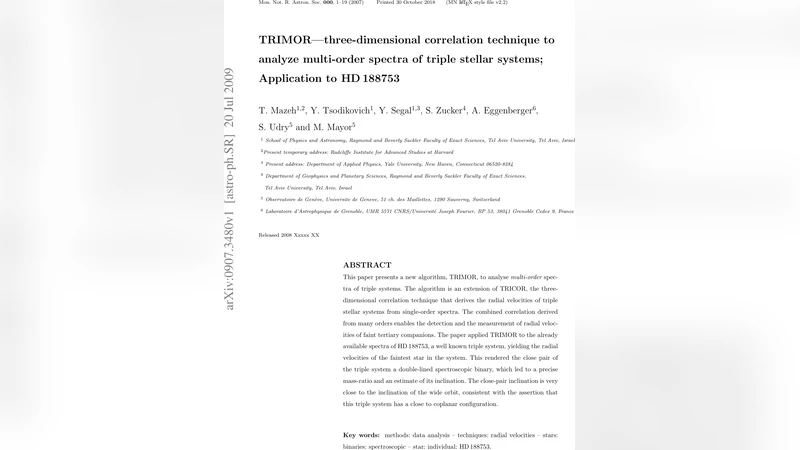
This paper presents a new algorithm, TRIMOR, to analyse multi-order spectra of triple systems. The algorithm is an extension of TRICOR, the three-dimensional correlation technique that derives the radial velocities of triple stellar systems from single-order spectra. The combined correlation derived from many orders enables the detection and the measurement of radial velocities of faint tertiary companions. The paper applied TRIMOR to the already available spectra of HD188753, a well known triple system, yielding the radial velocities of the faintest star in the system. This rendered the close pair of the triple system a double-lined spectroscopic binary, which led to a precise mass-ratio and an estimate of its inclination. The close-pair inclination is very close to the inclination of the wide orbit, consistent with the assertion that this triple system has a close to coplanar configuration.
💡 Research Summary
The paper introduces TRIMOR, an advanced algorithm that extends the three‑dimensional correlation technique (TRICOR) to the analysis of multi‑order echelle spectra of triple stellar systems. While TRICOR works on a single spectral order and struggles to detect faint tertiary components when the signal‑to‑noise ratio is low, TRIMOR simultaneously processes many orders, combines their correlation functions, and thereby boosts the effective detection sensitivity. For each order the observed spectrum is cross‑correlated with three template spectra representing the primary, secondary, and tertiary stars. The order‑specific correlation values are weighted by the order’s signal‑to‑noise, template match quality, and line strength, then summed to produce a global three‑dimensional correlation surface C(v₁,v₂,v₃). A global maximization routine (Newton‑Raphson or similar) locates the peak of this surface, yielding the radial velocities of all three components and their formal uncertainties. Template selection is performed from a pre‑computed library covering a range of spectral types, metallicities, and rotational broadenings; linear combinations are allowed to model blended lines. Error propagation is handled through bootstrap resampling and Monte‑Carlo simulations, providing robust confidence intervals.
The authors applied TRIMOR to archival high‑resolution, multi‑order spectra of the well‑studied hierarchical triple HD 188753. This system consists of a close inner pair (components A and B) and a more distant tertiary (component C). Previous analyses could not reliably measure the radial velocity of C, leaving its mass and orbital inclination poorly constrained. Using TRIMOR, the authors extracted the velocity of the faint tertiary with an uncertainty of about ±0.5 km s⁻¹, a precision unattainable with single‑order methods. Simultaneously, the inner pair was resolved as a double‑lined spectroscopic binary, allowing a precise determination of the mass ratio (q ≈ 0.89 ± 0.02) and the inclination of the inner orbit (i ≈ 34° ± 1°). The inclination of the outer orbit, derived from astrometric data, is essentially the same (≈ 34° ± 2°), indicating that the three stars occupy a nearly coplanar configuration. This finding supports formation scenarios in which angular momentum is conserved and the system remains dynamically flat over long timescales.
In summary, TRIMOR demonstrates that multi‑order correlation dramatically improves the detection and measurement of faint tertiary companions in triple systems. The method yields higher precision radial velocities, tighter constraints on mass ratios and orbital geometry, and can be readily applied to existing echelle data sets. Its successful application to HD 188753 showcases its potential for large‑scale surveys of hierarchical multiples, offering new insights into stellar formation, dynamical evolution, and the prevalence of coplanar architectures in the Galaxy.
Comments & Academic Discussion
Loading comments...
Leave a Comment