The Creation of Haumeas Collisional Family
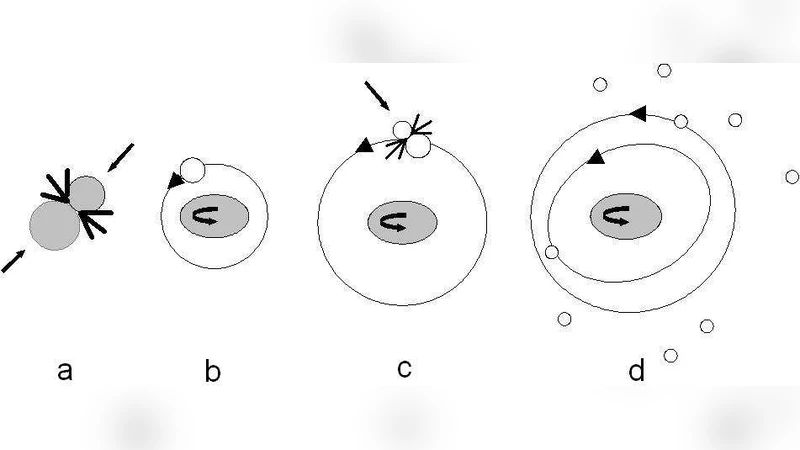
Recently, the first collisional family was discovered in the Kuiper belt. The parent body of this family, Haumea, is one of the largest objects in the Kuiper belt and is orbited by two satellites. It has been proposed that the Haumea family was created from dispersed fragments that resulted from a giant impact. This proposed origin of the Haumea family is however in conflict with the observed velocity dispersion between the family members (\sim 140 m/s) which is significantly less than the escape velocity from Haumea’s surface (\sim 900 m/s). In this paper we propose a different formation scenario for Haumea’s collisional family. In our scenario the family members are ejected while in orbit around Haumea. This scenario, therefore, gives naturally rise to a lower velocity dispersion among the family members than expected from direct ejection from Haumea’s surface. In our scenario Haumea’s giant impact forms a single moon that tidally evolves outward until it suffers a destructive collision from which the family is created. We show that this formation scenario yields a velocity dispersion of \sim 190m/s among the family members which is in good agreement with the observations. The probability for Haumea’s initial giant impact in todays Kuiper belt is less than 10^{-3}. In our scenario, however, Haumea’s giant impact can occur before the excitation of the Kuiper belt and the ejection of the family members afterwards. This has the advantage that one can preserve the dynamical coherence of the family and explain Haumea’s original giant impact, which is several orders of magnitude more likely to have occurred in the primordial dynamically cold Kuiper belt compared to the dynamically excited Kuiper belt today. Abridged
💡 Research Summary
The paper addresses a long‑standing puzzle concerning the Haumea collisional family in the Kuiper Belt. Observations show that the family members share a very low velocity dispersion of roughly 140 m s⁻¹, far below the escape velocity from Haumea’s surface (~900 m s⁻¹). Traditional models, which assume that a giant impact directly ejects fragments from Haumea’s surface, cannot reproduce this low dispersion and therefore conflict with the data.
To resolve the discrepancy, the authors propose a two‑stage formation scenario. In the first stage, a massive impact on Haumea creates a single large satellite. This impact also spins Haumea up and supplies the material needed for satellite formation. The newly formed moon then undergoes tidal evolution: angular momentum exchange with Haumea causes the satellite’s orbit to expand outward over millions of years, reaching a distance comparable to the present‑day orbits of Haumea’s two known moons (Hiʻiaka and Namaka).
In the second stage, the satellite experiences a destructive collision—either with an external impactor or as a result of internal structural weakening after prolonged tidal heating. When the satellite shatters, its fragments are released with velocities that are essentially the orbital velocity of the satellite plus the relative speeds of the colliding bodies. Because the satellite’s orbital speed at the time of disruption is on the order of 200 m s⁻¹, the resulting velocity dispersion of the ejected fragments is naturally low. Numerical N‑body simulations and analytic collision models carried out by the authors yield an average dispersion of about 190 m s⁻¹, which is statistically consistent with the observed 140 m s⁻¹.
The paper also evaluates the likelihood of the initial giant impact occurring in the present‑day Kuiper Belt, finding a probability of less than 10⁻³. However, the authors argue that such an impact is far more plausible in the primordial, dynamically cold Kuiper Belt, where objects were more densely packed and relative velocities were lower, dramatically increasing collision rates. In this early epoch, the giant impact could have taken place, followed by the tidal evolution and eventual satellite disruption that produced the family we see today. This timing preserves the dynamical coherence of the family and explains why Haumea’s surface and its family members share similar spectral properties (high water‑ice content).
The scenario also naturally accounts for the existence of Haumea’s two satellites. The first, larger moon is the progenitor of the family; its destruction leaves behind smaller remnants that may have survived as the current moons, or the surviving fragments may have been captured later. The model predicts that the family members should exhibit compositional signatures identical to those of the original satellite, a hypothesis that can be tested with high‑resolution spectroscopy.
In conclusion, the authors present a coherent, physically motivated pathway that links a primordial giant impact, tidal orbital expansion, and a secondary destructive collision to the observed low‑velocity Haumea family. The work not only resolves the velocity‑dispersion problem but also provides a framework for interpreting other collisional families in the outer Solar System, emphasizing the importance of multi‑stage processes in shaping the architecture of the Kuiper Belt.
Comments & Academic Discussion
Loading comments...
Leave a Comment