The Role of Planet Accretion in Creating the Next Generation of Red Giant Rapid Rotators
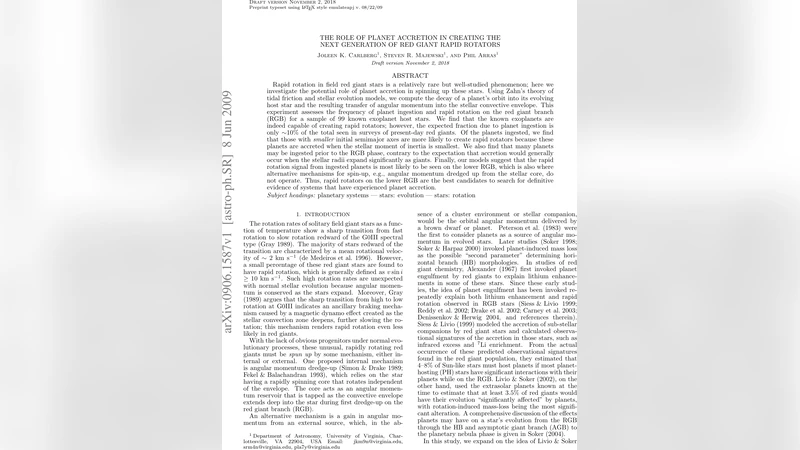
Rapid rotation in field red giant stars is a relatively rare but well-studied phenomenon; here we investigate the potential role of planet accretion in spinning up these stars. Using Zahn’s theory of tidal friction and stellar evolution models, we compute the decay of a planet’s orbit into its evolving host star and the resulting transfer of angular momentum into the stellar convective envelope. This experiment assesses the frequency of planet ingestion and rapid rotation on the red giant branch (RGB) for a sample of 99 known exoplanet host stars. We find that the known exoplanets are indeed capable of creating rapid rotators; however, the expected fraction due to planet ingestion is only ~10% of the total seen in surveys of present-day red giants. Of the planets ingested, we find that those with smaller initial semimajor axes are more likely to create rapid rotators because these planets are accreted when the stellar moment of inertia is smallest. We also find that many planets may be ingested prior to the RGB phase, contrary to the expectation that accretion would generally occur when the stellar radii expand significantly as giants. Finally, our models suggest that the rapid rotation signal from ingested planets is most likely to be seen on the lower RGB, which is also where alternative mechanisms for spin-up, e.g., angular momentum dredged up from the stellar core, do not operate. Thus, rapid rotators on the lower RGB are the best candidates to search for definitive evidence of systems that have experienced planet accretion.
💡 Research Summary
The paper investigates whether the ingestion of planets by evolving red‑giant stars can account for the observed population of rapidly rotating red giants. Using Zahn’s theory of tidal friction to model orbital decay and the MESA stellar evolution code to follow the structural changes of stars from the main sequence through the red‑giant branch (RGB), the authors compute how much angular momentum a planet can deliver to the convective envelope at the moment of engulfment. They apply this framework to a sample of 99 known exoplanet host stars, each with measured planetary mass, orbital radius, and stellar parameters.
Key methodological steps include: (1) calculating the tidal torque as a function of stellar radius, mass, and convective‑zone depth; (2) integrating the orbital decay equation to determine the time at which the planet’s orbit shrinks to the stellar surface; (3) evaluating the moment of inertia of the convective envelope (I_env) at that instant; and (4) comparing the planet’s angular momentum (L_p = M_p √(G M_* a)) with I_env to estimate the resulting increase in surface rotation. The authors also distinguish between planets that are engulfed during the main‑sequence phase, early RGB, or late RGB, noting that the effectiveness of spin‑up depends critically on the envelope’s moment of inertia, which is smallest at the base of the RGB.
The simulations reveal several important trends. First, only about 30 % of the planets in the sample are predicted to be engulfed while the host is on the RGB; the remainder are either consumed earlier (during the subgiant phase) or survive beyond the tip of the RGB. Second, of those engulfed on the RGB, roughly half impart enough angular momentum to raise the surface rotation above the empirical rapid‑rotator threshold (≈8–10 km s⁻¹). Consequently, planet ingestion can explain only ~10 % of the rapid rotators observed in field red‑giant surveys, implying that additional mechanisms—such as internal angular‑momentum transport from the core or binary interactions—must dominate the remainder.
A second salient result is that planets with small initial semi‑major axes (a ≲ 0.5 AU) are far more likely to generate rapid rotators because they are engulfed when the star’s envelope is compact and its moment of inertia is minimal. Conversely, planets on wider orbits are typically accreted later, when the stellar radius and I_env have grown, diluting the spin‑up effect. The authors also find that many planets are swallowed before the star reaches the tip of the RGB, contrary to the naive expectation that engulfment should occur only when the stellar radius expands dramatically.
The paper argues that the most promising observational window for detecting the signature of planet ingestion is the lower RGB, where internal angular‑momentum dredge‑up from the core is not yet active. In this regime, a rapid rotator is more likely to have been spun up by an external source. The authors suggest several diagnostic tests: (i) surface lithium enrichment, which can arise from the mixing of planetary material; (ii) altered carbon isotopic ratios (¹³C/¹²C) indicative of external pollution; and (iii) asteroseismic measurements of internal rotation profiles that could reveal a discrepancy between core‑driven and envelope‑driven spin‑up.
In summary, the study provides a rigorous quantitative assessment of planet‑induced spin‑up on the RGB, demonstrates that the mechanism can produce rapid rotators but only accounts for a minority of the observed population, and highlights the lower RGB as the optimal regime for searching for definitive chemical and seismic evidence of past planet engulfment. Future work should integrate planet ingestion with internal angular‑momentum transport models and pursue targeted observations of lower‑RGB rapid rotators to test the predictions presented here.
Comments & Academic Discussion
Loading comments...
Leave a Comment