Protoplanetary Disk Structures in Ophiuchus
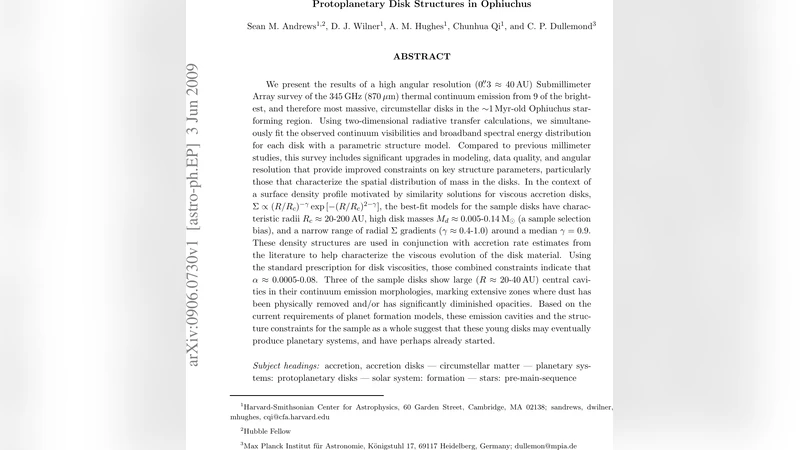
We present a high angular resolution (0.3" = 40 AU) SMA survey of the 870 micron thermal continuum emission from 9 of the brightest, and therefore most massive, circumstellar disks in the ~1 Myr-old Ophiuchus star-forming region. Using 2-D radiative transfer calculations, we simultaneously fit the observed continuum visibilities and broadband spectral energy distribution for each disk with a parametric structure model. Compared to previous millimeter studies, this survey includes significant upgrades in modeling, data quality, and angular resolution that provide improved constraints on key structure parameters, particularly those that characterize the spatial distribution of mass in the disks. In the context of a surface density profile motivated by similarity solutions for viscous accretion disks, the best-fit models for the sample disks have characteristic radii R_c = 20-200 AU, high disk masses M_d = 0.005-0.14 M_sun, and a narrow range of radial surface density gradients around a median $\gamma$ = 0.9. These density structures are used in conjunction with accretion rate estimates from the literature to help characterize the viscous evolution of the disk material. Using the standard prescription for disk viscosities, those combined constraints indicate that $\alpha$ = 0.0005-0.08. Three of the sample disks show large (R = 20-40 AU) central cavities in their continuum emission morphologies, marking extensive zones where dust has been physically removed and/or has significantly diminished opacities. Based on the current requirements of planet formation models, these emission cavities and the structure constraints for the sample as a whole suggest that these young disks may eventually produce planetary systems, and have perhaps already started. (abridged)
💡 Research Summary
This paper presents a high‑resolution (0.3″ ≈ 40 AU) Submillimeter Array (SMA) survey of the 870 µm thermal continuum emission from the nine brightest, and therefore most massive, circumstellar disks in the ~1 Myr‑old Ophiuchus star‑forming region. The authors selected these disks because their millimeter fluxes place them among the top ~10 % of the Ophiuchus disk population, ensuring sufficient signal‑to‑noise for detailed interferometric analysis. Observations were carried out with a compact + extended configuration, delivering a synthesized beam of 0.3″ and a typical rms noise of ≤1 mJy beam⁻¹. The data consist of calibrated visibilities in the uv‑plane and continuum images that reveal sub‑structure down to ∼20 AU scales.
To extract physical parameters, the authors employed a two‑dimensional radiative‑transfer framework (e.g., RADMC‑3D) that simultaneously fits the observed visibilities and the broadband spectral energy distribution (SED) from the optical to the millimeter regime. The disk surface density is parameterized using the similarity solution for a viscously evolving disk:
\
Comments & Academic Discussion
Loading comments...
Leave a Comment