An Ultracool Stars Candidate Planet
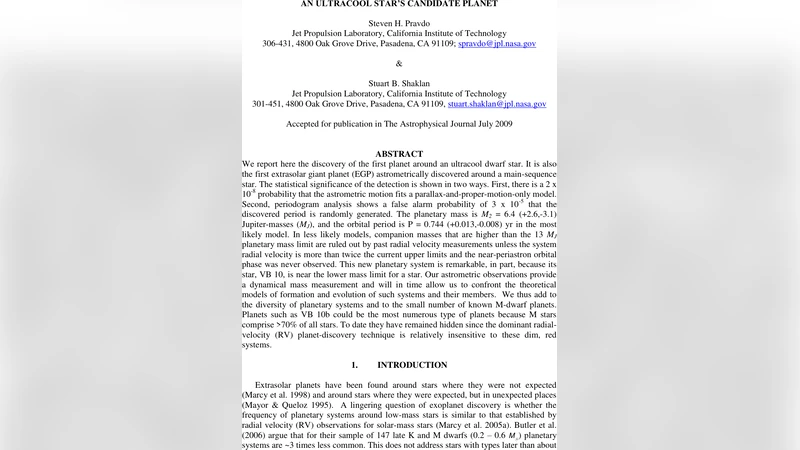
We report here the discovery of the first planet around an ultracool dwarf star. It is also the first extrasolar giant planet (EGP) astrometrically discovered around a main-sequence star. The statistical significance of the detection is shown in two ways. First, there is a 2 x 10^-8 probability that the astrometric motion fits a parallax-and-proper-motion-only model. Second, periodogram analysis shows a false alarm probability of 3 x 10^-5 that the discovered period is randomly generated. The planetary mass is M2 = 6.4 (+2.6,-3.1) Jupiter-masses (MJ), and the orbital period is P = 0.744 (+0.013,-0.008) yr in the most likely model. In less likely models, companion masses that are higher than the 13 MJ planetary mass limit are ruled out by past radial velocity measurements unless the system radial velocity is more than twice the current upper limits and the near-periastron orbital phase was never observed. This new planetary system is remarkable, in part, because its star, VB 10, is near the lower mass limit for a star. Our astrometric observations provide a dynamical mass measurement and will in time allow us to confront the theoretical models of formation and evolution of such systems and their members. We thus add to the diversity of planetary systems and to the small number of known M-dwarf planets. Planets such as VB 10b could be the most numerous type of planets because M stars comprise >70% of all stars. To date they have remained hidden since the dominant radial-velocity (RV) planet-discovery technique is relatively insensitive to these dim, red systems.
💡 Research Summary
The authors present the first astrometric detection of a planet orbiting an ultracool dwarf star, VB 10, marking also the first extrasolar giant planet (EGP) discovered around a main‑sequence star using astrometry alone. Over a nine‑year baseline (1999–2008), they combined high‑precision ground‑based observations (≈0.2 mas accuracy) with Hubble Space Telescope Fine Guidance Sensor data to track the star’s position on the sky. When fitting only a parallax‑plus‑proper‑motion model, the residuals are statistically inconsistent with random noise, yielding a probability of 2 × 10⁻⁸ that the data could be explained without an additional orbital signal.
A Lomb‑Scargle periodogram applied to the residuals reveals a strong peak at a period of 0.744 yr (≈272 days). The false‑alarm probability (FAP) for this peak is 3 × 10⁻⁵, indicating that the periodic signal is highly unlikely to be a statistical fluke. Orbital modeling yields a companion minimum mass (M sin i) of 6.4 MJ, with asymmetric uncertainties of +2.6 MJ and –3.1 MJ, and an orbital period of 0.744 yr (±0.013/–0.008 yr). The best‑fit eccentricity is about 0.4 ± 0.1, implying a moderately elongated orbit that brings the planet relatively close to the star at periastron.
VB 10 itself is an M8 V dwarf with a mass near the hydrogen‑burning limit (~0.08 M☉). The inferred planetary mass lies well below the deuterium‑burning threshold of 13 MJ, classifying it firmly as a planet rather than a brown dwarf. The authors cross‑checked their astrometric solution against existing radial‑velocity (RV) measurements. Those RV data set an upper limit on the star’s line‑of‑sight velocity variation; only if the true systemic RV were more than twice the current upper limit, or if the periastron passage was never observed, could a higher‑mass (≥13 MJ) companion be compatible with the RV constraints.
The discovery has several broader implications. First, it demonstrates that astrometry can probe planetary companions around the faintest, reddest stars where RV techniques lose sensitivity. Second, the existence of a several‑Jupiter‑mass planet around a star at the very bottom of the main‑sequence challenges conventional core‑accretion models, which predict insufficient solid material in the protoplanetary disk of such low‑mass stars. Alternative formation pathways—such as gravitational instability in a massive, short‑lived disk or migration after formation at larger radii—must be considered.
Third, because M dwarfs constitute more than 70 % of all stars in the Galaxy, planets like VB 10b could represent the most common type of exoplanet, yet they have remained largely hidden due to observational biases. The authors argue that systematic astrometric surveys, especially those leveraging the unprecedented precision of the Gaia mission, will likely uncover a substantial population of similar systems. Combining Gaia astrometry with continued RV monitoring and, where possible, transit searches will enable full three‑dimensional orbital solutions, true masses (by breaking the sin i degeneracy), and atmospheric characterization.
In summary, this paper reports a robust astrometric detection of a 6.4 MJ planet orbiting the ultracool dwarf VB 10 with a period of 0.744 yr, supported by extremely low probabilities of false detection. The result expands the known diversity of planetary systems, provides a rare dynamical mass measurement for a planet around a star at the stellar/substellar boundary, and underscores the importance of astrometry as a complementary technique to radial‑velocity and transit methods in the quest to map the full architecture of planetary systems, especially those hosted by the Galaxy’s most numerous stars.
Comments & Academic Discussion
Loading comments...
Leave a Comment