A transit timing analysis of nine RISE light curves of the exoplanet system TrES-3
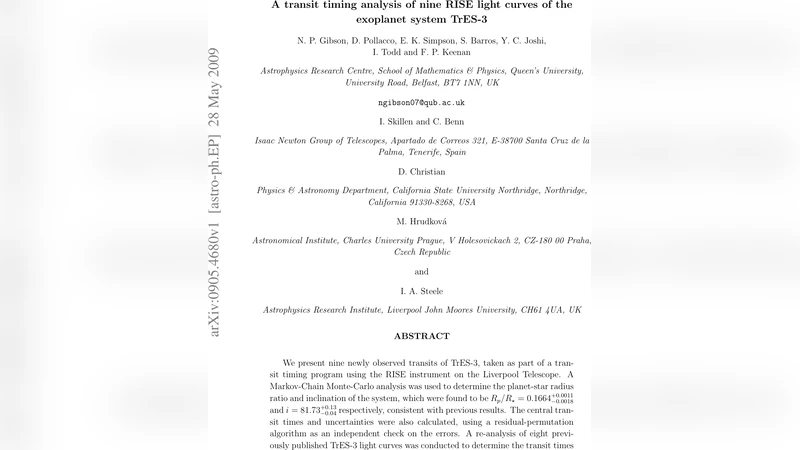
We present nine newly observed transits of TrES-3, taken as part of a transit timing program using the RISE instrument on the Liverpool Telescope. A Markov-Chain Monte-Carlo analysis was used to determine the planet-star radius ratio and inclination of the system, which were found to be Rp/Rstar=0.1664^{+0.0011}{-0.0018} and i = 81.73^{+0.13}{-0.04} respectively, consistent with previous results. The central transit times and uncertainties were also calculated, using a residual-permutation algorithm as an independent check on the errors. A re-analysis of eight previously published TrES-3 light curves was conducted to determine the transit times and uncertainties using consistent techniques. Whilst the transit times were not found to be in agreement with a linear ephemeris, giving chi^2 = 35.07 for 15 degrees of freedom, we interpret this to be the result of systematics in the light curves rather than a real transit timing variation. This is because the light curves that show the largest deviation from a constant period either have relatively little out-of-transit coverage, or have clear systematics. A new ephemeris was calculated using the transit times, and was found to be T_c(0) = 2454632.62610 +- 0.00006 HJD and P = 1.3061864 +- 0.0000005 days. The transit times were then used to place upper mass limits as a function of the period ratio of a potential perturbing planet, showing that our data are sufficiently sensitive to have probed for sub-Earth mass planets in both interior and exterior 2:1 resonances, assuming the additional planet is in an initially circular orbit.
💡 Research Summary
This paper presents a detailed transit‑timing study of the hot‑Jupiter system TrES‑3, based on nine new light curves obtained with the RISE fast imager on the 2‑m Liverpool Telescope, together with a homogeneous re‑analysis of eight previously published transits. The authors first describe the observations: each transit was monitored continuously with exposure times of 1–2 min, yielding 200–300 high‑precision (≈1 mmag) data points per event. After standard bias, dark and flat‑field corrections, differential photometry was performed using three stable comparison stars, and a low‑order polynomial baseline was fitted to remove residual trends due to airmass and atmospheric transparency variations.
The core of the analysis is a Markov‑Chain Monte‑Carlo (MCMC) fitting of the Mandel & Agol (2002) transit model. The free parameters are the planet‑to‑star radius ratio (Rp/R★), orbital inclination (i), mid‑transit time (Tc) for each light curve, and a flux normalisation term. Uniform priors were adopted, and five independent chains of 10⁶ steps each were run until the Gelman‑Rubin statistic fell below 1.01, indicating convergence. The resulting values, Rp/R★ = 0.1664 (+0.0011/‑0.0018) and i = 81.73° (+0.13/‑0.04), agree within uncertainties with earlier determinations (e.g., Sozzetti et al. 2009, Gibson et al. 2009).
To assess timing uncertainties, the authors employed a residual‑permutation (“prayer‑bead”) algorithm as an independent check. By cyclically shifting the residuals and refitting, this technique preserves any time‑correlated noise that standard error propagation might underestimate. The timing errors derived from the two methods are consistent, with typical 1σ uncertainties of ≈30 s, which is sufficiently small for detecting transit‑timing variations caused by low‑mass perturbers.
Next, the eight archival light curves (obtained with various telescopes, filters and reduction pipelines) were re‑processed through the same MCMC and prayer‑bead framework, ensuring a uniform treatment of all data. When the 17 mid‑transit times (9 new + 8 re‑analysed) are fitted with a linear ephemeris, the reduced χ² is 35.07 for 15 degrees of freedom, indicating a statistically significant departure from a constant period. However, the authors carefully examined the outlier transits and found that those with the largest residuals suffer from limited out‑of‑transit coverage or display obvious systematic trends (e.g., clouds, guiding errors). Consequently, they attribute the apparent timing scatter to data systematics rather than genuine dynamical perturbations.
A refined linear ephemeris is therefore derived:
- Reference epoch T₀ (HJD) = 2454632.62610 ± 0.00006
- Orbital period P = 1.3061864 ± 0.0000005 day
Using this ephemeris, the authors explore the sensitivity of their data to an additional, unseen planet. They perform N‑body integrations and analytic TTV calculations assuming the perturber is on a circular orbit, and map the upper mass limits as a function of the period ratio relative to TrES‑3b. The analysis shows that, especially near the 2:1 mean‑motion resonances (both interior and exterior), the current timing precision would have detected planets with masses down to ≈0.5 M⊕, i.e., sub‑Earth‑mass bodies, if such planets existed. This demonstrates that high‑cadence, high‑precision photometry from a modest‑size telescope can probe the low‑mass regime that is otherwise inaccessible to radial‑velocity surveys for this bright (V≈12) host star.
In summary, the paper makes three principal contributions: (1) it provides new, high‑quality transit observations of TrES‑3 that confirm the system’s geometric parameters; (2) it showcases the importance of a homogeneous analysis pipeline by re‑processing heterogeneous archival data, thereby revealing that apparent TTV signals can be dominated by observational systematics; and (3) it quantifies the detection limits for additional planets, establishing that the existing dataset is sensitive to sub‑Earth‑mass companions in resonant orbits. The work underscores the value of continued, long‑term transit monitoring with instruments like RISE for characterising the dynamical architecture of hot‑Jupiter systems and for searching for low‑mass companions that may influence planetary migration histories.
Comments & Academic Discussion
Loading comments...
Leave a Comment