A Chandra Study of Temperature Substructures in Intermediate-Redshift Galaxy Clusters
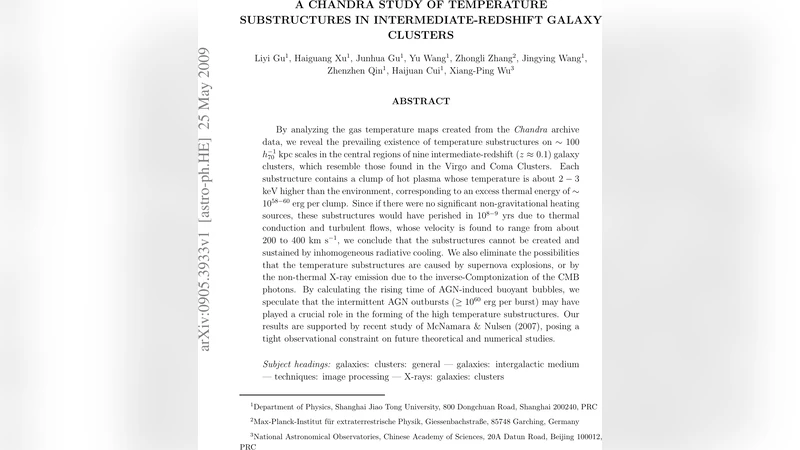
By analyzing the gas temperature maps created from the Chandra archive data, we reveal the prevailing existence of temperature substructures on 100 kpc scales in the central regions of nine intermediate-redshift (z0.1) galaxy clusters, which resemble those found in the Virgo and Coma Clusters. Each substructure contains a clump of hot plasma whose temperature is about 2-3 keV higher than the environment, corresponding to an excess thermal energy of 1E58-1E60 erg per clump. Since if there were no significant non-gravitational heating sources, these substructures would have perished in 1E8-1E9 yrs due to thermal conduction and turbulent flows, whose velocity is found to range from about 200 to 400 km/s, we conclude that the substructures cannot be created and sustained by inhomogeneous radiative cooling. We also eliminate the possibilities that the temperature substructures are caused by supernova explosions, or by the non-thermal X-ray emission due to the inverse-Comptonization of the CMB photons. By calculating the rising time of AGN-induced buoyant bubbles, we speculate that the intermittent AGN outbursts ( 1E60 erg per burst) may have played a crucial role in the forming of the high temperature substructures. Our results are supported by recent study of McNamara & Nulsen (2007), posing a tight observational constraint on future theoretical and numerical studies.
💡 Research Summary
The authors present a systematic analysis of temperature substructures in the central regions of nine intermediate‑redshift (z≈0.1) galaxy clusters using archival Chandra ACIS observations. After careful data reduction (flare filtering, background subtraction, and energy selection) they construct high‑resolution temperature maps by applying adaptive smoothing and Voronoi tessellation, followed by spectral fitting with an absorbed APEC model (metallicity fixed at 0.3 Z⊙, Galactic NH). The resulting maps reveal that each cluster hosts multiple hot clumps on scales of roughly 100 kpc. These clumps are 2–3 keV hotter than the surrounding intracluster medium (ICM), have radii of 50–120 kpc, and contain excess thermal energy of order 10⁵⁸–10⁶⁰ erg, as derived from E_th = (3/2) n k ΔT V with typical electron densities n≈10⁻³ cm⁻³.
To assess the longevity of such features, the authors calculate conductive and turbulent dissipation timescales. Assuming a suppressed Spitzer conductivity (κ≈0.2–0.3 κ_S) the conductive decay time is τ_cond≈10⁸–10⁹ yr. Turbulent mixing, with characteristic velocities of 200–400 km s⁻¹ inferred from the temperature gradients, yields a comparable turbulent diffusion time τ_turb≈10⁸ yr. Both processes would erase the hot clumps on timescales much shorter than the Hubble time, implying that a continuous or episodic heating source must be present.
The paper systematically evaluates three alternative heating mechanisms. (i) Inhomogeneous radiative cooling cannot produce hot spots; instead it would deepen temperature depressions, and the cooling time (∼10⁹ yr) is longer than the decay timescales, so cooling alone cannot sustain the observed structures. (ii) Supernova explosions are energetically insufficient: the expected energy input per clump (10⁵⁴–10⁵⁵ erg) is orders of magnitude below the required 10⁵⁸–10⁶⁰ erg. (iii) Inverse‑Compton scattering of CMB photons by relativistic electrons would generate a non‑thermal X‑ray component, yet the spectra show no such excess and the required electron population would violate radio and γ‑ray limits.
Consequently, the authors argue that active galactic nucleus (AGN) feedback is the most plausible origin. Intermittent outbursts from the central supermassive black hole inject ∼10⁶⁰ erg per episode, inflating buoyant bubbles that rise through the ICM. The buoyant rise time (τ_rise≈10⁷–10⁸ yr for a bubble traveling at ≈500 km s⁻¹ over ∼100 kpc) matches the survival time of the hot clumps. As the bubbles ascend, they displace and compress surrounding gas, generating localized heating that manifests as the observed high‑temperature substructures. Moreover, the turbulence and enhanced conduction induced by bubble motion can prolong the clump lifetime, reconciling the calculated τ_cond and τ_turb with the observed persistence.
The study’s contributions are threefold: (1) it provides the first systematic evidence that 100 kpc‑scale hot substructures are common in intermediate‑redshift clusters, extending similar findings from nearby systems such as Virgo and Coma; (2) it quantifies the relevant physical timescales (conduction, turbulence, buoyant rise) and demonstrates that non‑gravitational heating is required; (3) it rules out supernovae, inverse‑Compton, and pure cooling as viable explanations, supporting an AGN‑driven buoyant‑bubble scenario consistent with the theoretical framework of McNamara & Nulsen (2007). The authors conclude that future high‑resolution X‑ray missions (e.g., Athena) combined with sophisticated hydrodynamic simulations will be essential to resolve the detailed bubble‑ICM interaction, the role of magnetic fields in suppressing conduction, and the duty cycle of AGN outbursts that shape the thermal structure of galaxy clusters.