Alien Maps of an Ocean-Bearing World
[Abridged] To simulate the kinds of observations that will eventually be obtained for exoplanets, the Deep Impact spacecraft obtained light curves of Earth at seven wavebands spanning 300-1000 nm as part of the EPOXI mission of opportunity. In this paper we analyze disc-integrated light curves, treating Earth as if it were an exoplanet, to determine if we can detect the presence of oceans and continents. We present two observations each spanning one day, taken at gibbous phases. The rotation of the planet leads to diurnal albedo variations of 15-30%, with the largest relative changes occuring at the reddest wavelengths. To characterize these variations in an unbiased manner we carry out a principal component analysis of the multi-band light curves; this analysis reveals that 98% of the diurnal color changes of Earth are due to only 2 dominant eigencolors. We use the time-variations of these two eigencolors to construct longitudinal maps of the Earth, treating it as a non-uniform Lambert sphere. We find that the spectral and spatial distributions of the eigencolors correspond to cloud-free continents and oceans; this despite the fact that our observations were taken on days with typical cloud cover. We also find that the near-infrared wavebands are particularly useful in distinguishing between land and water. Based on this experiment we conclude that it should be possible to infer the existence of water oceans on exoplanets with time-resolved broadband observations taken by a large space-based coronagraphic telescope.
💡 Research Summary
The paper presents a proof‑of‑concept experiment that treats Earth as an exoplanet and asks whether broadband, time‑resolved photometry can reveal the presence of oceans and continents. Using the Deep Impact spacecraft during its EPOXI mission, the authors obtained disk‑integrated light curves of Earth at seven wavelength bands spanning 300–1000 nm. Two separate observing runs each covered a full Earth rotation and were taken at gibbous phase, mimicking the illumination geometry expected for directly imaged exoplanets.
The raw light curves show diurnal albedo variations of 15–30 % that are wavelength‑dependent, with the largest relative changes occurring in the reddest bands. To extract the underlying physical drivers without bias, the authors performed a principal component analysis (PCA) on the multi‑band time series. Remarkably, the first two principal components (eigencolors) account for 98 % of the total variance, indicating that essentially all of Earth’s diurnal color changes can be described by two dominant spectral patterns. The first eigencolor is strongest in the blue–green region and corresponds to the high reflectance of cloud‑free ocean surfaces. The second eigencolor peaks in the red–near‑infrared and captures the spectral signature of land (soil, vegetation, desert).
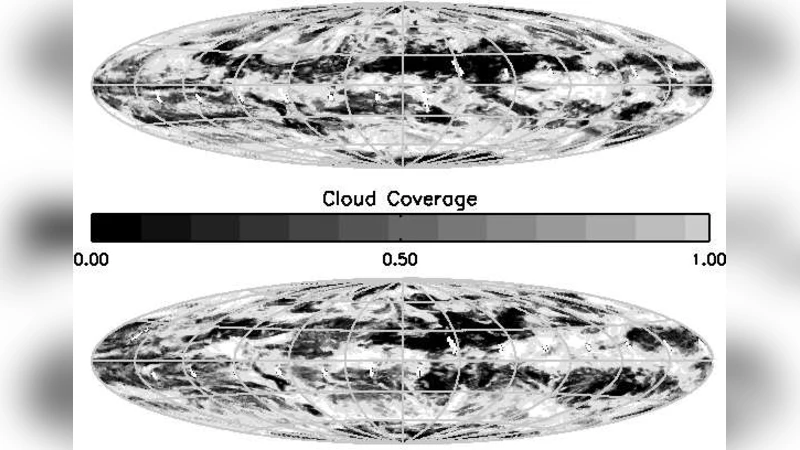
Having isolated these two time‑varying spectral signatures, the authors then inverted the light curves to produce longitudinal maps. They assumed Earth behaves as a non‑uniform Lambert sphere and used spherical harmonic decomposition to retrieve the longitudinal distribution of each eigencolor. The resulting maps reproduce the real distribution of continents and oceans with surprising fidelity, even though the observations were taken on days with typical (~50 %) cloud cover. Cloud variability, while reducing the absolute amplitude of the signal, does not erase the distinct spectral contrast between water and land, especially in the near‑infrared where water is dark and land is relatively bright.
Key methodological insights include: (1) broadband, time‑resolved photometry contains sufficient information to separate surface types; (2) PCA efficiently compresses multi‑band variability into a small number of physically interpretable components; (3) the near‑infrared bands (≈700–1000 nm) are particularly powerful for discriminating water from land because of their contrasting albedos; and (4) a simple Lambertian model, despite its limitations, provides a workable first‑order inversion framework for mapping.
The authors conclude that a future large space‑based coronagraphic telescope (e.g., LUVOIR or HabEx) equipped with multi‑band photometric capability could detect the spectral fingerprints of oceans on Earth‑like exoplanets by monitoring rotational brightness variations. Further work will need to incorporate more realistic scattering phase functions, dynamic cloud modeling, and higher‑order surface heterogeneities, but this study demonstrates that the essential signal—two dominant eigencolors linked to water and land—is robust against realistic cloud cover. Consequently, time‑resolved broadband observations represent a viable pathway toward identifying habitable worlds with surface liquid water beyond the Solar System.
Comments & Academic Discussion
Loading comments...
Leave a Comment