EUV Observational consequences of the spatial localisation of nanoflare heating within a multi-stranded atmospheric loop
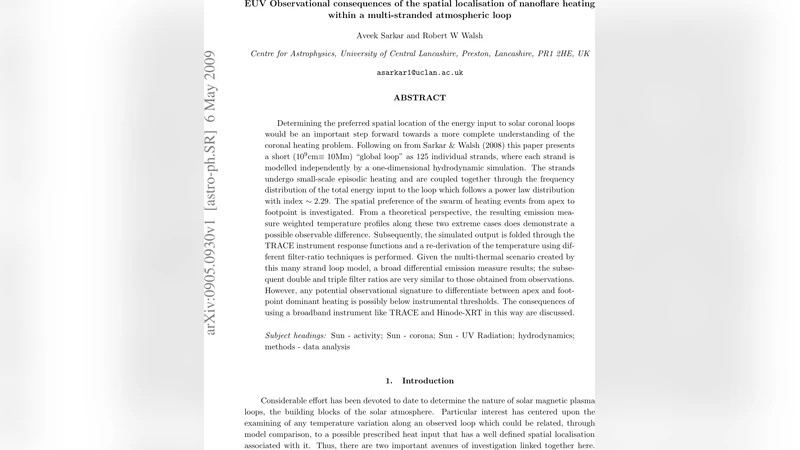
Determining the preferred spatial location of the energy input to solar coronal loops would be an important step forward towards a more complete understanding of the coronal heating problem. Following on from Sarkar & Walsh (2008) this paper presents a short 10e9 cm “global loop” as 125 individual strands, where each strand is modelled independently by a one-dimensional hydrodynamic simulation. The strands undergo small-scale episodic heating and are coupled together through the frequency distribution of the total energy input to the loop which follows a power law distribution with index ~ 2.29. The spatial preference of the swarm of heating events from apex to footpoint is investigated. From a theoretical perspective, the resulting emission measure weighted temperature profiles along these two extreme cases does demonstrate a possible observable difference. Subsequently, the simulated output is folded through the TRACE instrument response functions and a re-derivation of the temperature using different filter-ratio techniques is performed. Given the multi-thermal scenario created by this many strand loop model, a broad differential emission measure results; the subsequent double and triple filter ratios are very similar to those obtained from observations. However, any potential observational signature to differentiate between apex and footpoint dominant heating is possibly below instrumental thresholds. The consequences of using a broadband instrument like TRACE and Hinode-XRT in this way are discussed.
💡 Research Summary
**
The paper tackles one of the central questions of coronal heating: where along a coronal loop is the energy released by nanoflares deposited? Building on the earlier work of Sarkar & Walsh (2008), the authors construct a “global” loop of length 10⁹ cm that is composed of 125 independent magnetic strands. Each strand is simulated with a one‑dimensional hydrodynamic code that includes thermal conduction, optically thin radiation, gravity and compressive work. The heating events are modeled as impulsive nanoflares whose energies follow a power‑law distribution N(E) ∝ E⁻²·²⁹, a slope consistent with observed flare statistics.
Two extreme spatial heating scenarios are examined. In the first, the nanoflare energy is preferentially deposited near the loop apex; in the second, the energy is concentrated near the footpoints. For each case the authors compute the time‑averaged electron density and temperature along each strand, then combine the strands to obtain an emission‑measure‑weighted temperature profile, T_EM(s) = ∫ n_e² T ds / ∫ n_e² ds. The apex‑dominant heating produces a relatively flat temperature distribution, with T_EM ranging from about 1.2 MK at the footpoints to 1.5 MK at the apex. Footpoint‑dominant heating yields a steeper gradient: temperatures rise sharply to ≳ 1.5 MK near the bases but fall back to ≈ 1.1 MK in the upper half of the loop. The maximum difference between the two profiles is only ≈ 0.2 MK, a value that is smaller than the temperature resolution of most EUV imagers.
To assess whether such a subtle difference could be observed, the simulated plasma parameters are folded through the temperature response functions of the TRACE 171 Å, 195 Å and 284 Å channels (and, for completeness, Hinode‑XRT filters). Synthetic images are generated and standard filter‑ratio techniques are applied: the classic two‑filter ratio (e.g., 195/171) and a three‑filter χ² minimisation method that attempts to recover a single “effective” temperature per pixel. Because the multi‑strand model inherently produces a broad differential emission measure (DEM) – essentially a superposition of many narrow temperature components – the filter‑ratio analysis returns temperatures in the narrow range 1.2–1.4 MK for both heating scenarios. In other words, the multi‑thermal nature of the plasma masks the underlying spatial heating pattern, and the derived temperatures are virtually indistinguishable from each other and from typical TRACE observations.
The authors conclude that, with the current capabilities of broadband EUV imagers such as TRACE and Hinode‑XRT, it is unlikely that one can observationally discriminate between apex‑dominant and footpoint‑dominant nanoflare heating in a multi‑strand loop. They argue that the limitation stems from two factors: (1) the modest temperature sensitivity of broadband filters, and (2) the loss of information caused by averaging many strands with different temperatures into a single pixel.
To overcome these obstacles, the paper recommends several avenues for future work. High‑resolution spectroscopic instruments (e.g., Hinode‑EIS, Solar Orbiter‑SPICE) can provide multiple temperature‑sensitive line intensities that allow a direct reconstruction of the DEM, preserving the multi‑thermal information. Narrow‑band, high‑cadence imagers such as SDO‑AIA (especially the 94 Å and 131 Å channels) could be combined with sophisticated multi‑filter inversion techniques to improve temperature discrimination. Finally, next‑generation soft X‑ray telescopes with higher dynamic range and sensitivity (e.g., Solar‑C, FOXSI) may be able to detect the faint high‑temperature emission expected near footpoints in the footpoint‑dominant scenario.
In summary, the study demonstrates that while theoretical models predict measurable differences in temperature profiles for different nanoflare heating locations, the practical detection of these differences is hampered by instrumental limitations. The work underscores the need for spectroscopic diagnostics and advanced inversion methods to truly probe the spatial distribution of coronal heating.
Comments & Academic Discussion
Loading comments...
Leave a Comment