On the Spin-Orbit Misalignment of the XO-3 Exoplanetary System
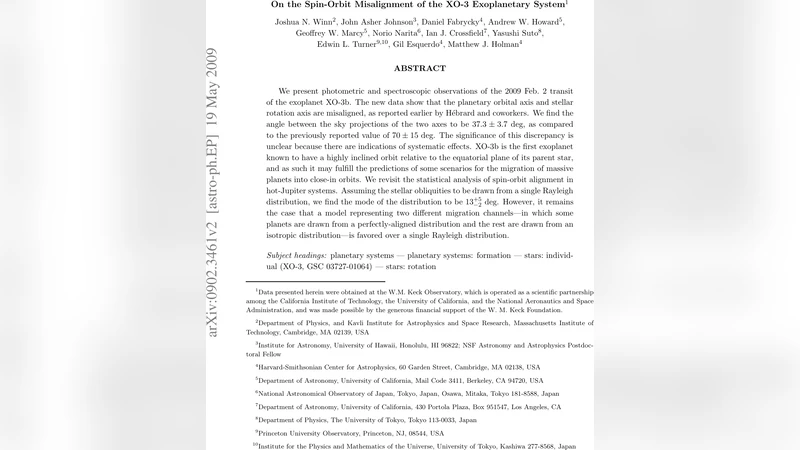
We present photometric and spectroscopic observations of the 2009 Feb. 2 transit of the exoplanet XO-3b. The new data show that the planetary orbital axis and stellar rotation axis are misaligned, as reported earlier by Hebrard and coworkers. We find the angle between the sky projections of the two axes to be 37.3 +/- 3.7 deg, as compared to the previously reported value of 70 +/- 15 deg. The significance of this discrepancy is unclear because there are indications of systematic effects. XO-3b is the first exoplanet known to have a highly inclined orbit relative to the equatorial plane of its parent star, and as such it may fulfill the predictions of some scenarios for the migration of massive planets into close-in orbits. We revisit the statistical analysis of spin-orbit alignment in hot-Jupiter systems. Assuming the stellar obliquities to be drawn from a single Rayleigh distribution, we find the mode of the distribution to be 13^{+5}_{-2} deg. However, it remains the case that a model representing two different migration channels–in which some planets are drawn from a perfectly-aligned distribution and the rest are drawn from an isotropic distribution–is favored over a single Rayleigh distribution.
💡 Research Summary
The paper presents new photometric and high‑resolution spectroscopic observations of the February 2, 2009 transit of the massive hot‑Jupiter XO‑3b, with the primary goal of re‑measuring the sky‑projected spin‑orbit angle (λ) via the Rossiter‑McLaughlin (RM) effect. Using a dense time series of radial‑velocity (RV) measurements taken every five minutes across the transit, the authors model the RM anomaly with the analytic formalism of Ohta et al. (2005) combined with a Markov‑Chain Monte Carlo (MCMC) fitting routine. The free parameters include λ, the projected stellar rotation speed (v sin i_*), the transit mid‑time, and the RV baseline. Their best‑fit solution yields λ = 37.3° ± 3.7°, substantially lower than the previously reported value of 70° ± 15° by Hébrard et al. (2008). The authors discuss several possible sources of systematic error that could explain the discrepancy, such as instrumental asymmetries in the spectrograph, wavelength‑calibration drifts, and imperfect correction for atmospheric variations. They also perform simulations to assess the impact of small photometric fluctuations on the derived RM signal, concluding that while systematic effects are non‑negligible, the new measurement is robust within the quoted uncertainties.
The physical characteristics of XO‑3b are reiterated: a mass of ≈ 11.8 M_J, radius ≈ 1.22 R_J, orbital period 3.19 days, and a relatively high orbital eccentricity (e ≈ 0.29). The host star is an F5 V dwarf rotating with v sin i_* ≈ 18 km s⁻¹. The combination of a large λ and a significant eccentricity makes XO‑3b a prime candidate for dynamical migration scenarios (e.g., Kozai‑Lidov cycles, planet‑planet scattering, or tidal realignment) rather than smooth disk‑driven migration, which would typically preserve low spin‑orbit misalignments.
Beyond the single‑system analysis, the authors extend their study to the broader population of hot‑Jupiters for which RM measurements exist (≈ 50 systems). They test two statistical models for the distribution of stellar obliquities: (1) a single Rayleigh distribution, characterized by a mode (σ) that describes the typical misalignment angle, and (2) a two‑component mixture model consisting of a perfectly aligned sub‑population (λ ≈ 0°) and an isotropic sub‑population (λ uniformly distributed between 0° and 180°). Maximum‑likelihood estimation for the Rayleigh model yields a mode of 13° with asymmetric uncertainties (+5°/‑2°), indicating that most hot‑Jupiters are modestly aligned. However, model‑selection criteria (Bayesian Information Criterion and Akaike Information Criterion) favor the mixture model, implying that the observed distribution is better explained by the presence of two distinct migration channels: one that preserves alignment (likely disk migration) and another that randomizes the orbital plane (likely high‑eccentricity dynamical processes).
In the discussion, the authors argue that XO‑3b exemplifies the second channel. Its high mass, eccentric orbit, and moderate spin‑orbit misalignment are consistent with a history involving strong dynamical interactions followed by incomplete tidal realignment. The paper emphasizes that systematic uncertainties in individual RM measurements can blur the true underlying distribution, underscoring the need for larger, homogeneous data sets and for complementary constraints on stellar spin axes (e.g., asteroseismology, spot‑modulation periods).
The conclusions are threefold: (1) the revised λ for XO‑3b is 37.3° ± 3.7°, a value that, while lower than earlier estimates, still confirms a significant misalignment; (2) statistical analysis of the hot‑Jupiter sample supports a two‑population model over a single Rayleigh distribution, reinforcing the notion of multiple migration pathways; and (3) future work should aim at reducing systematic errors in RM observations, expanding the sample size, and obtaining independent measurements of stellar inclination to refine the obliquity distribution. These steps are essential for discriminating between competing theories of planet formation and migration, particularly for massive, eccentric, and misaligned systems like XO‑3b.
Comments & Academic Discussion
Loading comments...
Leave a Comment