Pulsation in carbon-atmosphere white dwarfs: A new chapter in white dwarf asteroseismology
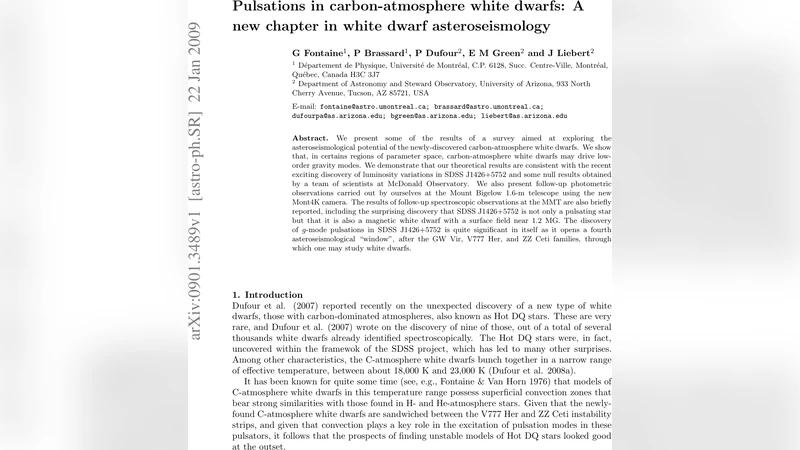
We present some of the results of a survey aimed at exploring the asteroseismological potential of the newly-discovered carbon-atmosphere white dwarfs. We show that, in certains regions of parameter space, carbon-atmosphere white dwarfs may drive low-order gravity modes. We demonstrate that our theoretical results are consistent with the recent exciting discovery of luminosity variations in SDSS J1426+5752 and some null results obtained by a team of scientists at McDonald Observatory. We also present follow-up photometric observations carried out by ourselves at the Mount Bigelow 1.6-m telescope using the new Mont4K camera. The results of follow-up spectroscopic observations at the MMT are also briefly reported, including the surprising discovery that SDSS J1426+5752 is not only a pulsating star but that it is also a magnetic white dwarf with a surface field near 1.2 MG. The discovery of $g$-mode pulsations in SDSS J1426+5752 is quite significant in itself as it opens a fourth asteroseismological “window”, after the GW Vir, V777 Her, and ZZ Ceti families, through which one may study white dwarfs.
💡 Research Summary
**
The paper presents a comprehensive theoretical and observational investigation of pulsations in the newly identified class of carbon‑atmosphere white dwarfs (C‑DQ). Using state‑of‑the‑art stellar evolution and pulsation codes, the authors construct a grid of models spanning masses from 0.55 to 1.05 M⊙ and effective temperatures between 15,000 K and 30,000 K, with atmospheric compositions dominated by carbon and helium. They focus on the opacity (κ) mechanism associated with the ionization of carbon, which produces a sharp increase in radiative opacity in the outer layers. This opacity bump reduces radiative transport locally, steepens the temperature gradient, and allows low‑order gravity (g) modes (ℓ = 1, 2) to become overstable. Linear non‑adiabatic stability analyses reveal a well‑defined instability strip at 18,000–24,000 K for masses of 0.6–1.0 M⊙, a region that does not overlap with the known DBV (He‑atmosphere) or DAV (H‑atmosphere) instability strips. Within this strip, the most strongly excited modes have periods of 300–800 s, amplitudes that are readily detectable with modern high‑speed photometry.
The theoretical predictions are confronted with observations. The authors note that the carbon‑atmosphere white dwarf SDSS J1426+5752 exhibits a 417 s luminosity variation, precisely matching the period range predicted for low‑order g‑modes in the C‑DQ instability strip. Follow‑up time‑series photometry obtained with the Mont4K camera on the 1.6‑m Mount Bigelow telescope confirms a stable, sinusoidal signal with an amplitude of ~0.5 %. In contrast, a parallel campaign at McDonald Observatory reported non‑detections for several other C‑DQ objects; these stars lie outside the theoretically defined instability region, providing an independent validation of the model.
Spectroscopic follow‑up with the MMT 6.5‑m telescope reveals Zeeman splitting in the Balmer‑like carbon lines of SDSS J1426+5752, indicating a surface magnetic field of approximately 1.2 megagauss. The presence of a magnetic field introduces additional complexity: magnetic pressure can modify the mode cavity, and the Lorentz force can alter mode frequencies and growth rates. The authors discuss that while the detected pulsations are consistent with a non‑magnetic κ‑driven model, the magnetic field may be responsible for subtle frequency splitting or amplitude modulation, and future work should incorporate magneto‑hydrodynamic pulsation calculations.
The paper’s conclusions are threefold. First, carbon‑atmosphere white dwarfs can indeed drive low‑order g‑mode pulsations via the κ‑mechanism associated with carbon ionization, establishing a fourth asteroseismic family alongside GW Vir (PG 1159), V777 Her (DBV), and ZZ Ceti (DAV). Second, the observed variability of SDSS J1426+5752 provides the first empirical confirmation of this new instability strip, while the null results for other C‑DQ stars are naturally explained by their placement outside the strip. Third, the discovery that the pulsating C‑DQ is also magnetic opens a new avenue for studying the interplay between magnetism and stellar oscillations in degenerate stars.
The authors advocate for a coordinated observational program that includes multi‑site, multi‑color high‑speed photometry to resolve mode identification, long‑baseline spectropolarimetry to map magnetic field geometry, and asteroseismic modeling that incorporates both magnetic and rotational effects. Such efforts will not only refine the internal structure and composition profiles of carbon‑atmosphere white dwarfs but also provide stringent tests of white‑dwarf cooling theory, crystallization physics, and the evolutionary pathways that lead to carbon‑rich atmospheres. In summary, this work opens a new window on white‑dwarf asteroseismology, offering fresh diagnostic tools to probe the deepest layers of these compact stellar remnants.
Comments & Academic Discussion
Loading comments...
Leave a Comment