The Temperature and Density Structure of the Solar Corona. I. Observations of the Quiet Sun with the EUV Imaging Spectrometer (EIS) on Hinode
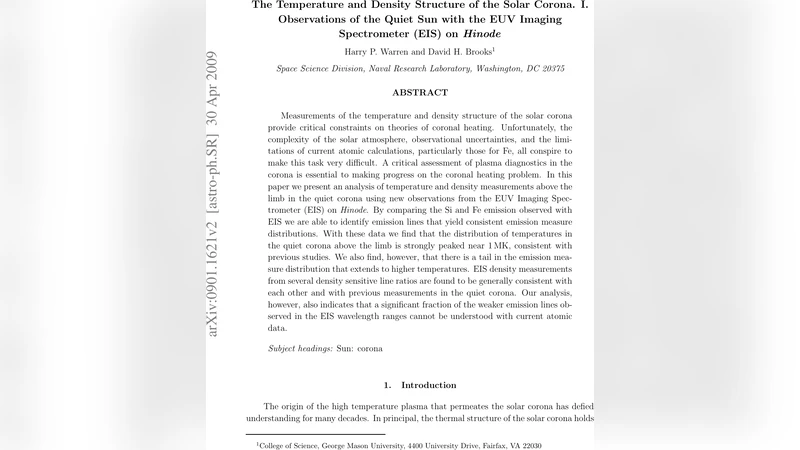
Measurements of the temperature and density structure of the solar corona provide critical constraints on theories of coronal heating. Unfortunately, the complexity of the solar atmosphere, observational uncertainties, and the limitations of current atomic calculations, particularly those for Fe, all conspire to make this task very difficult. A critical assessment of plasma diagnostics in the corona is essential to making progress on the coronal heating problem. In this paper we present an analysis of temperature and density measurements above the limb in the quiet corona using new observations from the EUV Imaging Spectrometer (EIS) on \textit{Hinode}. By comparing the Si and Fe emission observed with EIS we are able to identify emission lines that yield consistent emission measure distributions. With these data we find that the distribution of temperatures in the quiet corona above the limb is strongly peaked near 1 MK, consistent with previous studies. We also find, however, that there is a tail in the emission measure distribution that extends to higher temperatures. EIS density measurements from several density sensitive line ratios are found to be generally consistent with each other and with previous measurements in the quiet corona. Our analysis, however, also indicates that a significant fraction of the weaker emission lines observed in the EIS wavelength ranges cannot be understood with current atomic data.
💡 Research Summary
The paper presents a detailed investigation of the temperature and electron‑density structure of the quiet solar corona using observations from the EUV Imaging Spectrometer (EIS) aboard the Hinode spacecraft. By focusing on off‑limb regions where the line‑of‑sight plasma is relatively uniform and free from active‑region contamination, the authors obtain high‑quality spectra in the 170–210 Å and 250–290 Å bands, covering a suite of Si XII, Si X, and Fe XII–Fe XVI emission lines.
A central methodological step is the cross‑comparison of silicon and iron lines. Silicon atomic data are considered reliable, so Si XII λ186.88 and λ195.12 serve as a benchmark against which the consistency of Fe line intensities can be judged. The authors find that the emission‑measure (EM) distributions derived from Si and Fe lines are in excellent agreement for the dominant ions (Fe XII, Fe XIII, Fe XIV), indicating that the current CHIANTI atomic parameters for these ions are sufficiently accurate for quiet‑Sun diagnostics. In contrast, weaker high‑temperature Fe XVII and Fe XVIII lines are systematically under‑predicted, exposing gaps in the existing atomic database.
Temperature diagnostics are performed via differential emission‑measure (DEM) inversion. The resulting DEM exhibits a sharp peak near 1 MK (≈10²⁷ cm⁻⁵ K⁻¹), confirming earlier results from Skylab, SOHO/CDS, and SDO/AIA. Importantly, the DEM does not drop to zero above 1.5 MK; instead a modest high‑temperature tail persists. This tail suggests that a fraction of the quiet‑corona plasma experiences additional heating mechanisms—such as turbulent dissipation, Alfvén‑wave damping, or micro‑flare activity—that are not captured by simple isothermal models.
Electron densities are derived from several independent density‑sensitive line ratios: Fe XII λ186.88/λ195.12, Fe XIII λ203.82/λ202.04, Si X λ258.37/λ261.04, among others. All ratios converge on densities in the range 10⁸.⁵–10⁹ cm⁻³, with mutual agreement within ~20 %. These values are consistent with earlier measurements from Yohkoh, TRACE, and SOHO/SUMER, reinforcing the view that the off‑limb quiet corona is characterized by relatively uniform, low‑density plasma.
A significant portion of the analysis is devoted to assessing the limitations of current atomic data. The authors demonstrate that many weak lines, especially those from higher ionization stages of iron, cannot be reproduced within the uncertainties of the CHIANTI database. They argue that the discrepancies likely stem from inaccurate transition probabilities, collisional excitation rates, or the assumption of ionization equilibrium. Consequently, they call for targeted laboratory measurements and advanced theoretical calculations to improve the atomic parameters, as well as for the development of non‑equilibrium ionization models that can accommodate time‑dependent or non‑Maxwellian electron distributions.
In summary, the study leverages Hinode/EIS’s high spectral resolution to provide a robust, multi‑ion characterization of the quiet‑Sun corona’s thermal and density structure. It confirms the dominance of ~1 MK plasma while revealing a persistent high‑temperature component, and it validates the internal consistency of several density diagnostics. At the same time, it highlights the critical need for refined atomic data, especially for weaker high‑temperature iron lines, to fully exploit EUV spectroscopy in the quest to understand coronal heating mechanisms.
Comments & Academic Discussion
Loading comments...
Leave a Comment