Weakly group-theoretical and solvable fusion categories
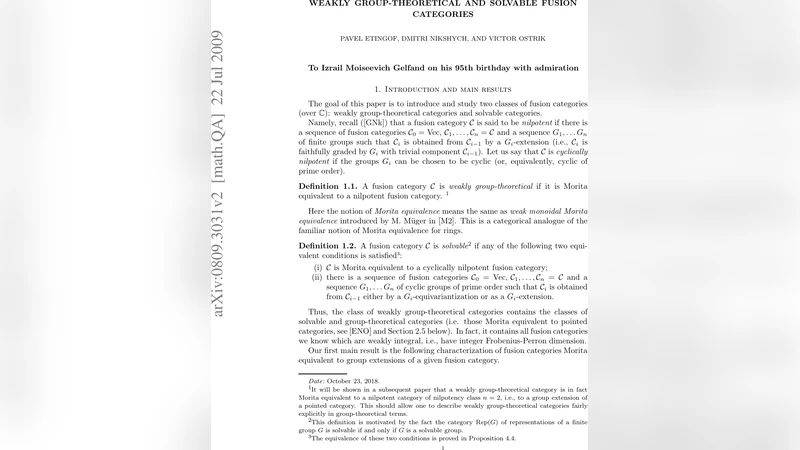
We introduce two new classes of fusion categories which are obtained by a certain procedure from finite groups - weakly group-theoretical categories and solvable categories. These are fusion categories that are Morita equivalent to iterated extensions (in the world of fusion categories) of arbitrary, respectively solvable finite groups. Weakly group-theoretical categories have integer dimension, and all known fusion categories of integer dimension are weakly group theoretical. Our main results are that a weakly group-theoretical category C has the strong Frobenius property (i.e., the dimension of any simple object in an indecomposable C-module category divides the dimension of C), and that any fusion category whose dimension has at most two prime divisors is solvable (a categorical analog of Burnside’s theorem for finite groups). This has powerful applications to classification of fusion categories and semsisimple Hopf algebras of a given dimension. In particular, we show that any fusion category of integer dimension <84 is weakly group-theoretical (i.e. comes from finite group theory), and give a full classification of semisimple Hopf algebras of dimensions pqr and pq^2, where p,q,r are distinct primes.
💡 Research Summary
The paper introduces two new families of fusion categories—weakly group‑theoretical and solvable—that are built from finite groups via a recursive extension process. A fusion category C is called weakly group‑theoretical if it is Morita equivalent to a category obtained by repeatedly taking extensions (in the categorical sense) of arbitrary finite groups. If, in addition, all groups used in the construction are solvable, C is called solvable. These definitions generalize the classical notion of a group‑theoretical fusion category and provide a hierarchical framework for classifying fusion categories according to the arithmetic complexity of their dimensions.
The authors prove two central theorems. First, every weakly group‑theoretical category satisfies the strong Frobenius property: for any indecomposable C‑module category M and any simple object X∈M, the categorical dimension dim X divides the global dimension dim C. This extends the usual Frobenius–Perron integrality results and shows that integer‑dimensional fusion categories are tightly constrained when they arise from group‑theoretical data.
Second, they establish a categorical analogue of Burnside’s theorem: if the global dimension of a fusion category has at most two distinct prime factors, then the category is solvable. In other words, the arithmetic condition “only two primes appear in the factorisation of |C|” forces the category to be built from solvable groups. The proof combines Drinfeld centre techniques, module‑category analysis, and a careful study of central extensions in the categorical setting.
Using these results, the paper derives several powerful classification corollaries. It shows that every fusion category with integer dimension less than 84 is weakly group‑theoretical; consequently, all such categories can be described entirely in terms of finite‑group data. Moreover, the authors give a complete classification of semisimple Hopf algebras whose dimensions are of the form pqr or pq² (p, q, r distinct primes). In these cases the Hopf algebras are necessarily either group algebras, their duals, or bicrossed products arising from solvable group extensions, confirming that no exotic non‑group‑theoretical Hopf algebras exist in these dimensions.
The paper also discusses broader implications for the ongoing program of classifying fusion categories and semisimple Hopf algebras. The hierarchy “solvable ⊂ weakly group‑theoretical ⊂ integer‑dimensional” provides a roadmap: one first checks the prime‑factor structure of the global dimension, applies the Burnside‑type theorem to reduce to the solvable case when possible, and otherwise studies the category via its Drinfeld centre and Morita equivalence to a weakly group‑theoretical one. This approach unifies many previously disparate classification results and suggests that, at least for dimensions with few prime factors, the landscape of fusion categories is completely governed by finite‑group theory.
In summary, the paper establishes that weakly group‑theoretical fusion categories enjoy strong arithmetic divisibility properties, that the presence of at most two prime divisors forces solvability, and that these insights lead to concrete classifications of low‑dimensional fusion categories and Hopf algebras. The work bridges group theory, category theory, and quantum algebra, offering a robust toolkit for future investigations into the structure of fusion categories beyond the known examples.
Comments & Academic Discussion
Loading comments...
Leave a Comment