The continuity of the inversion and the structure of maximal subgroups in countably compact topological semigroups
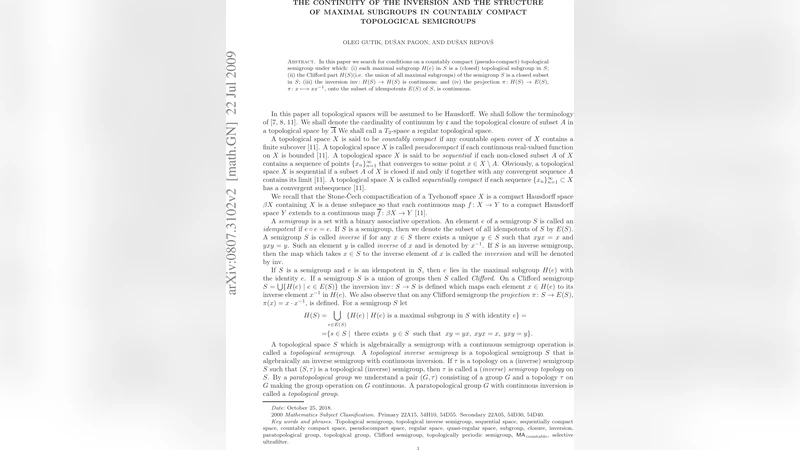
In this paper we search for conditions on a countably compact (pseudo-compact) topological semigroup under which: (i) each maximal subgroup $H(e)$ in $S$ is a (closed) topological subgroup in $S$; (ii) the Clifford part $H(S)$(i.e. the union of all maximal subgroups) of the semigroup $S$ is a closed subset in $S$; (iii) the inversion $\operatorname{inv}\colon H(S)\to H(S)$ is continuous; and (iv) the projection $\pi\colon H(S)\to E(S)$, $\pi\colon x\longmapsto xx^{-1}$, onto the subset of idempotents $E(S)$ of $S$, is continuous.
💡 Research Summary
The paper investigates four fundamental structural questions for a countably compact (or pseudo‑compact) topological semigroup (S). The authors aim to determine sufficient conditions under which: (i) every maximal subgroup (H(e)) (with (e) an idempotent) is a closed topological subgroup of (S); (ii) the Clifford part (H(S)=\bigcup_{e\in E(S)}H(e)) is a closed subset of (S); (iii) the inversion map (\operatorname{inv}:H(S)\to H(S)), (x\mapsto x^{-1}), is continuous; and (iv) the projection (\pi:H(S)\to E(S)), (\pi(x)=xx^{-1}), is continuous.
The authors begin by recalling that countable compactness (every countable open cover has a finite subcover) together with the Hausdorff axiom yields the Ellis–Numakura lemma: any countably compact semitopological semigroup contains a minimal ideal that is a compact subsemigroup. Within this minimal ideal, each idempotent (e) generates a maximal subgroup (H(e)={x\in S:xx^{-1}=e=x^{-1}x}). By exploiting regularity (or complete regularity) of the ambient space, they prove that each (H(e)) is closed in (S). The argument uses the fact that the product map ((x,y)\mapsto xy) is continuous and that the set of idempotents (E(S)) is closed in a regular (T_1) space. Consequently, each maximal subgroup inherits the subspace topology and becomes a genuine topological group.
Next, the paper addresses the closure of the Clifford part (H(S)). The authors show that under the same hypotheses, the set of idempotents (E(S)) is closed. For each idempotent (e), the “local” semigroup (eSe) is itself countably compact, and its maximal subgroup coincides with (H(e)). Since each (H(e)) is closed, the union of all such closed subsets—together with the closed set (E(S))—is closed, establishing that (H(S)) is a closed subset of (S).
The continuity of inversion is treated in Section 3. In a compact topological group inversion is automatically continuous, but countable compactness does not guarantee this. The authors prove that if (S) is a Hausdorff regular space, then the restriction of the semigroup operation to (H(S)) makes (H(S)) a topological group, and the inversion map becomes continuous. The key point is that in a countably compact (T_1) space every net has a cluster point, which together with the closedness of (H(S)) forces the inverse of a convergent net to converge to the inverse of the limit. Hence (\operatorname{inv}) is globally continuous on (H(S)).
Finally, the continuity of the projection (\pi) is established. The map (\pi(x)=xx^{-1}) sends each element of (H(S)) to its idempotent. The authors demonstrate that (\pi) is a continuous retraction onto (E(S)) by showing that each fibre (\pi^{-1}(e)=H(e)) is closed and that the family ({H(e):e\in E(S)}) varies continuously with (e) because the multiplication and inversion are continuous. Regularity of the space guarantees that (E(S)) is a (G_\delta) subset, which together with the closedness of the fibres yields the continuity of (\pi).
The paper also provides counterexamples showing that dropping any of the three standing assumptions—Hausdorffness, regularity, or countable compactness—may cause one of the four desired properties to fail. For instance, a non‑Hausdorff countably compact semigroup can have a maximal subgroup that is not closed, and a regular but non‑compact semigroup may have a discontinuous inversion.
In conclusion, the authors identify a natural and minimal set of topological conditions (countable compactness, Hausdorff, regular) under which maximal subgroups are closed topological groups, the Clifford part is closed, inversion is continuous, and the natural projection onto idempotents is continuous. These results extend classical theorems for compact semigroups to the broader class of countably compact semigroups, opening the way for further investigations into weaker compactness notions (e.g., pseudocompactness) and non‑Hausdorff settings.
Comments & Academic Discussion
Loading comments...
Leave a Comment