An approximate many-body theory incorporating two-body correlations has been employed to calculate low-lying collective multipole frequencies in a Bose-Einstein condensate containing $A$ bosons, for different values of the interaction parameter $\lambda=\frac{Aa_{s}}{a_{ho}}$. Significant difference from the variational estimate of the Gross-Pitaevskii equation has been found near the collapse region. This is attributed to two-body correlations and finite range attraction of the realistic interatomic interaction. A large deviation from the hydrodynamic model is also seen for the second monopole breathing mode and the quadrupole mode for large positive $\lambda$.
Deep Dive into Many-body approach to low-lying collective excitations in a BEC approaching collapse.
An approximate many-body theory incorporating two-body correlations has been employed to calculate low-lying collective multipole frequencies in a Bose-Einstein condensate containing $A$ bosons, for different values of the interaction parameter $\lambda=\frac{Aa_{s}}{a_{ho}}$. Significant difference from the variational estimate of the Gross-Pitaevskii equation has been found near the collapse region. This is attributed to two-body correlations and finite range attraction of the realistic interatomic interaction. A large deviation from the hydrodynamic model is also seen for the second monopole breathing mode and the quadrupole mode for large positive $\lambda$.
arXiv:0809.3680v2 [cond-mat.quant-gas] 31 Oct 2008
Many-body approach to low-lying collective
excitations in a BEC approaching collapse
Anindya Biswas∗and Tapan Kumar Das†
Department of Physics, University of Calcutta, 92 A.P.C. Road, Kolkata 700009, India
Abstract
An approximate many-body theory incorporating two-body correlations has
been employed to calculate low-lying collective multipole frequencies in a Bose-
Einstein condensate containing A bosons, for different values of the interaction pa-
rameter λ = Aas
aho . Significant difference from the variational estimate of the Gross-
Pitaevskii equation has been found near the collapse region. This is attributed to
two-body correlations and finite range attraction of the realistic interatomic inter-
action. A large deviation from the hydrodynamic model is also seen for the second
monopole breathing mode and the quadrupole mode for large positive λ.
Low-lying collective excitations of a Bose-Einstein condensate can provide valu-
able information about the interactions and stability of the condensate, as the dimension-
less interaction parameter λ = Aas
aho decreases from a large positive (repulsive interaction)
value to negative (attractive interaction) values. Starting from the Gross-Pitaevskii (GP)
equation, and using a sum rule approach, Stringari [1] obtained analytic expressions in
terms of expectation values of kinetic energy (Ekin) and harmonic confining potentials
(Eho), for the monopole (ωM) and quadrupole (ωQ) frequencies. In Fig.1 of Ref.[1], vari-
ational estimates [2, 3] were plotted against λ, which shows a sharp change for both ωM
and ωQ as λ approaches the variational critical value λGP,var
cr
= −0.671 [3]. Note that
this provides an upper bound. Furthermore, numerical calculation of Ekin by the GP
equation close to the collapse region involves large errors. Hence, it is desirable to calcu-
late the low-lying excitation frequencies directly using a many-body approach, which can
∗e-mail : anindya.biswas@ymail.com
†e-mail : kumartd@rediffmail.com
1
handle a finite range interaction instead of the contact interaction in the GP equation.
In the present work, we calculate low-lying collective excitation frequencies of
a dilute Bose-Einstein condensate (BEC), using the many-body potential harmonics
expansion (PHE) approach [4]. Only two-body correlations are relevant in the dilute
many-body system. Hence the (ij)-Faddeev component of the many-body wave function,
is a function of the relative separation (⃗rij) and a global length called hyperradius (r)
only. In the PHE method, one expands the Faddeev component (ψij), corresponding to
the (ij)-interacting pair of the condensate containing A atoms, in the corresponding po-
tential harmonics (PH) basis [5] (which is the subset of the full hyperspherical harmonics
(HH) basis [6], needed for the expansion of the two-body potential V (⃗rij))
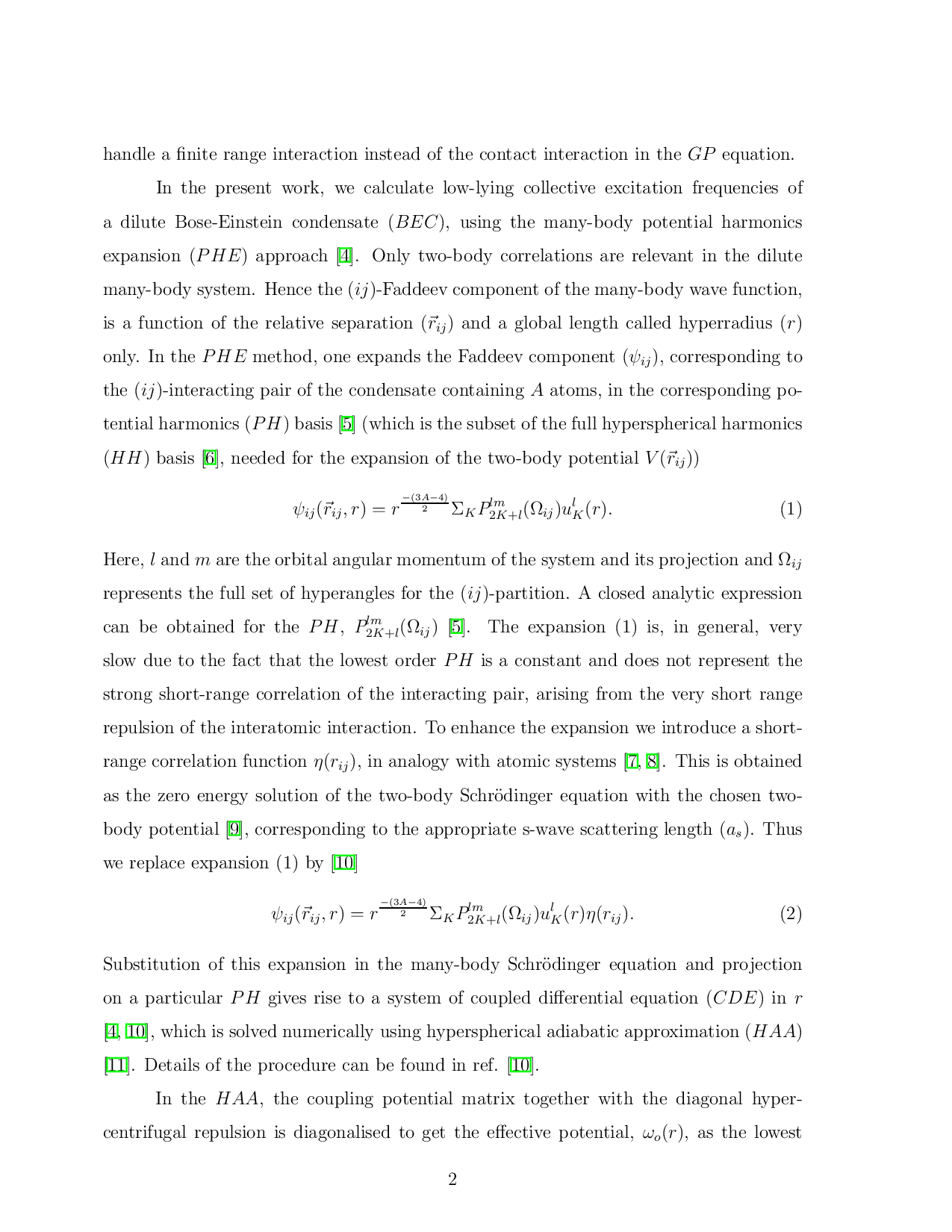
ψij(⃗rij, r) = r
−(3A−4)
2
ΣKPlm
2K+l(Ωij)ul
K(r).
(1)
Here, l and m are the orbital angular momentum of the system and its projection and Ωij
represents the full set of hyperangles for the (ij)-partition. A closed analytic expression
can be obtained for the PH, Plm
2K+l(Ωij) [5].
The expansion (1) is, in general, very
slow due to the fact that the lowest order PH is a constant and does not represent the
strong short-range correlation of the interacting pair, arising from the very short range
repulsion of the interatomic interaction. To enhance the expansion we introduce a short-
range correlation function η(rij), in analogy with atomic systems [7, 8]. This is obtained
as the zero energy solution of the two-body Schr¨odinger equation with the chosen two-
body potential [9], corresponding to the appropriate s-wave scattering length (as). Thus
we replace expansion (1) by [10]
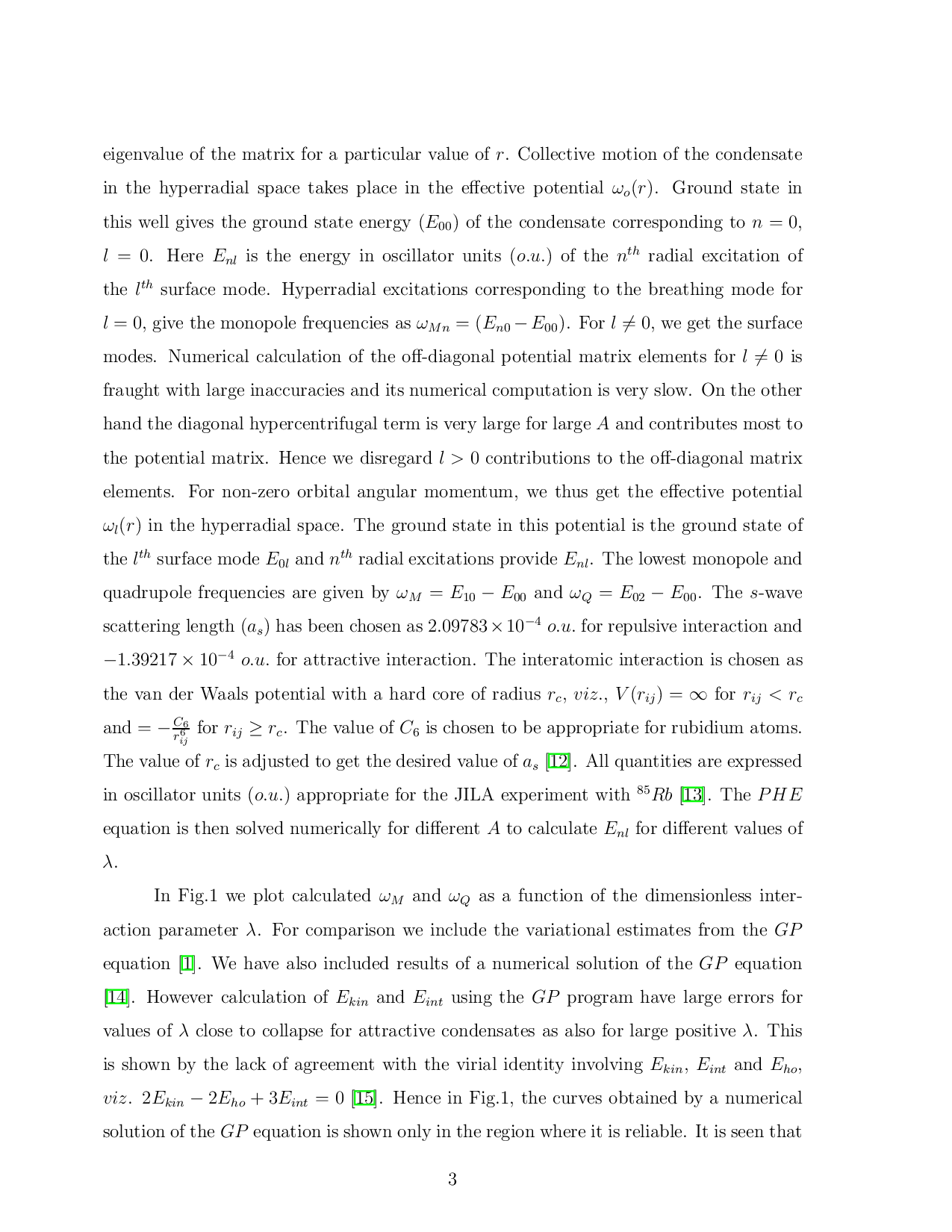
ψij(⃗rij, r) = r
−(3A−4)
2
ΣKPlm
2K+l(Ωij)ul
K(r)η(rij).
(2)
Substitution of this expansion in the many-body Schr¨odinger equation and projection
on a particular PH gives rise to a system of coupled differential equation (CDE) in r
[4, 10], which is solved numerically using hyperspherical adiabatic approximation (HAA)
[11]. Details of the procedure can be found in ref. [10].
In the HAA, the coupling potential matrix together with the diagonal hyper-
centrifugal repulsion is diagonalised to get the effective potential, ωo(r), as the lowest
2
eigenvalue of the matrix for a particular value of r. Collective motion of the condensate
in the hyperradial space takes place in the effective potential ωo(r). Ground state in
this well gives the ground state energy (E00) of the condensate corresponding to n = 0,
l = 0. Here Enl is the energy in oscillator units (o.u.) of the nth radial excitation of
the lth surface mode. Hyperradial excitations corresponding to the breathing mode for
l = 0, give the monopole frequencies as ωMn = (En0 −E00). For l ̸= 0, we get the surface
modes. Numerical calculation of the off-diagonal potential matrix elements for l ̸= 0 is
fraught with large inaccuracies and its numerical computati
…(Full text truncated)…
This content is AI-processed based on ArXiv data.